
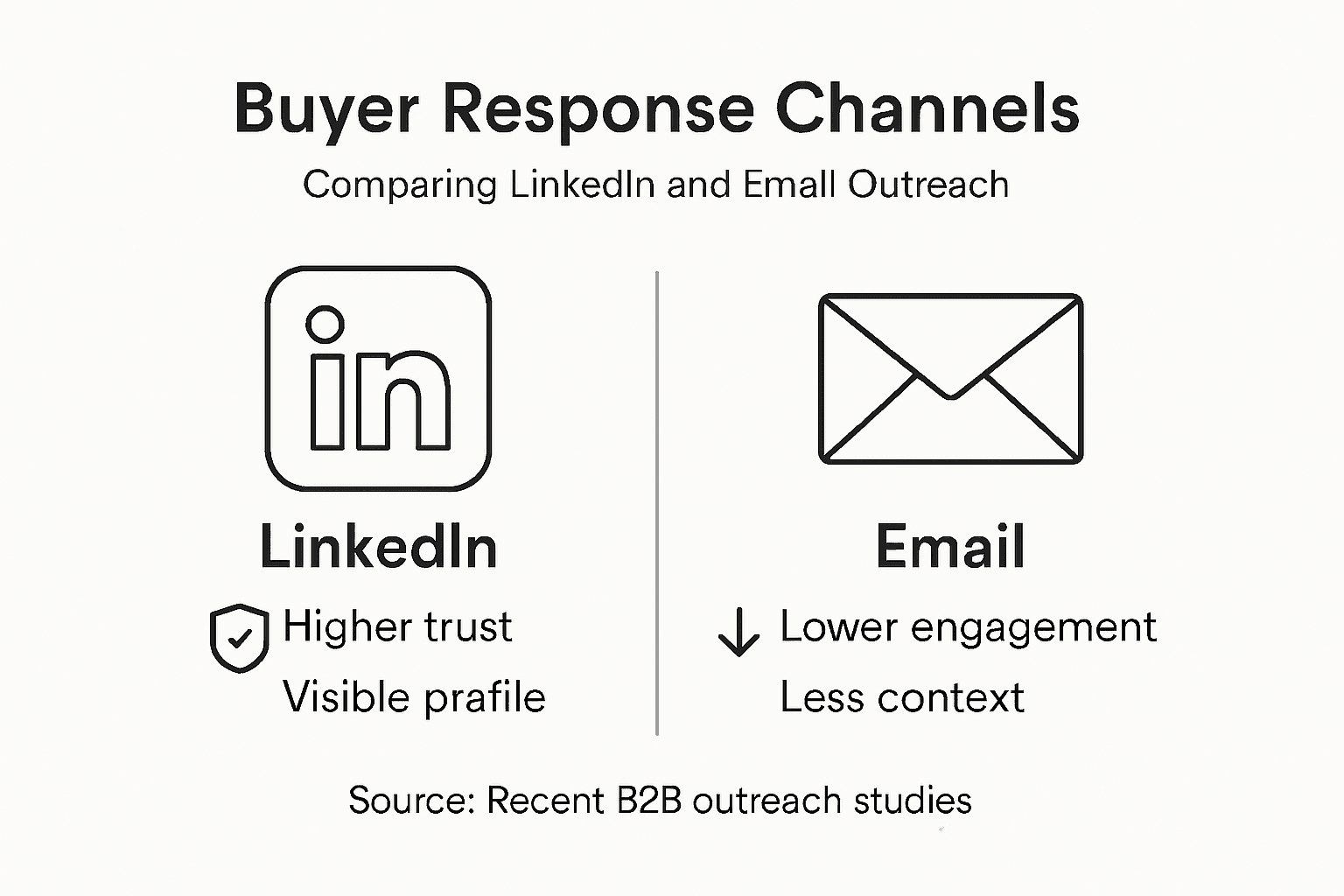
The gap between LinkedIn and email response rates surprises many B2B leaders. While email inboxes are crowded with generic pitches, LinkedIn conversations unfold in a professional ecosystem where transparency and social proof carry real weight. Research shows that LinkedIn messages can yield response rates of 5 to 20 percent, compared to email’s 1 to 10 percent range. This article reveals how context shapes buyer reactions and uncovers practical ways to build trust for stronger LinkedIn outreach.
Table of Contents
- Defining Buyer Response on LinkedIn Versus Email
- Identity Transparency and Professional Credibility Online
- Social Proof and Layered Familiarity in Outreach
- How Context Lowers Perceived Risk for Buyers
- When LinkedIn Fosters Trust-First Conversations
Key Takeaways
| Point | Details |
|---|---|
| Professional Context Matters | LinkedIn provides a curated professional environment that enhances trust and engagement compared to the impersonal nature of email. |
| Higher Response Rates | Messaging on LinkedIn yields response rates of 5-20%, significantly higher than email’s typical 1-10%. |
| Trust Through Transparency | Professional profiles on LinkedIn offer immediate access to identities and credentials, establishing trust before initial contact. |
| Social Proof Enhances Credibility | Endorsements, mutual connections, and content engagement on LinkedIn create a nuanced ecosystem for assessing professional legitimacy. |
Defining Buyer Response on LinkedIn Versus Email
B2B buyers experience fundamentally different psychological interactions when responding through LinkedIn versus email. Professional context significantly shapes communication dynamics, creating nuanced engagement patterns that traditional outreach strategies often overlook.
Unlike email’s generic communication environment, LinkedIn provides a rich professional ecosystem where identities, credentials, and social networks are transparently visible. This visibility transforms buyer response mechanisms through several critical dimensions:
- Identity verification becomes instantaneous
- Professional credentials are immediately accessible
- Mutual connections create implicit trust signals
- Social proof emerges through shared networks
Research demonstrates that LinkedIn messaging achieves substantially different response rates compared to email. Targeted professional messaging yields higher engagement, with response rates ranging between 5-20% versus email’s more limited 1-10% range.
Here’s a concise comparison of buyer response dynamics between LinkedIn and email:
| Factor | LinkedIn Messaging | Email Outreach |
|---|---|---|
| Average Response Rate | 5-20% | 1-10% |
| Professional Context | Highly visible and curated | Often generic and crowded |
| Identity Verification | Immediate and transparent | Rarely immediate |
| Social Proof | Built through networks | Limited or absent |
| Trust Signal Strength | High, due to profile visibility | Moderate, often indirect |
The fundamental difference emerges from context. Email represents a crowded, often impersonal communication channel where messages compete against countless promotional and transactional communications. LinkedIn, conversely, functions as a curated professional environment where interactions carry inherent credibility and purpose.
Professional networking platforms provide layers of contextual information that email cannot replicate. A LinkedIn profile reveals career trajectory, recommendations, mutual connections, and professional achievements – creating an instant trust foundation before the first message is even read.
Buyer responses are deeply influenced by perceived professional legitimacy and contextual relevance.
Pro tip: Prioritize building a comprehensive, authentic LinkedIn profile that showcases your professional narrative and expertise.
Identity Transparency and Professional Credibility Online
Professional identity transforms how B2B buyers evaluate potential interactions in digital spaces. Transparency fundamentally reshapes business communication dynamics, creating nuanced mechanisms of trust and credibility that extend far beyond traditional networking approaches.
LinkedIn represents a sophisticated platform where professional identities are constructed through multifaceted signals. These signals go beyond simple resume details and encompass complex professional narratives:
- Comprehensive work history documentation
- Skill endorsements from professional peers
- Detailed project and achievement descriptions
- Visible professional network connections
- Recommendations from colleagues and supervisors
The platform’s design enables a unique form of professional validation that traditional communication channels cannot replicate. Academic perspectives reveal platform complexity in establishing credible professional representations, highlighting both opportunities and limitations in digital identity construction.
Professional networking platforms offer unprecedented transparency, allowing buyers to quickly assess a connection’s authenticity. A detailed LinkedIn profile provides instantaneous insights into an individual’s professional trajectory, expertise, and potential alignment with business objectives.
Digital professional identities function as dynamic trust ecosystems, continuously evolving through networked interactions.
Beyond surface-level information, these platforms enable sophisticated contextual understanding. Buyers can now evaluate potential partnerships by examining shared connections, mutual professional experiences, and verified skill sets – creating a more nuanced approach to professional relationship building.

Pro tip: Invest consistent effort in maintaining an authentic, comprehensive LinkedIn profile that genuinely reflects your professional journey and expertise.
Social Proof and Layered Familiarity in Outreach
B2B buyer interactions have evolved dramatically with the emergence of sophisticated digital networking platforms. Comprehensive engagement frameworks reveal intricate trust mechanisms that transform how professionals establish credibility and connection in digital environments.
Social proof operates through multiple interconnected layers that systematically build buyer confidence:
- Visible professional endorsements
- Quantifiable skill validations
- Shared network connections
- Mutual professional experiences
- Content interaction history
These elements create a nuanced trust ecosystem where buyers can rapidly assess professional legitimacy without traditional lengthy vetting processes. Each interaction leaves a digital footprint that contributes to an individual’s professional reputation, allowing potential partners to make more informed connection decisions.
This summary highlights key layers of social proof influencing B2B buyer trust on digital platforms:
| Social Proof Layer | Impact on Buyer Trust | Example Signal |
|---|---|---|
| Endorsements | Validates expertise | Skill endorsements |
| Shared Network Connections | Builds familiarity | Mutual professional contacts |
| Content Interaction History | Demonstrates relevance | Likes, comments on posts |
| Recommendations | Confirms credibility | Colleague testimonials |
Unlike traditional networking, digital platforms enable multi-dimensional credibility assessment. Potential buyers can instantly examine an individual’s professional trajectory, skill endorsements, published content, and network depth – creating a comprehensive view that extends far beyond traditional resume credentials.
Professional credibility emerges through consistent, transparent digital interactions that reveal authentic expertise.
The strategic accumulation of social proof signals transforms how B2B buyers perceive and evaluate potential partnerships. Each recommendation, skill validation, and professional connection incrementally builds a sophisticated trust profile that speaks volumes about an individual’s professional capabilities.
Pro tip: Systematically cultivate your professional digital presence by consistently sharing valuable insights and maintaining an authentic, comprehensive networking profile.
How Context Lowers Perceived Risk for Buyers
B2B purchasing decisions are fundamentally driven by risk mitigation strategies that extend far beyond traditional transactional considerations. Contextual factors profoundly shape buyer perceptions, creating sophisticated psychological frameworks that guide high-stakes investment choices.
Context reduces perceived risk through multiple strategic dimensions:
- Transparent professional backgrounds
- Verifiable skill endorsements
- Mutual network connections
- Demonstrated industry expertise
- Consistent professional engagement
Contextual intelligence transforms how buyers evaluate potential partnerships. Each digital interaction provides incremental reassurance, allowing professionals to build trust through granular, observable professional signals that traditional communication channels cannot replicate.
Defending purchase decisions becomes paramount in complex B2B environments. Professional networking platforms offer buyers comprehensive context that enables robust decision validation, reducing the psychological friction associated with significant business investments.
Risk perception diminishes when professional context provides comprehensive, transparent insights into potential partnerships.
Digital platforms enable buyers to construct intricate risk assessment models through multidimensional professional information. These sophisticated context layers allow decision-makers to evaluate potential collaborations with unprecedented depth and nuance, transforming traditional relationship-building paradigms.
Pro tip: Systematically document your professional journey, ensuring each digital interaction contributes to a coherent, trustworthy narrative that reduces buyer uncertainty.
When LinkedIn Fosters Trust-First Conversations
B2B relationship building has fundamentally transformed with the emergence of digital professional networking platforms. Trust emerges through strategic thought leadership, creating sophisticated engagement mechanisms that transcend traditional sales approaches.
Trust-first conversations on LinkedIn develop through several nuanced interaction layers:
- Authentic professional storytelling
- Demonstrated industry expertise
- Transparent professional achievements
- Consistent value-driven content sharing
- Meaningful peer engagement
Conversational intelligence transforms how professionals connect, moving beyond transactional interactions toward substantive professional dialogues. Each interaction becomes an opportunity to demonstrate genuine expertise, reliability, and collaborative potential.
LinkedIn’s unique environment enables professionals to establish credibility through multifaceted engagement strategies. The platform’s design encourages depth over surface-level connections, allowing individuals to showcase their professional narrative through rich, contextual information.
Meaningful conversations emerge when professionals prioritize genuine value over immediate self-promotion.
The platform’s professional context creates a sophisticated ecosystem where trust is built incrementally, through consistent, transparent interactions that reveal an individual’s true professional capabilities and collaborative potential.
Pro tip: Develop a content strategy that systematically demonstrates your professional expertise, focusing on insights that genuinely serve your professional community.
Unlock the Power of Trust-First LinkedIn Outreach for Your B2B Growth
The article highlights a key challenge for B2B leaders: buyers respond differently on LinkedIn because of the platform’s unique professional context and layered social proof. If you are struggling to break through email clutter or create meaningful, trust-based conversations that lead to predictable deal flow, these insights reveal why traditional outreach falls short. Buyers seek authentic professional identity transparency, real social proof, and relevant context that fundamentally lower their perceived risk.
At Pursuitz, we specialize in helping B2B founders and leadership teams leverage these exact dynamics. Our hyper-personalized LinkedIn outreach and founder-led personal branding systems craft genuine, trust-first conversations that build credibility over time without email campaigns or generic lead gen. Discover how to transform your approach by integrating consistent value-driven content and transparent storytelling that align perfectly with the psychological mechanisms behind buyer responses in the article.
Ready to stop chasing cold leads and start creating lasting relationships on LinkedIn that deliver measurable growth? Explore how our founder-led personal branding and system design for predictable deal flow can power your B2B growth today. Don’t wait to embrace a proven method that resonates with buyers’ deepest needs and professional expectations.
Frequently Asked Questions
What factors contribute to higher response rates on LinkedIn compared to email?
LinkedIn messaging typically achieves response rates of 5-20%, significantly higher than email’s 1-10%. Factors include immediate identity verification, accessible professional credentials, and mutual connections that foster trust.
How does professional context shape buyer interactions on LinkedIn?
LinkedIn provides a curated professional environment, allowing for transparent identity verification and social proof. This context enhances the perceived legitimacy of interactions compared to the generic nature of email outreach.
What role does social proof play in B2B buyer engagement on LinkedIn?
Social proof, such as endorsements, shared connections, and mutual professional experiences, builds a nuanced trust ecosystem. It allows potential buyers to assess credibility quickly, enhancing their confidence in making connection decisions.
How can I effectively establish trust-first conversations on LinkedIn?
Establish trust by focusing on authentic professional storytelling, sharing valuable insights, and engaging meaningfully with peers. Consistent value-driven content sharing can help build credibility and encourage deeper professional dialogues.