

Bold declarations about B2B sales rarely match everyday experience. Many companies still believe that collecting endless contact lists or relying on face-to-face meetings guarantees pipeline growth, but these myths overlook how decision-makers actually buy today. As B2B founders and sales leaders look to LinkedIn for predictable deal flow, understanding the difference between volume tactics and trust-first lead generation is what separates consistent closers from frustrated sellers.
Table of Contents
- Defining B2B Lead Generation And Common Myths
- Types Of B2B Outreach And Their Drawbacks
- The Breakdown Of Volume-Based Lead Generation
- Predictability Through Trust-First LinkedIn Systems
- Long-Term Outcomes Of Systemic Lead Generation
Key Takeaways
| Point | Details |
|---|---|
| B2B Lead Generation Focus | Prioritize building trust and credibility over merely increasing lead volume to enhance conversion rates. |
| Channel Limitations | Recognize the inherent drawbacks of traditional outreach methods and shift focus to personalized, relationship-driven engagements. |
| Volume vs. Quality | Understand that pursuing a high number of unqualified leads undermines true sales potential; focus on qualified conversations instead. |
| Systemic Approach Benefits | Adopt a long-term, consistent strategy for lead generation that emphasizes relationship nurturing for sustainable growth. |
Defining B2B Lead Generation and Common Myths
B2B lead generation is the process of identifying, attracting, and qualifying potential buyers for business services or products. But here’s what matters: it’s not about collecting names. It’s about creating conditions where decision-makers recognize a need and view you as capable of solving it.
The challenge starts with understanding what lead generation actually is. Most organizations still think of it as volume based, meaning larger prospect lists equal better results. The theory suggests that more touches, more emails, more outreach automatically increases conversion rates. This assumption drives the majority of failing lead generation efforts today.
One persistent myth is that face-to-face meetings alone drive sales. Organizations built entire strategies around conferences and dinners, assuming personal connection guaranteed deals. Reality is different. Today’s buyers research solutions independently before engaging sales. They prefer conversations that happen on their terms, in channels they already use.
Another widespread belief is that lead generation sits separate from brand building. Companies think they can outsource lead capture while ignoring reputation and presence. The data shows otherwise: prospects evaluate your credibility long before they respond to outreach. Your visibility, content, and perceived expertise shape whether they engage at all.
A third myth claims that multi-channel bombardment works better. The assumption is that hitting prospects via email, phone, and social platforms increases response rates. But fatigue is real. Generic messages sent across multiple channels breed skepticism and lower reply rates, not higher ones.
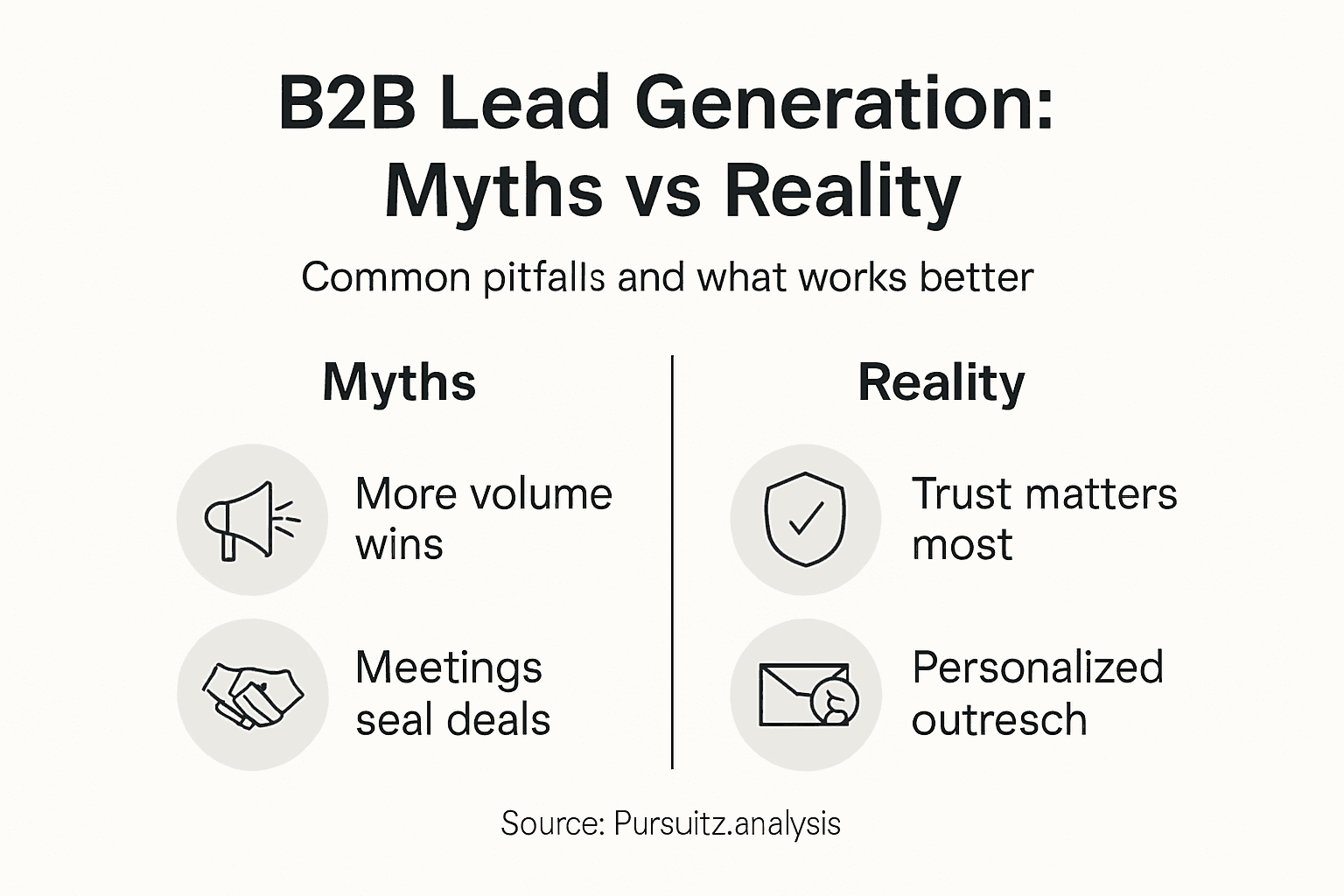
What actually separates successful approaches from failing ones is recognition that B2B marketing requires innovation in customer journey understanding. This means treating lead generation as a system built on trust, relevance, and credibility rather than volume and frequency.
Pro tip: Stop measuring success by leads generated and start measuring by conversations that demonstrate buying potential—this shift in thinking alone changes how you design your entire outreach process.
Types of B2B Outreach and Their Drawbacks
B2B organizations use several outreach channels to reach decision-makers, but each comes with significant limitations. Understanding these drawbacks helps explain why volume-based approaches fail consistently across industries.
Email remains the default channel for most B2B outreach. The problem is saturation. Decision-makers receive between 40 to 80 emails daily, and generic messages get filtered or ignored immediately. Personalization at scale becomes expensive and time-consuming. When emails do land, they compete for attention against hundreds of other messages.
Phone calls work for some situations but come with their own friction. Decision-makers screen calls and rarely answer unknown numbers. Cold calling requires reaching the right person at the right time, a timing challenge that scales poorly. The approach also creates negative sentiment when executed without context or previous relationship building.
Account-based marketing and digital outreach channels present engagement obstacles. Multiple decision-makers involved in B2B purchases mean your message must resonate across finance, operations, and technical teams simultaneously. Each stakeholder has different priorities and concerns. A message that convinces the operations lead might confuse the CFO.
Generic LinkedIn connection requests flood inboxes constantly. Cutting through noise to capture decision-maker attention remains difficult without genuine personalization and context. Most platforms encourage broadcast messaging rather than meaningful one-to-one conversation. The result is connection fatigue, where prospects ignore new requests automatically.
What unites these channels is their reliance on volume and frequency. Organizations assume that more attempts across more channels equals better results. Long sales cycles mean prospects need repeated touches, but those touches often arrive without building any actual trust or credibility first. Each outreach attempt without context compounds the noise problem.
The deeper issue is that traditional outreach channels treat lead generation as a broadcasting problem, not a relationship problem. They optimize for reach instead of relevance.
Key limitations of major B2B outreach channels at a glance:
| Outreach Channel | Common Limitation | Impact on Conversion |
|---|---|---|
| High saturation | Low open and reply rates | |
| Phone Calls | Call screening/friction | Negative sentiment risk |
| Connection fatigue | Hard to stand out | |
| Account-Based | Multiple stakeholders | Messages often diluted |
Pro tip: Audit which channels your target decision-makers actually monitor and respond to, then focus your effort there rather than spreading thin across every available platform.
The Breakdown of Volume-Based Lead Generation
Volume-based lead generation operates on a simple assumption: more leads equal more sales. Generate 1,000 leads and convert 2 percent, you get 20 customers. Generate 5,000 leads and hit the same conversion rate, you get 100 customers. The math seems straightforward. The reality is far messier.
The first problem is pipeline quality. When you chase volume, qualification becomes secondary. Sales teams inherit lists filled with prospects who barely fit your ideal customer profile. Time gets spent chasing unlikely deals instead of nurturing conversations with genuine potential. The quality versus volume tradeoff creates inefficient sales pipelines with conversion rates that never improve despite larger lead counts.
Resource waste compounds quickly. Targeting 5,000 prospects instead of 500 requires five times the outreach effort. But those additional 4,500 prospects generate minimal return because they were never qualified properly. Your sales team spends energy on unqualified conversations while actual opportunities get neglected. The cost per closed deal climbs even as lead volume increases.

Predictability disappears in volume-based systems. If you don’t know which leads will convert, you can’t forecast revenue accurately. You can predict that 1,000 leads might yield 20 deals, but you cannot predict when those deals close or which specific conversations will advance. This uncertainty makes resource planning impossible and revenue forecasting unreliable.
The scoring problem matters too. Traditional volume approaches generate many unqualified leads, wasting resources because they lack systematic evaluation of lead quality. Without differentiation between high-potential and low-potential prospects, your team treats all leads equally. Effort gets distributed randomly rather than strategically.
Most importantly, volume-based systems break the trust-building process. Genuine relationships require focused attention and contextual understanding. When you’re chasing 5,000 prospects monthly, personalization becomes impossible. Your outreach feels automated and generic, reinforcing the skepticism that makes B2B sales difficult in the first place.
Here’s a comparison of volume-based versus trust-first lead generation in B2B sales:
| Approach | Lead Quality | Sales Predictability | Relationship Building |
|---|---|---|---|
| Volume-Based | Often low, generic | Unreliable, inconsistent | Weak, lacks personalization |
| Trust-First LinkedIn | High, pre-qualified | Stable, more predictable | Strong, built over time |
Pro tip: Track your actual conversion rate by lead source and quality tier, then calculate the true cost per closed deal rather than cost per lead generated.
Predictability Through Trust-First LinkedIn Systems
Predictability in B2B sales comes from systems that build trust consistently over time. This is not about generating more leads faster. It’s about creating conditions where prospects recognize you as credible before they ever engage with a sales conversation.
LinkedIn-based systems work differently than volume-driven outreach. Instead of broadcasting messages to thousands of prospects, you build visibility through founder-led presence and consistent content distribution. Prospects see you repeatedly across their feed, in relevant discussions, and through personalized conversations. This exposure builds familiarity without feeling intrusive.
The trust component matters more than outreach volume. When a prospect receives a hyper-personalized message from someone whose content they’ve already seen, the context changes entirely. They recognize your name. They understand your work. The message arrives as a conversation, not an interrupt. Predictable and transparent interactions build trust and enhance engagement outcomes, fundamentally shifting how leads respond to your approach.
Predictability emerges from measuring inputs, not outputs. Rather than hoping leads convert, you track consistent activities that generate conversations. You know how many meaningful conversations you need to close deals. You understand which topics resonate with your target market. You measure content engagement and response rates to specific personalization elements. This data reveals patterns that make revenue forecasting possible.
The system creates a flywheel. As you build content presence and credibility, incoming conversations shift from skepticism to genuine interest. Prospects arrive pre-qualified because they’ve already researched you. Sales cycles compress. Deal quality improves. Transparent and reliable interactions foster user trust and enable predictable lead generation success over time in ways that volume approaches never can.
This approach requires patience. Trust builds over weeks and months, not days. But once established, it generates deal flow that remains stable and predictable regardless of market conditions or platform changes.
Pro tip: Document which LinkedIn content topics generate the most meaningful conversations with your ideal customers, then increase your publishing frequency around those specific themes.
Long-Term Outcomes of Systemic Lead Generation
Systemic lead generation produces outcomes that compound over time. This is fundamentally different from campaign-based approaches that spike briefly then plateau. When you build systems designed for consistency, the results accumulate in ways that create sustainable competitive advantage.
The first visible outcome is deal flow stability. Organizations using volume-based tactics experience unpredictable swings. One month generates momentum, the next produces silence. Systemic approaches smooth this volatility. As your content library grows and your credibility compounds, inbound conversations arrive steadily. You stop chasing and start filtering.
Cost per acquisition decreases significantly over time. Initial months require heavy content investment and relationship building without immediate returns. But as your reputation solidifies and your network expands, each new deal requires less incremental effort. Your existing content continues working, your established relationships refer business, and your credibility shortens sales cycles. The ROI improves continuously.
Lead generation as a long-term marketing process focused on nurturing relationships and driving brand awareness produces sustainable pipelines that extend beyond one-off outreach campaigns. Your sales team transitions from constant prospecting to managing qualified opportunities. The quality of conversations improves dramatically because prospects approach you with intent.
Team dynamics shift too. Sales leaders stop demanding volume metrics and start measuring conversation quality and win rates. Your founder or sales leader no longer feels pressure to execute endless outreach. Instead, they focus on strategic relationships and complex deals. This creates space for genuine relationship building and opens doors that transactional approaches never reach.
Market positioning strengthens as well. Consistent content presence and thoughtful engagement establish you as an authority in your space. Competitors using volume tactics fade into noise. Your brand becomes synonymous with expertise. This positioning attracts better fit customers and repels tire-kickers automatically.
The compounding effect means year two produces better results than year one despite similar effort. Year three surpasses year two. This trajectory makes long-term planning possible and sustainable growth achievable.
Pro tip: Measure your cost per closed deal quarterly over a 12-month period to see how systemic approaches compound and justify continued investment in relationship-based strategies.
Transform Your B2B Lead Generation with Trust-First LinkedIn Strategies
Most B2B lead generation efforts fail because they focus on volume rather than building genuine relationships based on trust and credibility. If you are tired of generic outreach, low reply rates, and unpredictable sales pipelines, it is time to rethink your approach. The article highlights the struggle of volume-based tactics and how they overlook the importance of trust-first conversations and personalized, founder-led presence. These elements create predictable deal flow by fostering familiarity and relevance with decision-makers on their terms.
At Pursuitz, we specialize in helping B2B founders and leadership teams grow through hyper-personalized LinkedIn outreach combined with consistent content distribution. Our approach does not rely on cold email campaigns or paid ads. Instead, we design systems that focus on measurable activities and build long-term credibility. If you want to break free from the noise and fatigue of traditional lead generation methods, explore how our trust-first LinkedIn systems can help you attract qualified conversations that lead to real sales outcomes.
Ready to move beyond volume chasing and build a predictable pipeline? Visit Pursuitz now to discover how to transform your B2B lead generation with genuine relationships and strategic content presence.
Frequently Asked Questions
What is B2B lead generation?
B2B lead generation is the process of identifying, attracting, and qualifying potential buyers for business services or products, focusing on creating conditions where decision-makers recognize a need for your solutions.
Why do traditional volume-based lead generation strategies often fail?
Traditional volume-based strategies fail because they prioritize the quantity of leads over quality, leading to inefficient sales pipelines filled with unqualified prospects, decreased conversion rates, and a lack of trust with potential buyers.
How can personalization improve B2B lead generation results?
Personalization improves lead generation results by building trust and credibility. Tailoring messages to specific decision-makers makes outreach feel more relevant and engaging; prospects are more likely to respond positively when they feel understood.
What is a trust-first lead generation approach?
A trust-first lead generation approach focuses on building relationships and credibility over time, rather than merely increasing lead volume. It emphasizes meaningful conversations and consistent content sharing to make prospects feel familiar and receptive before engaging in sales discussions.