

Generic sales messages rarely open doors for B2B leaders striving to connect on LinkedIn. The shift toward consultative outbound isn’t just a trend—it’s a way to stand out through precise targeting and value delivery rooted in deep customer understanding. Adopting personalized engagement and intent-driven strategies brings lasting relationships instead of short-lived deals. This article breaks down practical principles that help founders and sales executives build powerful pipelines and trusted American business connections.
Table of Contents
- Core Principles Of Consultative Outbound
- Consultative Versus Transactional Lead Generation
- Why One-Size Outbound Approaches Fail
- GTM Alignment And Messaging Architecture
- System Design For Predictable Pipeline
Key Takeaways
| Point | Details |
|---|---|
| Consultative Approach | Focus on building meaningful relationships through personalized engagement rather than transactional methods. |
| Deep Understanding | Invest time in researching customer pain points to tailor solutions that address specific challenges. |
| GTM Alignment | Develop a cohesive messaging framework that synchronizes sales, marketing, and customer success efforts. |
| Predictive Systems | Implement advanced data integration and predictive modeling to create a reliable pipeline for sustained growth. |
Core Principles Of Consultative Outbound
Consultative outbound lead generation represents a strategic evolution beyond traditional sales approaches. Unlike transactional methods that prioritize volume and generic messaging, this approach centers on understanding, precision, and value creation for potential clients. The goal is not simply generating leads, but building meaningful connections that translate into sustainable business relationships.
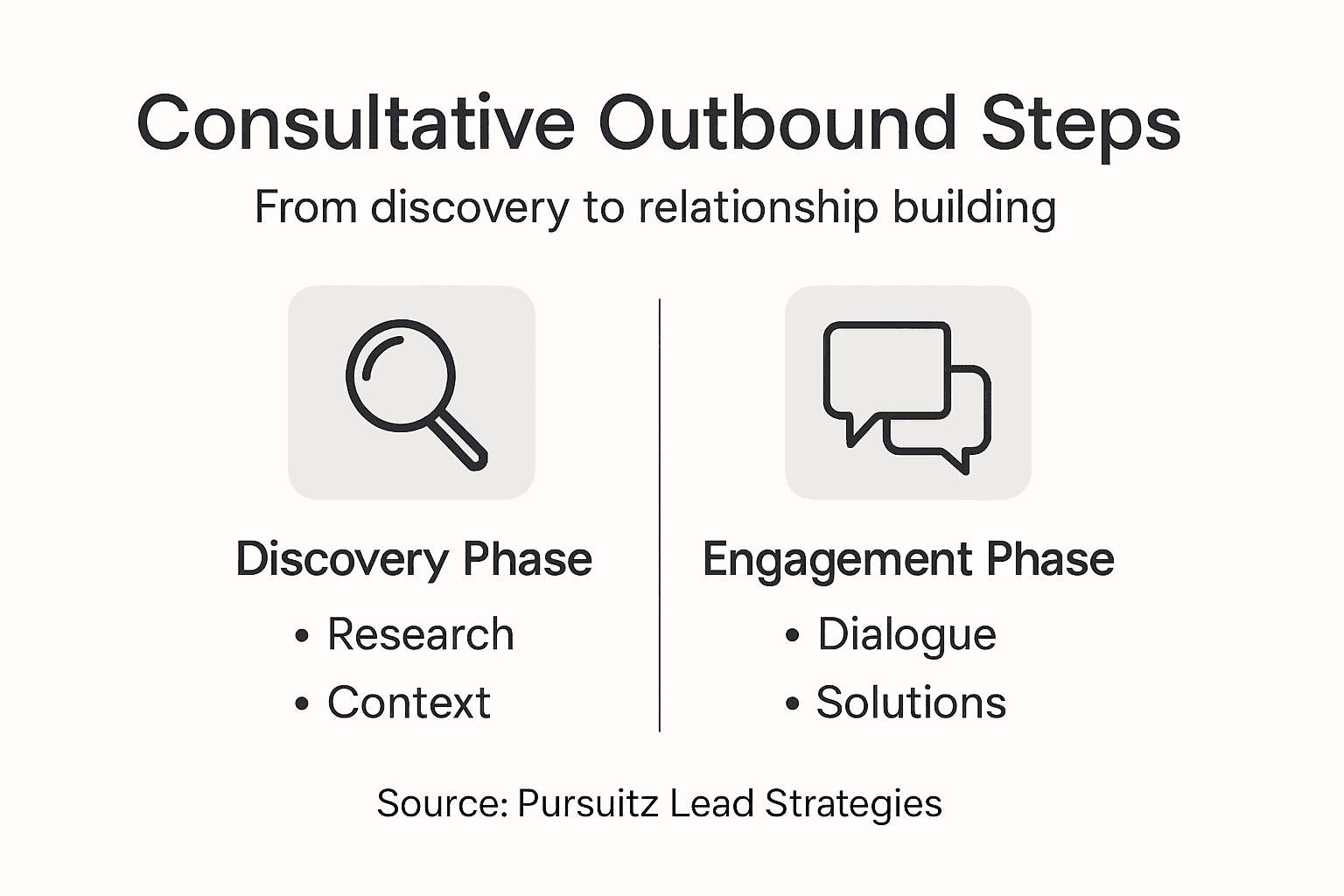
The foundational principles of consultative outbound are rooted in comprehensive research and targeted engagement. Precise targeting and value delivery become paramount, moving beyond superficial interactions toward deeply personalized communication strategies. Key principles include:
- Deep Customer Understanding: Developing comprehensive ideal customer profiles
- Contextual Personalization: Tailoring engagement based on specific buyer pain points
- Intent-Driven Approach: Leveraging data signals to identify genuine opportunity
- Multi-Channel Strategy: Blending strategic touchpoints across communication platforms
- Continuous Refinement: Iteratively improving outreach based on measured engagement quality
Successful consultative outbound transcends traditional sales scripts by transforming interactions into collaborative problem-solving experiences. AI-powered personalization and intent data now enable unprecedented precision in identifying and engaging potential customers. This approach demands a strategic mindset that views each interaction as an opportunity to understand, diagnose, and propose meaningful solutions.
Pro tip: Invest more time in research and understanding your prospect’s specific context than crafting generic outreach messages.
Consultative Versus Transactional Lead Generation
The fundamental difference between consultative and transactional lead generation represents a profound shift in sales philosophy. Transactional approaches treat potential customers as simple numerical targets, prioritizing quantity over quality and focusing on rapid deal closure. In contrast, consultative strategies build strategic relationships that transform potential customers into long-term partners.
Key distinctions between these approaches emerge through multiple critical dimensions:
-
Customer Interaction:
- Transactional: Brief, product-focused exchanges
- Consultative: In-depth, problem-solving dialogues
-
Sales Cycle Length:
- Transactional: Short and immediate
- Consultative: Longer, more strategic engagement
-
Primary Objective:
- Transactional: Immediate sale
- Consultative: Solving customer challenges
-
Value Proposition:
- Transactional: Product features
- Consultative: Tailored solutions
Comprehensive needs assessment distinguishes consultative approaches, where sales professionals invest significant time understanding client contexts, challenges, and strategic objectives. This method requires deeper research, more nuanced communication, and a genuine commitment to delivering meaningful value beyond simple product transactions.
The consultative model demands a more sophisticated skill set from sales professionals. Success depends on developing deep industry knowledge, exceptional listening skills, and the ability to translate complex customer needs into precise, customized solutions. By positioning themselves as trusted advisors rather than mere vendors, consultative practitioners create more sustainable, mutually beneficial business relationships.
Here’s how consultative and transactional lead generation impact business outcomes:
| Dimension | Consultative Approach | Transactional Approach |
|---|---|---|
| Relationship Longevity | Long-term partnerships | Short-term interactions |
| Lead Quality | High, qualified leads | High volume, lower quality |
| Sales Team Skills | Advanced problem-solving required | Product-focused selling |
| Customer Lifetime Value | Increased retention and upsell | Limited repeat business |
| Adaptability | Agile to client needs | Rigid, standard process |
Pro tip: Invest more energy in understanding your prospect’s specific business context than preparing generic sales pitches.
Why One-Size Outbound Approaches Fail
Modern B2B markets demand sophisticated, nuanced engagement strategies that transcend simplistic, cookie-cutter approaches. Generic outbound frameworks consistently underperform because they fundamentally misunderstand the complex dynamics of customer decision-making. These standardized methods ignore the intricate variations in buyer preferences, organizational cultures, and strategic priorities that define successful interactions.
The critical weaknesses of one-size-fits-all outbound strategies manifest through several key dimensions:
-
Prospect Diversity:
- Ignores unique industry contexts
- Overlooks individual company challenges
- Fails to recognize decision-maker motivations
-
Messaging Limitations:
- Produces generic, impersonal communication
- Lacks meaningful personalization
- Reduces engagement potential
-
Strategic Misalignment:
- Disconnects from specific buyer journeys
- Minimizes understanding of complex needs
- Reduces conversion probability
Individualized interventions based on detailed assessments represent the antidote to these generalized approaches. Effective outbound strategies require deep research, nuanced understanding, and a commitment to crafting highly tailored engagement models that reflect the unique characteristics of each potential customer.

Successful lead generation demands a sophisticated approach that prioritizes understanding over standardization. Sales teams must develop adaptive frameworks that can quickly recognize and respond to the distinct challenges, motivations, and behavioral patterns of different prospect segments. This requires continuous learning, robust research capabilities, and a willingness to move beyond templated interactions.
Pro tip: Develop prospect personas that go beyond demographics and capture the complex motivational landscape of your target decision-makers.
GTM Alignment And Messaging Architecture
Successful go-to-market strategies demand more than isolated tactical execution—they require holistic, integrated communication frameworks that synchronize organizational efforts. Strategic GTM alignment creates organizational coherence by establishing a unified narrative that resonates across sales, marketing, product, and customer success teams. This alignment transforms disconnected activities into a powerful, synchronized growth engine.
The core components of an effective messaging architecture include:
-
Narrative Framework:
- Defines core brand storytelling
- Establishes consistent value propositions
- Creates emotional connection points
-
Persona Development:
- Maps detailed buyer profiles
- Identifies decision-maker motivations
- Segments communication strategies
-
Positioning Strategy:
- Articulates unique market differentiation
- Aligns messaging across touchpoints
- Creates competitive advantage narrative
A robust GTM alignment process requires deliberate design and continuous refinement. Teams must develop shared understanding through regular cross-functional workshops, collaborative messaging development, and transparent communication protocols. This approach ensures that every customer interaction reflects a cohesive, intentional strategy rather than fragmented, inconsistent communication.
Deep messaging architecture goes beyond surface-level communication guidelines. It demands a nuanced understanding of buyer psychology, market dynamics, and organizational capabilities. Successful implementations create a flexible yet consistent framework that allows individual team members to personalize interactions while maintaining strategic coherence.
The main components of an effective GTM messaging architecture work together as follows:
| Component | Main Purpose | Business Benefit |
|---|---|---|
| Narrative Framework | Shape brand story | Drives emotional engagement |
| Persona Development | Map audience insights | Enables tailored outreach |
| Positioning Strategy | Highlight differentiation | Secures competitive edge |
Pro tip: Create a centralized messaging repository that becomes the single source of truth for all customer-facing communication strategies.
System Design For Predictable Pipeline
Predictable B2B pipeline development requires sophisticated system architecture that transcends traditional lead generation approaches. Advanced predictive modeling creates strategic pipeline insights by transforming raw data into actionable forecasting mechanisms. These systems integrate multiple data signals to generate reliable, repeatable growth trajectories.
Effective pipeline systems incorporate several critical design elements:
-
Data Integration:
- Consolidate multiple prospect signals
- Connect intent data across platforms
- Create holistic prospect understanding
-
Predictive Modeling:
- Use machine learning classifiers
- Forecast engagement probabilities
- Identify high-potential opportunities
-
Continuous Learning:
- Track interaction quality metrics
- Refine targeting algorithms
- Adapt to changing market dynamics
Proactive maintenance of pipeline systems requires consistent monitoring and strategic intervention. Successful approaches leverage sophisticated machine learning models that can detect subtle shifts in prospect behavior, enabling teams to make data-driven adjustments before potential opportunities diminish.
The most advanced pipeline systems treat lead generation as a dynamic, interconnected ecosystem. They recognize that predictability emerges not from rigid processes, but from flexible frameworks capable of rapidly interpreting complex market signals. This demands a holistic approach that combines technological sophistication with deep strategic intelligence.
Pro tip: Design your pipeline system to prioritize signal quality over quantity, focusing on meaningful interactions rather than vanity metrics.
Unlock Predictable Growth With Consultative Outbound on LinkedIn
The article highlights a critical challenge faced by B2B leaders today: moving beyond generic lead generation to embrace consultative outbound strategies that prioritize deep customer understanding and tailored engagement. If you struggle with traditional outbound pitfalls like impersonal messaging or short-term transactional interactions you know how vital it is to build authentic, trust-first conversations that convert into long-lasting partnerships. Your goal is clear: deliver strategic, personalized value that leads to a predictable and high-quality pipeline.
At Pursuitz we empower B2B founders and leadership teams to master this consultative philosophy using hyper-personalized LinkedIn outreach combined with founder-led personal branding and consistent content distribution. Our system design focuses on measurable inputs and avoids outdated tactics like email blasts or paid ads. Experience a workflow that respects your prospect’s unique context and motivates meaningful dialogues aligned to their business challenges. Learn how our approach creates a steady flow of trusted connections that amplify your strategic impact.
Discover how to transform your outbound lead generation by integrating consultative methodologies with LinkedIn’s powerful network. Ready to elevate your growth beyond one-size-fits-all models? Explore what makes a system built for sustainable success at Pursuitz and see how founder-driven narratives and personalized outreach generate results that last. Start your journey toward predictable deal flow today.
Frequently Asked Questions
What is consultative outbound lead generation?
Consultative outbound lead generation is a strategic approach that focuses on building meaningful customer relationships through deep understanding and targeted engagement, rather than merely generating a high volume of leads.
How does consultative outbound differ from transactional lead generation?
Consultative outbound emphasizes long-term partnerships and in-depth problem-solving dialogues, while transactional lead generation prioritizes immediate sales and short, product-focused exchanges.
What are the key principles of consultative outbound lead generation?
The key principles include deep customer understanding, contextual personalization, intent-driven approaches, multi-channel strategies, and continuous refinement of outreach efforts based on engagement metrics.
Why do one-size-fits-all outbound approaches fail?
One-size-fits-all approaches fail because they ignore the diverse needs and unique contexts of prospects, resulting in generic messaging that lacks meaningful personalization and misses strategic alignment with customer journeys.