

Most American companies miss out on up to 50 percent more B2B leads simply because their outreach strategy lacks precision. For businesses aiming to grow, sending emails without targeting the right organizations wastes time and hurts results. This practical guide reveals how to build an ideal client profile, personalize every message, and use smart automation so your American B2B email campaigns generate real meetings with high value prospects.
Table of Contents
- Step 1: Define Your Ideal Client Profile And Target List
- Step 2: Craft Personalized Email Outreach Sequences
- Step 3: Automate Sending While Maximizing Deliverability
- Step 4: Handle Replies And Book Meetings Effectively
- Step 5: Evaluate Campaign Performance And Refine Strategy
Quick Summary
| Key Insight | Explanation |
|---|---|
| 1. Define Your Ideal Client | Create a detailed profile based on successful clients’ attributes to improve targeting. |
| 2. Craft Personalized Sequences | Develop email sequences tailored to each prospect’s unique challenges and needs. |
| 3. Automate for Efficiency | Use CRM tools for personalized segmentation while ensuring email deliverability. |
| 4. Respond Promptly to Replies | Acknowledge responses quickly with personalized messages to facilitate meeting bookings. |
| 5. Continuously Evaluate Performance | Regularly analyze campaign metrics to optimize outreach strategies based on data insights. |
Step 1: Define your ideal client profile and target list
Creating a precise ideal client profile is fundamental to your B2B email outreach strategy. This process helps you target organizations most likely to benefit from your services by systematically analyzing their characteristics, needs, and potential alignment with your offerings.
To develop an effective Ideal Client Profile (ICP), start by gathering comprehensive data about your most successful existing clients. Research reveals that analyzing quantitative metrics, business situations, and organizational models can significantly improve targeting precision. Begin by examining common attributes among your top performing accounts such as company size, industry, annual revenue, technological infrastructure, and specific business challenges.
When building your target list, focus on creating a granular profile that goes beyond basic demographic information. Understand the deeper psychographic elements that distinguish high value prospects including their strategic goals, pain points, growth trajectories, and organizational culture. Develop a matrix that scores potential clients based on how closely they match your ideal customer characteristics. This approach transforms your prospecting from a scattershot method to a surgical targeting strategy.
Pro tip: Don’t just collect data passively. Actively interview your current best clients to uncover nuanced insights that quantitative analysis might miss. Their feedback can reveal unexpected patterns that refine your targeting approach.
Once you have defined your ICP, you’re ready to move into the next critical phase of developing a hyper-personalized outreach strategy that speaks directly to your ideal prospects’ specific needs and challenges.
Step 2: Craft personalized email outreach sequences
Personalized email sequences are the heartbeat of successful B2B outreach strategies. Your goal is to create targeted communications that speak directly to each prospect’s unique challenges and opportunities.

Effective email personalization goes far beyond inserting a recipient’s name. You must develop a sophisticated approach that demonstrates genuine understanding of the prospect’s business context. Start by segmenting your target list based on industry, company size, specific pain points, and potential growth opportunities. For each segment, develop a tailored email sequence that addresses their specific scenarios with precision and empathy.
Begin crafting your sequence by creating a compelling opening message that immediately demonstrates value. Your first email should focus on the prospect’s potential challenges rather than your own product features. Use research insights and industry specific language that shows you’ve invested time understanding their business landscape. Follow this initial message with a series of progressively more detailed communications that build trust incrementally. Each subsequent email should provide additional value – perhaps sharing a relevant case study, offering a strategic insight, or presenting a unique solution to a problem they might be experiencing.
Pro tip: Always include a clear yet low pressure call to action. Invite conversation rather than demanding an immediate sale. Your objective is to start a dialogue that positions you as a trusted advisor.
As you develop these sequences, remember that personalization is an ongoing process of refinement. Track your response rates, continuously test different approaches, and be prepared to adapt your strategy based on real world feedback.
Step 3: Automate sending while maximizing deliverability
Automating your email outreach requires a strategic approach that balances efficiency with personalization. Your ultimate goal is to create a streamlined system that delivers targeted messages while maintaining high inbox placement rates.
Effective email automation relies on sophisticated contact segmentation strategies that ensure your messages remain relevant and engaging. Utilize advanced CRM tools to categorize your prospects based on detailed criteria such as job role, industry vertical, company size, and specific interaction history. This granular approach allows you to develop nuanced email sequences that feel individually crafted even when sent through automated systems.
When implementing your automation strategy, focus on several critical deliverability factors. Configure your sending infrastructure to simulate human behavior by introducing intentional variations in send times and email intervals. Use reputable email service providers with strong sender reputations, and implement robust authentication protocols like SPF, DKIM, and DMARC to validate your domain and prevent potential spam classifications.
Pro tip: Always include a clean unsubscribe mechanism and monitor your sender reputation meticulously. Regularly clean your email list by removing unengaged contacts and maintaining a high engagement rate.
By blending intelligent automation with personalized targeting, you transform mass email campaigns into precision communication tools that respect both technological constraints and human connection.
Step 4: Handle replies and book meetings effectively
Successfully managing email replies transforms cold outreach into meaningful business conversations. Your ability to respond quickly and strategically can mean the difference between landing a potential client and losing their interest.
Effective response strategies require maintaining a concise and conversational communication style that facilitates smooth interaction and meeting scheduling. When a prospect responds, prioritize immediate acknowledgment with a personalized response that demonstrates you understand their specific context. Structure your reply to make booking a meeting as frictionless as possible by providing clear availability options and a simple mechanism for scheduling.
Crafting emails that encourage easy responses is crucial for converting initial interest into actual meetings. Design your follow up messages with precise call to action statements that guide prospects toward scheduling. Include specific time slots, offer calendar links, and create a sense of urgency without applying excessive pressure. Your communication should feel like a helpful collaboration rather than a sales pitch.
Pro tip: Implement a rapid response protocol where initial replies are addressed within two hours. Speed signals professionalism and genuine interest.
Remember that every interaction is an opportunity to build trust and demonstrate your commitment to solving the prospect’s potential business challenges.
Step 5: Evaluate campaign performance and refine strategy
Evaluating and refining your email outreach strategy is a continuous process that transforms raw data into actionable insights. Your goal is to create a systematic approach for measuring campaign effectiveness and making intelligent adjustments.
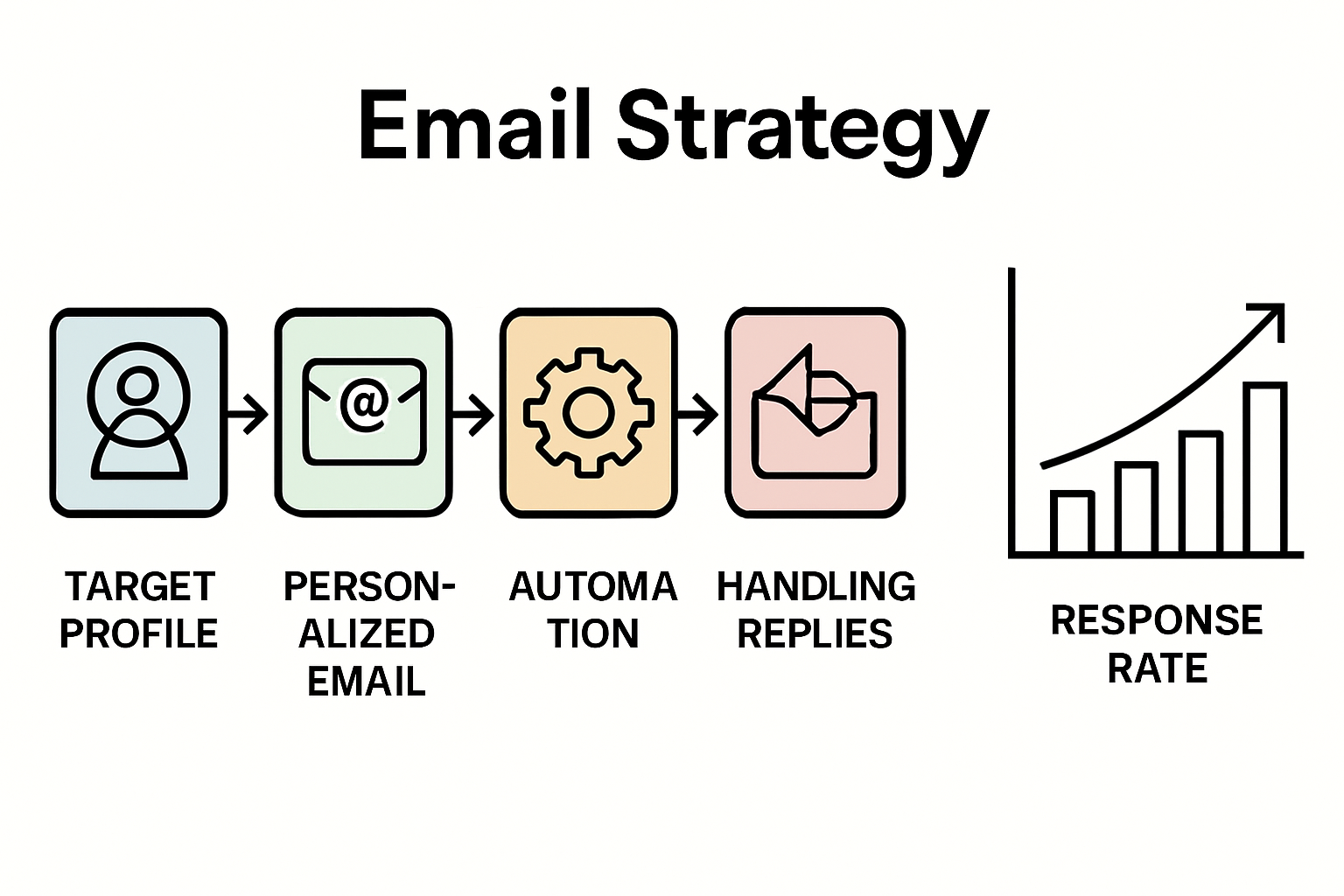
Advanced email response prediction techniques demonstrate how analyzing content and metadata can reveal critical performance patterns. Track key metrics beyond simple open and response rates including engagement depth, conversion timelines, and qualitative interaction quality. Develop a comprehensive dashboard that captures nuanced performance indicators such as response sentiment, meeting booking rates, and prospect progression through your sales funnel.
Start by establishing baseline performance metrics for each email sequence and segment. Compare different approaches systematically tracking variables like subject line language, email length, time of send, and personalization depth. Create controlled experiments where you modify single variables to understand their specific impact on prospect engagement. This methodical approach allows you to incrementally optimize your outreach strategy based on empirical evidence rather than intuition.
Pro tip: Implement a quarterly review process where you conduct a holistic analysis of your email outreach performance. Look for emerging trends and be prepared to pivot your strategy based on changing market dynamics.
Remember that data driven refinement is an ongoing journey of continuous improvement.
Transform Your B2B Email Outreach Into Predictable Client Wins
If you found value in mastering personalized outreach sequences and strategic targeting from the “Email Outreach How To Guide” then imagine accelerating those results with expert assistance. The article highlights the challenge of crafting hyper-personalized emails and managing responses effectively to win more B2B clients quickly. We understand your goal to eliminate guesswork in lead generation and build an unstoppable sales pipeline.
At Pursuitz, our team specializes in creating precise Ideal Client Profiles and executing multichannel LinkedIn and email outreach that feels like you spent ten minutes researching each prospect. We handle everything from prospect sourcing and reply handling to direct meeting booking and seamless lead exports. Our clients often see at least 2x return on investment within three months because we apply the proven principles you read about with expert precision and automation.

Ready to stop wondering where your next client will come from and start closing more deals faster? Visit Pursuitz now to learn how our end-to-end lead generation solutions can revolutionize your outreach. Discover tailored strategies that build trust, maximize deliverability, and turn every email into a valuable conversation.
Frequently Asked Questions
How do I define my ideal client profile for email outreach?
Defining your ideal client profile involves analyzing your most successful clients’ characteristics. Start by gathering data on aspects like company size, industry, and specific pain points. This analysis will help you create a targeted outreach strategy that focuses on organizations aligned with your offerings.
What should I include in personalized email outreach sequences?
Personalized email outreach sequences should address each prospect’s unique challenges and opportunities. Begin with a compelling opening message that focuses on their potential issues, followed by valuable insights tailored to their context. Aim to progressively build trust and offer solutions throughout your email series.
How can I automate my email outreach while ensuring high deliverability?
To automate your email outreach effectively, use advanced contact segmentation to keep your messages relevant. Implement strategies like varying send times and using reputable email services. Aim to establish a system that maximizes inbox placement rates while delivering personalized communications.
How should I respond to email replies from prospects?
When you receive email replies, respond quickly with a personalized message that acknowledges their specific needs. Make it easy for prospects to book a meeting by providing clear availability options and scheduling links. Focus on creating a friendly tone that encourages conversation.
What metrics should I track to evaluate the performance of my email outreach?
To effectively evaluate your email outreach, track key metrics like open rates, response rates, and meeting booking ratios. Additionally, analyze the quality of interactions and engagement depth to gain deeper insights. Regularly review your performance to identify trends and make data-driven adjustments to your strategy.
Recommended
- Pursuitz – Complete Guide to Why Use Email Outreach
- Pursuitz – Lead generation tutorial for beginners
- Pursuitz – What Is Sales Prospecting? Complete B2B Guide
- Pursuitz – The basics of effective lead generation
- 7 Practical Digital Sales Funnel Examples for Growth | Reddog Consulting Group
- Master Email Campaigns Step by Step for Regional Business