

Every buyer in a B2B market wants proof before they believe a founder can deliver. Lack of trust slows deals and draws out sales cycles. When you build personal brand equity through consistent visibility, credibility, and network engagement, you lay recognized signals of reliability and competence before any outreach begins. This article breaks down why showing up regularly on LinkedIn transforms skepticism into trust, giving American and Canadian founders a measurable advantage in client acquisition and deal speed.
Table of Contents
- Why Personal Branding Builds Trust Faster
- How Founders Reduce Outreach Barriers
- Visibility, Familiarity, and LinkedIn Reply Rates
- Content’s Role in Deepening B2B Relationships
- Consistency Over Viral Content for Long-Term Gains
- Lowering Customer Acquisition Cost and Boosting Deal Velocity
Key Takeaways
| Point | Details |
|---|---|
| Build Personal Brand Equity | Establish visibility, credibility, professional networking, and consistency to foster trust before outreach. |
| Engage with Thoughtful Content | Share insights and perspectives that directly address buyers’ problems, transforming content from monologue to dialogue. |
| Prioritize Consistency Over Virality | Regularly present valuable content to deepen familiarity with potential buyers and build long-term growth relationships. |
| Reduce Customer Acquisition Costs | By establishing familiarity and trust, reduce sales cycle length and customer acquisition costs while improving conversion rates. |
Why Personal Branding Builds Trust Faster
Trust is the only currency that matters in B2B relationships. Your prospect doesn’t trust your company at first. They trust a person. When you show up consistently as a founder with a clear point of view, a track record, and visible expertise, you skip past the skepticism that typically surrounds cold outreach. This is not about vanity or becoming famous. It’s about being recognizable and credible to the exact people who need your solutions.
The mechanics are straightforward. Personal brand equity builds through visibility, credibility, professional network, and reputation. When these elements stack together, they create what researchers call “signals of reliability and competence.” In practical terms, this means when a prospect sees you’ve been actively sharing insights in your space, engaging thoughtfully with your network, and demonstrating real experience, they mentally sort you into a different category than the founder they’ve never heard of. That categorization happens before the first conversation. You’ve already lowered their guard because familiarity preceded outreach.
Here’s what most founders misunderstand about this process. Speed matters less than consistency. You don’t need viral content or thousands of followers to build meaningful trust. You need to show up where your buyers congregate, share perspectives that reflect how you actually solve problems, and do it regularly enough that people begin to recognize your name and associate it with competence in your domain. Research on leadership personal branding and team trust shows that effective communication, authenticity, and consistent effort underpin rapid trust formation. Your LinkedIn presence isn’t a broadcast channel. It’s a place where your ideal buyers observe your thinking, watch how you engage with others, and begin to trust you before you ever mention what you sell.
The downstream effect on your growth is measurable. When prospects know your name and associate you with capability before a meeting request arrives, the entire sales dynamic shifts. Reply rates increase. Meetings that do happen have higher qualification and intent. Conversations move faster because you’re starting from a position of credibility rather than needing to establish it. Your cost of acquisition doesn’t just decrease because you get more meetings. It decreases because the meetings you get are with better fit prospects who have already made a decision to learn more about you, not about generic alternatives.
Below is a summary of key elements that build effective personal branding for founders:
| Element | Description | Business Impact |
|---|---|---|
| Visibility | Regular presence in target channels | Increases audience familiarity |
| Credibility | Demonstrated expertise and results | Accelerates trust-building |
| Network | Active engagement with industry peers | Expands reach to prospects |
| Consistency | Ongoing content and interactions | Enhances recognition and trust |
Pro tip: Start with one clear area of expertise and talk about real problems you solve in that area rather than broad industry observations. When prospects see you focused and knowledgeable, not scattered and general, trust builds faster.
How Founders Reduce Outreach Barriers
When you’re unknown, every outreach attempt hits friction. The prospect doesn’t know you. They don’t know your company. They have no reason to believe this message is worth their time. Most founders respond by cranking up volume, blasting more messages into the void, hoping one sticks. But friction doesn’t disappear through volume. It disappears through credibility.
Founders who build personal brands systematically reduce this friction before they ever send a message. Strong professional networks and reputational capital create shortcuts that cold outreach cannot replicate. When a prospect has already seen your thinking, recognizes your name, and has mentally associated you with competence in their problem space, your message arrives in a different context. You’re not a stranger. You’re someone they’ve observed solving problems similar to theirs. That distinction is everything. Your reply rates shift. Your meeting acceptance rates improve. Your conversations start from a place of mutual interest instead of you trying to convince someone to care.
This happens because authentic leadership brands strategically connect with stakeholders in ways that decrease resistance and accelerate deal-making. You’re not just reducing friction. You’re replacing skepticism with openness. When you reach out after having built visibility in your domain, you’re not pitching blind. You’re following up on a relationship that already exists, even if it’s a one-way relationship where they know you and you don’t know them yet. That asymmetry works in your favor because they’ve made a micro-decision to pay attention to you already.
The practical effect is profound for B2B founders. Your outreach becomes more targeted because you’re focusing on people who have engaged with your content or are adjacent to your network. Your timing improves because you’re reaching out when there’s already a point of connection. Your conversion improves because the person you’re contacting already understands your perspective and has implicitly validated that you’re worth listening to. You’re not cold anymore. You’ve warmed the relationship months in advance through consistent visibility, and now you’re simply formalizing what was already forming in their mind. This isn’t about manipulation or tricking people into meetings. It’s about honest positioning that lets qualified buyers recognize you as someone who can help before the first conversation happens.
Pro tip: Reference something specific from the prospect’s recent activity or content in your outreach message, connecting it to one of your posts or perspectives they’ve seen. This bridges the gap between passive visibility and active conversation, proving you’re not generic.
Visibility, Familiarity, and LinkedIn Reply Rates
There is a direct line connecting how often someone sees your name to whether they respond to your message. This isn’t mysterious psychology. It’s cognitive recognition. When a prospect encounters your content multiple times over weeks or months, a neural pathway forms. Your name becomes familiar. Familiar things feel safer. Safe things get responses.
The mechanics work like this. Every time someone sees a post you wrote, engages with a comment you made, or notices your name in a discussion about your industry, their brain categorizes you slightly differently than it did before. You move from unknown to known. Known to credible. Credible to worth listening to. By the time your outreach message arrives, you’re not a cold name in their inbox. You’re someone they recognize. Someone they’ve implicitly vetted through observation. The barrier to response drops dramatically because responding to you doesn’t feel risky anymore.

LinkedIn’s algorithm amplifies this effect naturally. When you share insights consistently in your space, your content reaches people in your target market who follow similar topics, engage with related posts, or share professional interests with people in your network. These are the exact people you want to reach out to later. You’re not just building visibility. You’re building visibility with qualified buyers. Then when you send a message to someone who has seen your perspective multiple times, you’re not interrupting a stranger. You’re continuing a conversation that started passively weeks ago. They already know what you think about their problems. They already have context for what you might say. Your message lands with far less friction.
The reply rate improvement is measurable and consistent. Founders who build visibility first report reply rates that double or triple compared to cold outreach where no prior visibility exists. It’s not magic. It’s predictable. The more times someone has seen your name and associated it with useful thinking in their problem space, the more likely they are to respond when you ask for a conversation. You’re not competing for attention as an unknown commodity. You’re asking a familiar contact to deepen a relationship that already exists in their mind. Familiarity doesn’t guarantee meetings, but it guarantees you get heard. And for B2B founders trying to build predictable deal flow, being heard is the first essential step.
Pro tip: Track which of your posts get engagement from your target buyer profile, then create follow-up content on those same topics at least weekly. This creates a recognizable pattern that builds familiarity faster than sporadic posting ever could.
Content’s Role in Deepening B2B Relationships
Content is not a marketing tactic. It’s a relationship tool. Most founders treat content as broadcast, a way to talk at their market. But the most effective founders use content to think alongside their market. They share what they’re learning, what they’re seeing in their customers’ businesses, what patterns are emerging in their space. This transforms content from monologue into dialogue. And dialogue is where relationships actually deepen.
When you share thinking that solves a real problem your buyer faces, something shifts in how they perceive you. Helpful, relevant content fosters cognitive-emotional engagement that builds trust over time. You’re not asking for anything. You’re offering clarity on a problem they care about. That asymmetry is powerful. They consume your thinking because it helps them. There’s no transaction. No pitch. Just useful perspective. Over months, this pattern accumulates. They begin to see you as someone who understands their world, someone who thinks about problems the way they do. That recognition is the foundation of every strong B2B relationship.
The mechanism is straightforward but often overlooked. Educational, personalized content aligned with buyer needs reduces friction in the decision process and strengthens trust. When a prospect reads your perspective on something they’re actively thinking about, you become part of their decision process without being in the room. You’re shaping how they think about their problem before they even talk to you. By the time they do reach out or respond to your outreach, they already know your framework, your values, your approach to problem-solving. The conversation isn’t starting from zero. It’s starting from a foundation you’ve built through consistent, relevant thinking shared publicly. This accelerates everything. Discovery calls take half the time because context is already there. Objections dissolve because you’ve already addressed them in your content. Trust exists because you’ve proven your thinking through months of consistent output, not through a pitch.
The deepening effect compounds because relationships require reciprocity. When you give value without asking for anything, buyers naturally want to reciprocate by giving you their attention, their time, their consideration. You’re not building a list of prospects. You’re building a network of people who know you, respect your thinking, and are predisposed to want to work with you. That’s infinitely more valuable than any metric. Your content isn’t accelerating your sales cycle by days. It’s accelerating it by months, sometimes by completely removing the skepticism phase entirely. Relationships deepen because you’ve invested in understanding your buyer’s world and sharing back what you’ve learned. That’s not manipulation. That’s genuine partnership starting before the first conversation.
Pro tip: Write about one specific problem you solve and the underlying misconceptions your buyers have about it, rather than general industry observations. When buyers recognize their exact situation in your content, the relationship-building effect compounds exponentially.
Consistency Over Viral Content for Long-Term Gains
Every founder has fantasized about the viral post. One piece of content that explodes overnight, reaches thousands, generates inbound interest without any effort. It’s a seductive idea. But it’s also a trap. Viral moments feel like wins. They deliver a rush of validation. Then they disappear. The views fade. The engagement collapses. The people who saw your post for a moment never think about you again. You’re left back where you started, but now convinced that chasing the algorithm is the path to growth.
The reality of B2B growth is different. Digital grit through consistent, value-driven efforts builds the kind of visibility that converts to relationships and revenue. Consistency compounds. Every week you show up with thinking that matters to your market, you’re building recognition with the same people. You’re not trying to reach new audiences constantly. You’re deepening familiarity with qualified buyers who keep encountering your name and your perspective. That repetition is what builds trust. That trust is what drives reply rates. That recognition is what creates predictable deal flow. Viral content rarely does any of this because the audience is often wrong. Random people who found your post by accident aren’t your buyers. They won’t remember you. They won’t hire you.
Consistency also builds search visibility and institutional credibility in ways viral posts never do. When you publish thinking regularly on the same topics, search engines begin to rank you as an authority on those topics. When someone in your market searches for a problem you solve, they find your content. When they read it, they recognize you. When you reach out weeks later, they already know you. This is the compounding effect that changes growth trajectories. It’s not flashy. It doesn’t feel exciting in the moment. But over six months or a year, consistent weekly output on your core problems generates more qualified meetings than chasing viral moments ever could.
The psychological shift required here is crucial. Stop measuring success by spikes and start measuring it by steady accumulation. One viral post might reach 50,000 people, 99 percent of whom are irrelevant to your business. One hundred consistent posts reach 5,000 of the exact people you want to work with, repeatedly, building familiarity and trust with each encounter. The second option builds business. The first option builds ego. For founders trying to grow predictable revenue, ego is a distraction. Consistency is strategy. Your market doesn’t need to see you once in a massive way. They need to see you regularly in a focused way. That’s how you move from unknown founder to recognizable voice in your space. That’s how outreach goes from friction to familiarity. That’s how you build a growth engine that doesn’t depend on viral luck.
Pro tip: Commit to publishing one piece of substantive thinking per week on a specific problem you solve for at least twelve weeks before evaluating results. Measure not by likes or shares, but by whether the same people keep showing up and engaging, and whether your outreach reply rates improve over that period.
Lowering Customer Acquisition Cost and Boosting Deal Velocity
Customer acquisition cost is the financial truth of B2B growth. Every founder knows the number. Many don’t like it. When your outreach is cold, your reply rates are low, and your meetings require heavy lifting to convert, your CAC climbs. You’re spending time and resources on prospects who don’t know you, don’t trust you, and have no reason to prioritize your message over everything else competing for their attention. The math gets brutal quickly. But when you’ve built visibility and familiarity first, the entire economics shift.
Consider what happens when a prospect already knows your name. They’ve seen your perspective on their problems. They’ve watched you engage thoughtfully in your space. When your outreach arrives, it’s not an interruption. It’s a continuation. They’re already warm. Your reply rate doubles or triples immediately. Your meeting acceptance rate increases. But the real savings comes from what happens inside those meetings. Because they know your thinking already, you skip entire discovery phases. You don’t need to explain what you do or why it matters. You don’t need to convince them you understand their world. That context exists. Your conversations move straight to diagnosis and solution. What typically takes three meetings takes one. What typically takes four weeks takes two weeks. Deal velocity accelerates dramatically.
The compounding effect on CAC is where the real economics live. When your cost per meeting decreases because your reply rates improve, your CAC goes down immediately. But when your sales cycle compresses by 40 or 50 percent because prospects arrive with context and intent, your CAC drops further. You’re closing more deals in less time with fewer touches. Your sales team spends less energy on convincing and more energy on serving. Your close rates improve because you’re only meeting with people who have already decided you’re worth considering. The entire acquisition machine becomes more efficient. And unlike tactics that depend on spending more money for reach, this efficiency compounds over time. Personal brand equity built through visibility and credibility creates a self-reinforcing cycle where better deals come faster and cost less to acquire.
The longer-term impact on growth trajectory is what separates founders who scale from those who plateau. A founder running cold outreach might achieve 5 percent reply rates with long sales cycles and high CAC. A founder who has built visibility and familiarity might achieve 25 percent reply rates, half the sales cycle, and CAC that’s 60 percent lower. That difference compounds annually. After twelve months, the second founder has acquired three times the customers at a fraction of the cost. Their growth rate accelerates. Their unit economics improve. Their ability to invest in the business scales. They’re not just growing faster. They’re growing more efficiently. They’re building a business model that gets better with time, not one that requires constant increase in spending to maintain growth. That’s the real power of founder-led personal branding. It’s not about vanity or status. It’s about ruthless economics.
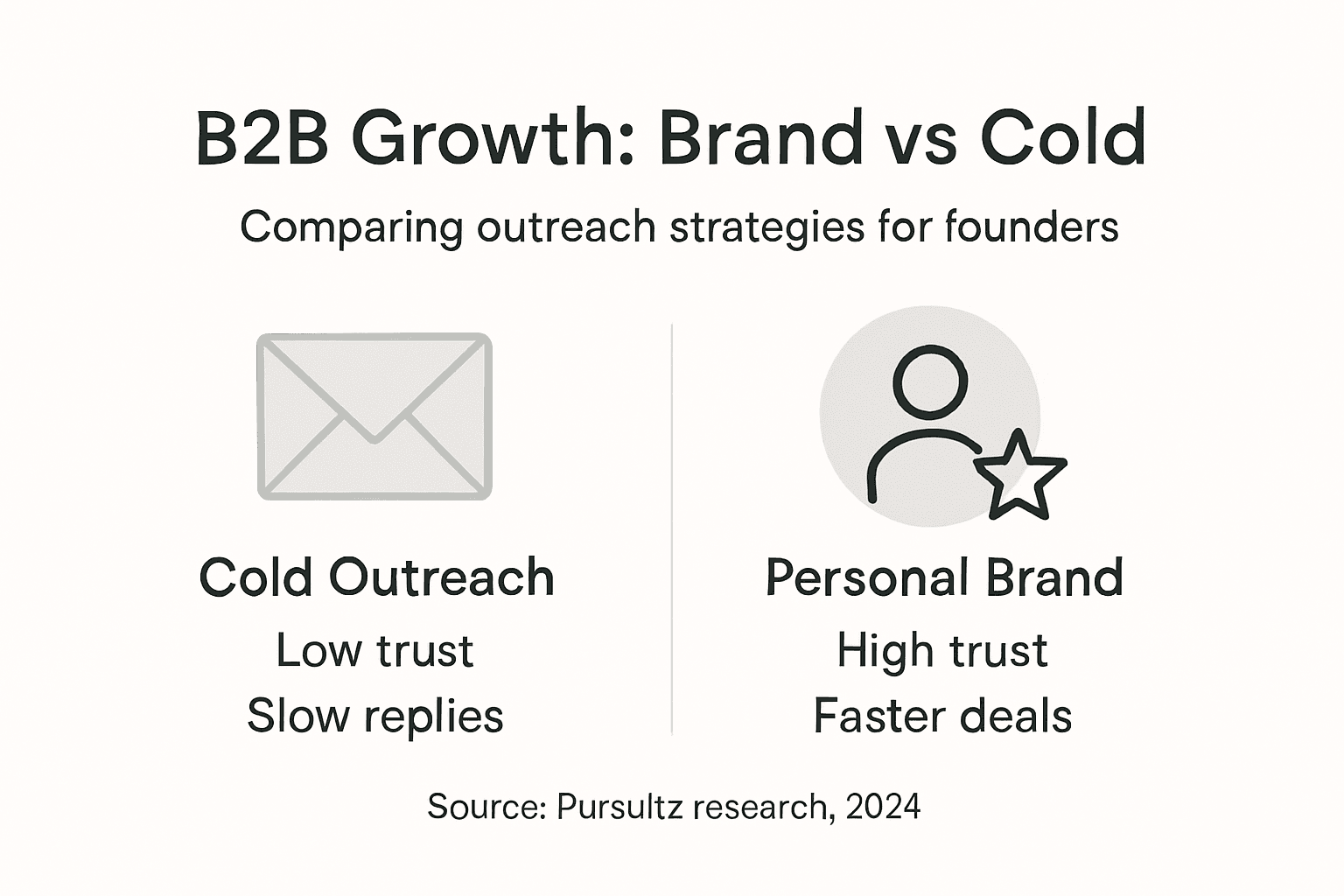
Here’s a comparison of cold outreach versus personal brand-driven outreach in B2B sales:
| Aspect | Cold Outreach | Personal Brand-Driven Outreach |
|---|---|---|
| Initial Trust | Minimal to none | Pre-established via visibility |
| Reply Rates | Typically below 10% | 20% or higher, often doubled |
| Meeting Acceptance | Requires heavy convincing | More receptive, higher intent |
| Sales Cycle Length | Extended, multiple meetings | Compressed, context ready |
| Customer Acquisition Cost | High due to inefficiency | Lower, due to better fit prospects |
Pro tip: Track your reply rate and average sales cycle length before and after building visibility through consistent content sharing. When both improve measurably, you’ll see your CAC decline without any increase in outreach volume, proving the leverage of familiarity.
Build Trust and Accelerate B2B Growth with Founder-Led Personal Branding
If you are a B2B founder struggling with the challenge of cold outreach producing low reply rates and stretched sales cycles, the solution lies in building personal brand equity that creates familiarity and trust before your first message. This article clearly shows that visibility, credibility, consistency, and network engagement are the pillars that reduce outreach friction and shorten deal velocity. When prospects recognize your name and associate it with real expertise, every interaction becomes warmer and more productive.
At Pursuitz, we specialize in empowering founders to turn these insights into measurable growth. Our hyper-personalized LinkedIn outreach coupled with consistent, founder-led content distribution is designed to help you show up authentically where your buyers gather, building trust-first relationships that cut your customer acquisition cost and accelerate deal velocity. Stop wasting effort on generic tactics and start orchestrating a system that delivers predictable deal flow over time. Learn how to transform your outreach by leveraging personal branding strategies explained in this article and take your growth to the next level with Pursuitz. Ready to break outreach barriers? Discover more about how your B2B growth can change when you lead with authenticity and relevance.
Frequently Asked Questions
What is founder-led personal branding and why is it important for B2B growth?
Founder-led personal branding involves establishing a recognizable and credible presence as a business leader in your industry. It is important for B2B growth because it helps build trust with potential clients, making outreach more effective and leading to higher response rates.
How does personal branding contribute to building trust with prospects?
Personal branding contributes to trust building by showcasing your expertise, demonstrating consistent engagement, and sharing insights relevant to your target audience. When prospects recognize your name and associate it with competence, they are more likely to respond positively to outreach efforts.
What role does consistency play in effective personal branding?
Consistency is key in personal branding as it helps establish familiarity and reinforces your credibility over time. Regularly sharing valuable content ensures that your audience continually recognizes you, which lowers barriers in outreach and fosters stronger relationships with prospects.
How can I measure the effectiveness of my personal branding efforts?
You can measure the effectiveness of your personal branding by tracking metrics such as reply rates to your outreach messages, average sales cycle length, and customer acquisition cost. Improvements in these areas indicate that your branding efforts are resonating with your target audience.