

What separates confident growth from unpredictable chaos on LinkedIn is not your content or connections, but the invisible system behind your sales pipeline. Many B2B founders and sales leaders discover that a pipeline filled with activity still results in stalled deals and missed forecasts. The real issue often lies in random outreach and outdated qualification criteria, which undermine predictability and create confusion when success seems within reach yet suddenly slips away. This guide breaks down the core reasons most LinkedIn pipelines fail and shows how to build the consistency that drives reliable client acquisition.
Table of Contents
- Step 1: Identify Why Most LinkedIn Pipelines Lack Predictability
- Step 2: Distinguish Actionable Inputs From Measured Outputs
- Step 3: Design A Consistent, Repeatable Outreach Rhythm
- Step 4: Correlate Conversation Volume With Steady Deal Flow
- Step 5: Implement A 30 To 60 To 90 Day Stabilization Period
- Step 6: Prioritize Pipeline Predictability Over Short Term Spikes
Quick Summary
| Key Insight | Explanation |
|---|---|
| 1. Identify Pipeline Failures | Assess your LinkedIn pipeline to pinpoint inconsistencies in outreach, qualification, and feedback. Detecting these issues is crucial for improving predictability. |
| 2. Focus on Actionable Inputs | Prioritize activities you control, like outreach frequency and conversation quality, instead of obsessing over unpredictable outputs like closed deals. |
| 3. Establish a Consistent Rhythm | Create a sustainable weekly routine for outreach, content sharing, and engagement. Consistency leads to better pipeline predictability over time. |
| 4. Document and Analyze Conversations | Keep track of each conversation’s progression and measure conversion ratios to forecast pipeline outcomes more accurately. |
| 5. Commit to Long-Term Stability | Avoid the temptation of chasing short-term spikes in results; focus on building a predictable pipeline that supports continuous growth. |
Step 1: Identify why most LinkedIn pipelines lack predictability
Most B2B founders and sales leaders believe their LinkedIn pipelines are working. The numbers look reasonable on a spreadsheet. Conversations are happening. Meetings are being booked. But then something shifts. Deals stall. Forecasts break. What looked predictable in month one falls apart by month three. This isn’t a LinkedIn problem. It’s a system problem, and it starts with understanding exactly where your pipeline is failing.
The root cause usually traces back to three interconnected failures. First, random outreach and static ICP lists create inconsistent entry points into your pipeline. You’re reaching out to accounts without structured account intelligence or clear engagement patterns, so the conversations you’re starting don’t match your actual buyer profile. Second, qualification standards aren’t uniform. One sales team member marks someone as “interested” while another requires three specific signals before moving them forward. This creates forecasting chaos because your pipeline appears larger than it actually is. Third, you’re operating without data-driven feedback loops. Manual CRM updates, anecdotal notes, and inconsistent qualification criteria mean poor account fit, weak buying signals, and mistimed outreach go undetected until deals collapse late in the cycle.
Here’s what this looks like in practice. A founder spends two weeks on LinkedIn publishing content and having conversations. Five people ask about a demo. All five go into the pipeline. But after deeper conversation, three of those five were never going to buy. They were curious. They liked the content. One lacked budget. One wasn’t the decision-maker. One had a different use case entirely. But because your qualification criteria weren’t documented, they sat in your pipeline for 60 days before being marked as lost. Your pipeline forecasting was wrong. Your deal velocity was wrong. Your planning was wrong. And you didn’t realize it until too late.
The problem compounds because LinkedIn conversations don’t follow a linear path. Someone might engage with your content for three weeks before responding to a direct message. Another person might reply immediately but need six months to move through their buying process. Without structured account intelligence and granular market insights, you’re essentially guessing which opportunities will close and when. This isn’t a qualification problem anymore. It’s a predictability problem. And predictability is what separates founders who can plan their growth from founders who are constantly surprised by their own pipelines.
Here’s a comparison of common pipeline failures and their downstream impacts in LinkedIn B2B sales:
| Pipeline Failure Type | How It Manifests | Business Impact |
|---|---|---|
| Unstructured outreach | Random connections and messages | Low lead quality, poor fit |
| Inconsistent qualification | Vague or varied interest signals | Bloated pipeline, bad forecasts |
| Missing data-driven feedback | Anecdotal updates, no tracking | Undetected issues, lost deals |
Pro tip: Start by auditing your current pipeline and documenting your actual qualification criteria. Write down exactly what signals matter before someone moves to the next stage, then compare that standard against your last 10 conversations. You’ll likely find inconsistency immediately, and that’s your starting point for building predictability.
Step 2: Distinguish actionable inputs from measured outputs
Once you understand why your pipeline lacks predictability, the next critical distinction is learning the difference between what you can control and what you cannot. Most founders confuse these two categories, which is why their LinkedIn strategies feel reactive and unpredictable. You need to separate actionable inputs from measured outputs. Inputs are the activities you directly control. Outputs are the results those activities eventually produce. Understanding this difference changes everything about how you approach your pipeline.
Actionable inputs are the daily and weekly activities that move your LinkedIn strategy forward. These are controllable activities such as call volume, prospecting steps, and outreach frequency. On LinkedIn specifically, your inputs include how many people you research and qualify each week, how many personalized messages you send, how many valuable conversations you initiate, and how consistently you share content that positions your expertise. These are activities you decide to do or not do. You can increase them tomorrow if you choose. You can measure them in real time. You control the quality and volume. When you show up and have five meaningful conversations, that’s an input you executed. When you publish a piece of content that adds genuine value to your audience, that’s an input you created. These inputs are predictable because they depend on your effort, not on external market conditions or buyer behavior.
Measured outputs are what happens as a result of those inputs over time. Outputs include the number of qualified opportunities that enter your pipeline, the meetings that get scheduled, the deals that close, and the revenue that comes in. Here’s the critical insight: outputs are delayed and variable. You might execute perfect inputs for two weeks and see no output change. Then suddenly, three conversations convert to meetings in the same week. You had no control over the timing. You had no control over when those buyers decided to respond or move forward. Input metrics represent the resources and actions used to drive sales activities, while output metrics measure outcomes like sales closed or customer satisfaction. The mistake most founders make is obsessing over outputs they cannot control while neglecting the inputs they can. They watch their pipeline forecast like hawks, trying to will deals to close faster. They blame LinkedIn for not delivering results. But they’re not actually measuring whether their inputs were consistent, high quality, or strategic.
The practical application is straightforward. Document your inputs first. Write down exactly what you commit to doing each week on LinkedIn. Not vague commitments like “reach out to more people.” Specific ones like “have 15 personalized conversations with qualified accounts in our target market” or “publish one piece of original content and engage meaningfully with five accounts in our ICP.” Then track these inputs relentlessly. Did you hit 15 conversations? Yes or no. Did you publish that content? Yes or no. These are binary measures, and they reveal whether your system is actually running. Once your inputs are consistent and documented for 60 days, only then do you start measuring outputs. By that point, you’ll have a real baseline for what conversion ratios should look like. You’ll know if five conversations typically generate one meeting. You’ll know if your content typically drives two engaged conversations per week. This clarity is where predictability begins.
Pro tip: Track your weekly inputs in a simple spreadsheet for the next 90 days without worrying about outcomes. Focus entirely on whether you executed the activities you committed to, and you’ll notice that output predictability starts appearing naturally around day 60.
Step 3: Design a consistent, repeatable outreach rhythm
Now that you understand inputs and outputs, the next step is building a rhythm that you can actually sustain. Most founders approach LinkedIn like a sprint. They get fired up, spend two weeks doing outreach, have some conversations, then disappear for a month. When they return, they start from zero again. This stop-and-start pattern destroys predictability. What you need instead is a repeatable rhythm that becomes part of your weekly routine, something you can execute whether you’re motivated or not.

Consistency on LinkedIn is not about working harder. It’s about designing a rhythm that fits your reality and then protecting it. Regular posting of valuable content, smart networking, sharp ICP targeting, and continuous engagement create trust and ongoing lead flow. The key word there is continuous. Not sporadic. Not whenever you have time. Continuous means Monday through Friday, every week, at predictable times. Think about what you can realistically commit to each week. Can you have 10 meaningful conversations with people in your target market? Can you engage thoughtfully with 5 to 7 posts from people in your ICP? Can you publish one original piece of content that teaches something your audience needs to know? These three things together form a rhythm. Not every single day needs to be a maximum effort day. But every week needs to follow the same pattern.
The rhythm works best when you separate it into distinct activities. Content days are when you share original insights or observations from your work. Engagement days are when you show up in other people’s conversations and add real value to their threads. Outreach days are when you initiate direct conversations with people you’ve qualified. This separation matters because each activity requires a different mindset. When you’re creating content, you’re thinking about what your audience needs to hear. When you’re engaging, you’re listening and adding to existing conversations. When you’re doing outreach, you’re being direct and specific about why you’re reaching out to that particular person. Mixing these activities together in the same day dilutes your focus. Separating them creates a cadence that feels natural and repeatable.
Let’s make this concrete. Monday you might publish one piece of content that reflects your expertise or a client insight. Tuesday and Wednesday you spend 30 minutes each morning engaging with 3 to 4 posts from people in your target market. Thursday you have 10 conversations, each one personalized based on something specific about that person’s background, recent activity, or stated challenges. Friday you review what happened that week, note which conversations generated interest, and prep for the following week. This rhythm takes maybe 5 to 7 hours total per week when you’re efficient about it. More importantly, it’s predictable. You know exactly what you’re doing each day. Your team knows what you’re doing. Your pipeline gets consistent inputs every single week.
The magic happens when you stack this rhythm across 60 to 90 days without breaking it. You will see patterns emerge. You’ll notice which types of people engage with your content. You’ll see which conversation starters actually get responses. You’ll watch as people begin recognizing your name because you’ve shown up consistently in their feed and inbox. Around day 45 to 60, you’ll start seeing output effects. Meetings will come from conversations you had three weeks ago. People will mention they’ve been following your content. Deals will begin moving forward predictably because you’ve built a consistent funnel of qualified conversations. This is not luck. This is what happens when you design a rhythm and protect it.
Pro tip: Block your calendar for your outreach rhythm at the same time each week and treat it like a client meeting that cannot be moved. Consistency is impossible when you’re squeezing LinkedIn work into random gaps between other priorities.
Step 4: Correlate conversation volume with steady deal flow
You now have a consistent rhythm generating predictable conversation volume. The next step is understanding the relationship between those conversations and your actual deal flow. This is where most founders get confused. They think more conversations automatically mean more deals. That’s partially true, but the real insight is deeper. The volume and quality of your conversations directly predict your deal flow. If you know your conversation patterns, you can forecast your pipeline with remarkable accuracy.
Here’s the fundamental relationship. Every qualified conversation you have this week is a potential deal that could close in 30 to 120 days depending on your sales cycle. Specific conversational patterns, including talk ratios and question frequency, correlate strongly with higher deal progression rates. This means the quality of your conversations matters as much as the quantity. A conversation where you talk 70 percent of the time and listen 30 percent will progress differently than a conversation where you ask genuine questions and let the other person talk. But here’s what matters for predictability: if you’re having 10 qualified conversations per week consistently, and your deal progression rate is stable, you can predict roughly how many of those conversations will convert to meetings, opportunities, and eventually closed deals. This prediction works because you’ve built a system with repeatable inputs.
Let’s make this practical. Let’s say you commit to 10 qualified conversations per week for the next 90 days. That’s 120 conversations total. Now track what happens with each one. How many turn into a second conversation? Of those, how many turn into a meeting? Of those meetings, how many turn into opportunities? And of those opportunities, how many close? These conversion ratios will stabilize around day 60. Once they stabilize, you have your formula. If historically 4 out of 10 conversations become second conversations, 2 of those become meetings, and 1 of those becomes an opportunity that closes, then you know that 120 conversations will produce roughly 12 closed deals. This isn’t guessing anymore. This is math. But you only get to this clarity by maintaining consistent conversation volume and tracking the journey of each conversation.
The reason most pipelines feel unpredictable is that conversation volume is inconsistent. One month you have 20 conversations. The next month you have 5. The month after that you have 15. With inconsistent inputs, your outputs look random. But when you fix your inputs to 10 conversations every single week, the noise disappears. You start seeing clean ratios. You start knowing exactly how many deals should be in your pipeline at any given time. You start forecasting with confidence because you understand the mechanical relationship between the conversations you’re having today and the deals you’ll close in 90 days.
This is also why founders often feel disappointed with their LinkedIn strategy. They might have 8 quality conversations in a week and see zero meetings scheduled. They conclude LinkedIn doesn’t work. But they’re measuring too soon. If their historical ratio is 1 meeting per 5 conversations, then 8 conversations should produce roughly 1.6 meetings, which might show up in week 2 or week 3, not immediately. Once you understand this correlation and you trust it because you’ve tested it across 60 days, you stop panicking about short-term noise. You focus entirely on maintaining your conversation volume and quality, knowing that deal flow will follow predictably.
Pro tip: Create a simple spreadsheet tracking every conversation you initiate and mark when it becomes a meeting, opportunity, or closed deal. After 60 days, calculate your conversion ratios from conversation to meeting and from meeting to close. These ratios become your predictability formula and the actual inputs you protect each week.
Step 5: Implement a 30 to 60 to 90 day stabilization period
Consistency alone is not enough. You need a structured timeline that allows your system to stabilize and reveal the real patterns in your pipeline. This is where the 30 to 60 to 90 day framework becomes essential. Instead of trying to judge your LinkedIn strategy after two weeks or a month, you need to give your system a full 90 days to settle. This period allows your inputs to compound, your conversion ratios to stabilize, and your pipeline to become genuinely predictable. Without this timeframe, you’re making decisions based on noise instead of signal.
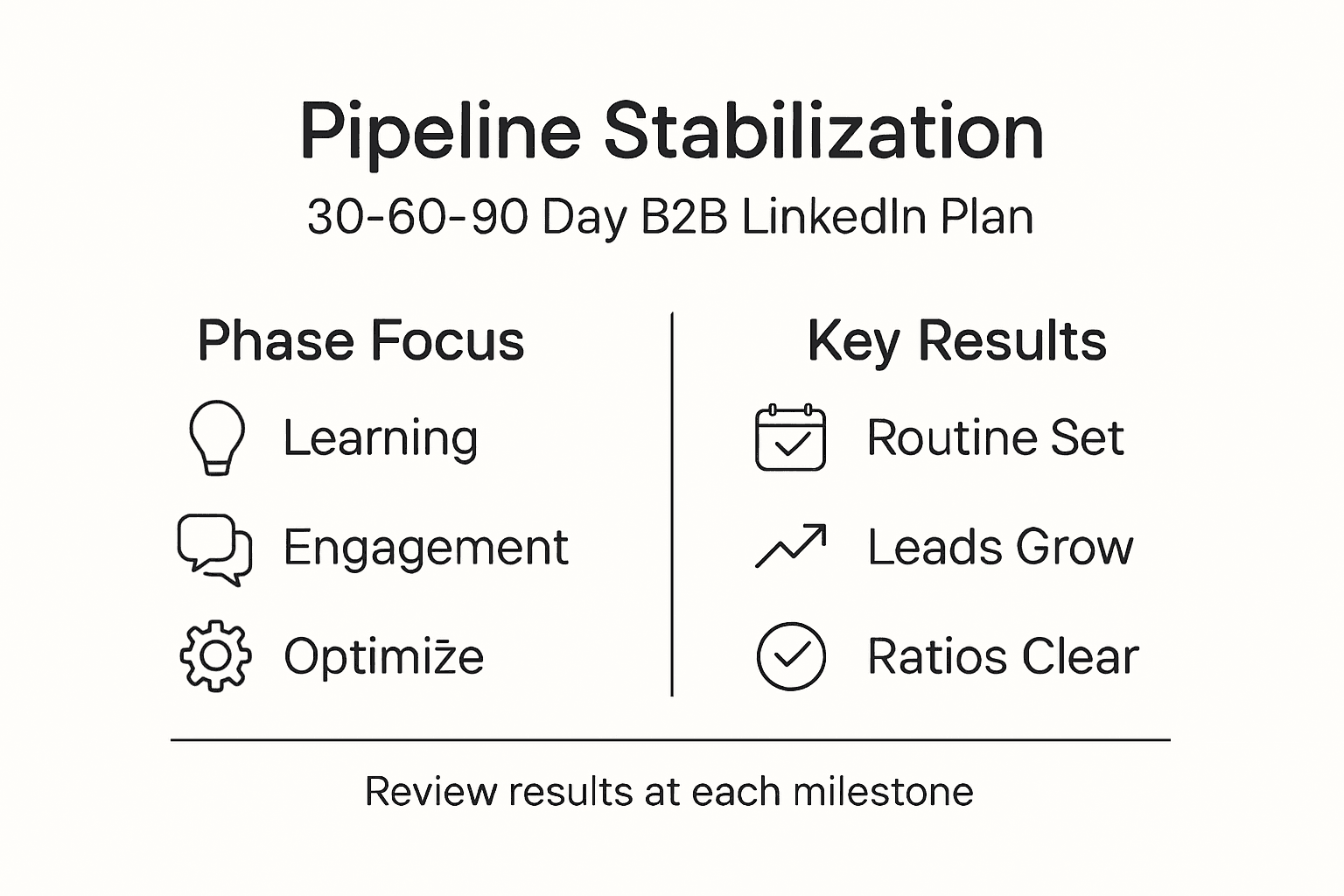
The first 30 days is your learning phase. You’re executing your rhythm consistently, but you’re not expecting major output results yet. A 30 to 60 to 90 day plan provides a phased framework focusing on learning and integration in the initial 30 days, strategic engagement in the next 30, and optimization in the final 30. During week one through four, your focus is entirely on establishing your rhythm and documenting everything. Are you having your 10 conversations per week? Are you publishing your content? Are you engaging consistently? You’re building the habit and the system. You’re not worrying about outcomes. In fact, you might have zero meetings scheduled at the end of week four, and that’s completely normal. You have 60 days of lead time before those conversations typically convert to meetings. So the conversations you’re having right now in weeks one through four are not expected to produce meetings yet.
Weeks five through eight are your strategic engagement phase. You’re maintaining your rhythm, but now you’re also beginning to notice patterns. Which types of conversations seem to progress further? Which people are responding most frequently? Which topics or conversation starters generate replies? You’re not changing your core system yet, but you’re gathering intelligence. You’re also likely beginning to see your first meetings scheduled from conversations you had in weeks one through four. This is when founders often get excited and think they’ve figured it out. But resist the urge to overhaul anything. You’re still in the learning phase. You have two more weeks of data before any real patterns emerge.
Weeks nine through twelve are your optimization phase. Now you have 90 days of data. Your conversion ratios should be stabilizing. You know roughly how many conversations produce meetings. You know which types of outreach work best. You know your actual pipeline velocity. By managing expectations and focusing on key metrics over this 30 to 60 to 90 day period, organizations create predictable sales activity and stabilize pipeline performance. This is when you can make informed adjustments. Maybe you notice that conversations initiated on Wednesday get 15 percent more responses than Monday conversations, so you shift your outreach day. Maybe you notice that certain industries convert at twice the rate of others, so you tighten your ICP further. Maybe you realize you can have 12 conversations per week instead of 10 without sacrificing quality. These adjustments are only valid because you have real data backing them up.
The critical mistake founders make is trying to optimize before day 90. They run their rhythm for three weeks, see mediocre results, panic, and completely change their approach. This ensures they never gather enough data to know what actually works. The 30 to 60 to 90 day framework protects you from this mistake. It gives you permission to stay consistent even when results look slow. It gives you a timeline that acknowledges the lag between effort and outcome. It tells you exactly when you should expect things to stabilize and when you should expect your pipeline to become genuinely predictable. After day 90, if you’ve maintained consistent inputs, your pipeline should feel less like chaos and more like math. You’ll know what to expect because you have 90 days of real data proving it.
Below is a summary of the 30-60-90 day framework for pipeline stabilization:
| Phase | Focus | Expected Outcome |
|---|---|---|
| First 30 Days | Build habits, document | System, not outputs |
| 30-60 Days | Analyze patterns | See initial conversions |
| 60-90 Days | Optimize system | Stable deal flow, clarity |
Pro tip: Mark day 30, day 60, and day 90 on your calendar right now and schedule a review session for each milestone. Document your inputs, your conversation ratios, and your output metrics at each checkpoint so you can see the exact moment your pipeline stabilizes.
Step 6: Prioritize pipeline predictability over short term spikes
By now, you understand that LinkedIn growth is built on systems, not moments. The final mindset shift is learning to value predictability over the allure of short term spikes. This is where many founders derail their own success. They see an opportunity to land a big deal quickly or close a massive contract, and they abandon their system to chase it. They sacrifice the consistency that was building their predictable pipeline for the promise of immediate results. Six months later, they wonder why their pipeline is empty again.
Short term spikes feel good. They generate excitement. They look impressive on a monthly report. But they come at a cost. Focusing on short term revenue spikes can lead to sales debt, where companies gain temporary gains but suffer from poor customer fit and operational burdens later. When you deviate from your system to chase a quick win, you often end up with customers who were not truly qualified. They seemed ready to buy, but they did not fit your product or your model. Now you have a customer you have to support, operations become more complicated, and your team gets distracted. Meanwhile, the consistent system you were building gets abandoned, so your pipeline dries up. You traded long term predictability for short term chaos.
Predictability is harder to celebrate than a spike. There is nothing flashy about having 10 conversations per week, every week, for 90 days straight. There is nothing exciting about the moment your conversion ratios stabilize at 1 meeting per 5 conversations. But here is what predictability gives you that spikes never will: the ability to plan. When your pipeline is predictable, you can forecast revenue with confidence. You can hire salespeople knowing they will have a steady stream of qualified opportunities. You can plan marketing budgets knowing what your customer acquisition cost actually is. You can make strategic decisions based on data instead of hope. A predictable pipeline that generates 3 to 5 qualified deals per month is worth infinitely more than a pipeline that randomly generates 10 deals one month and zero the next.
Consider the founder who gets excited because they had 15 conversations in one week instead of their normal 10. They think this is progress, so they try to maintain 15 conversations the following week. But they cannot sustain it while maintaining quality. By week three, they are burned out and drop back to 5 conversations per week. Their pipeline collapses because consistency was broken. Compare this to the founder who commits to 10 conversations per week, hits it every single week, and knows exactly what output to expect. After 90 days, they have a predictable formula. They know roughly how many meetings they will have, how many opportunities will be in their pipeline, and when deals will close. This founder can actually plan their business.
The trap is thinking that predictability is boring and spikes are where real growth happens. In reality, the opposite is true. A predictable system compounds over time. Month one, you have 10 deals in your pipeline. Month two, with consistent inputs, you have 15. Month three, you have 22. Not because you worked harder, but because your system is generating steady outputs while your previous deals are still progressing. This compound growth is far more powerful than a spike that creates temporary volume followed by a dry spell.
The practical decision point is this: when you are tempted to break your rhythm to chase a short term opportunity, stop and ask yourself whether this opportunity aligns with your qualified customer profile. If it does, you can incorporate it into your system without breaking your inputs. If it does not, walking away is the stronger move. You are protecting the predictability that will actually sustain your growth. You are choosing the system over the spike. You are choosing compounding long term success over temporary short term validation.
Pro tip: Commit publicly to your weekly input goals and measure them consistently so you are not tempted to sacrifice them for random opportunities. When you treat your rhythm as non-negotiable, spikes become irrelevant because your baseline is already strong.
Build a Predictable LinkedIn Pipeline with Proven Systems
The challenge of turning LinkedIn outreach into a steady predictable pipeline is more common than you think. This article highlights the pain points of inconsistent qualification, missing data-driven feedback loops, and the danger of chasing unpredictable short-term spikes. If you are aiming to break free from reactive cycles and finally control your pipeline inputs and outputs, you need a system designed around trust-first conversations and measurable weekly inputs.
At Pursuitz, we specialize in helping B2B founders and leadership teams build exactly this kind of sustainable LinkedIn growth. Our approach leverages hyper-personalized outreach combined with founder-led personal branding and consistent content distribution. This is not about generic lead generation or quick wins—it is about establishing a repeatable rhythm that leads to predictable deal flow over 90 days and beyond. If you want to protect your time, avoid burnout, and reliably forecast your sales, explore how our system can empower your pipeline.
Take the next step now and discover how to transform your LinkedIn strategy from random activity into a measurable growth engine at Pursuitz. Start building predictability today by focusing on the inputs that truly drive results with our proven methodology. Don’t wait for luck or short-term spikes—choose consistent, founder-led growth that scales.
Frequently Asked Questions
How can I identify the failures in my LinkedIn pipeline?
To identify failures in your LinkedIn pipeline, audit your current outreach methods and qualification criteria. Document the entry points to your pipeline and note any inconsistencies in how leads are qualified. Start by reviewing your last 10 conversations for discrepancies in how team members evaluate potential leads.
What are the key actionable inputs I should track for my LinkedIn strategy?
Focus on tracking specific activities such as the number of personalized messages sent, the number of meaningful conversations initiated, and the frequency of content shared. By documenting these inputs, you can gain clarity over what actions drive your pipeline forward. Aim to track these inputs weekly for at least 60 days to establish a baseline.
How often should I engage with potential leads on LinkedIn?
You should create a consistent outreach rhythm that allows for engagement multiple times a week. Aim to have 10 meaningful conversations and regularly publish valuable content to keep your audience engaged. Establish a schedule that includes engaging with posts and initiating conversations at set times each week to build trust and familiarity.
How do I correlate conversation volume with deal flow in my pipeline?
To correlate conversation volume with deal flow, consistently track the results of your conversations over time. After establishing a rhythm of 10 qualified conversations per week, analyze how many convert into meetings and deals. Document these ratios to predict future deal flow and understand how well your efforts translate into results.
What should I focus on during the 30 to 60 to 90-day stabilization period?
In the first 30 days, focus on maintaining your outreach routine and documenting your efforts. The next 30 days should involve analyzing patterns in your conversations, while the final 30 days focus on optimizing your system based on the data collected. Giving your strategy 90 days will help stabilize your pipeline and reveal actionable insights for growth.
How can I prioritize predictability over short-term gains?
To prioritize predictability, commit to a set number of weekly inputs and avoid altering your system for immediate opportunities. Maintain a consistent outreach schedule, as this builds long-term relationships and fosters reliability in your pipeline. Remember, a consistent system that generates steady growth is more valuable than spontaneous spikes in activity.