

Every B2B leader knows the frustration of seeing personalized LinkedIn outreach fall flat, no matter how carefully a name or job title is inserted. Relying on automation or basic templates often leads to messages that feel impersonal, disconnected, and easily ignored. Contextual relevance is what truly separates successful outreach from wasted effort, with research highlighting that human-facing communications need more than surface-level personalization to earn trust and spark real engagement.
Table of Contents
- Why Most LinkedIn Personalization Fails
- Automation Vs Contextual Relevance in Outreach
- Crafting LinkedIn Messages That Truly Matter
- How Trust Builds Before The First Reply
- Long-Term Scaling Through Relevance
Key Takeaways
| Point | Details |
|---|---|
| True Personalization Matters | Personalization is about creating authentic connections rather than superficial details. Understanding the recipient’s journey is key to meaningful communication. |
| Quality Over Quantity | Prioritize meaningful interactions over mass messaging to foster genuine professional relationships. Each connection should represent potential collaboration. |
| Build Trust Gradually | Trust is cultivated through consistent engagement and authentic value exchange before direct outreach. Invest time in understanding others’ professional narratives. |
| Strategic Scaling Is Essential | Scaling connections requires maintaining contextual relevance while expanding. Develop systems that enable personalized communication at scale. |
Why Most LinkedIn Personalization Fails
Personalization on LinkedIn has become a misunderstood art form, where professionals mistake superficial details for genuine connection. Most attempts at personalization fail because they fundamentally misunderstand human interaction, treating messages like mechanical data insertion rather than meaningful dialogue.
Research reveals that current personalization models often produce counterproductive results. Large language model personalization challenges demonstrate that naive approaches can create responses worse than generic communication. These models typically solve tasks objectively without truly understanding individual user preferences, leading to messages that feel robotic and disconnected.
The core problem stems from a fundamental misunderstanding of what true personalization represents. It’s not about inserting someone’s name or job title into a template, but creating a genuine connection that shows authentic interest. Contextual relevance requires deep understanding of the recipient’s professional journey, current challenges, and potential aspirations.
Most LinkedIn outreach fails because it prioritizes volume over quality, treating connections as transactional interactions rather than potential relationship building. Responsible personalization requires balancing communication benefits with nuanced understanding of individual professional contexts.
Here’s a comparison of LinkedIn outreach approaches:
| Approach | Key Characteristics | Typical Result |
|---|---|---|
| Mass Automation | Bulk messages, template-driven | Low engagement, feels impersonal |
| Basic Personalization | Inserts names/titles, surface info | Often ignored, lacks depth |
| Contextual Relevance | References unique experiences | Higher reply rates, builds trust |
| Relationship Building | Focuses on mutual value | Fosters collaboration, long-term |
Pro tip: Before sending any LinkedIn message, spend 10 minutes genuinely researching the person’s professional background and identifying a specific, meaningful point of authentic connection.
Automation Vs Contextual Relevance in Outreach
The battle between automation and contextual relevance represents a critical inflection point in modern professional networking. While automation promises efficiency, it simultaneously threatens to strip away the nuanced human connections that truly drive meaningful professional relationships.
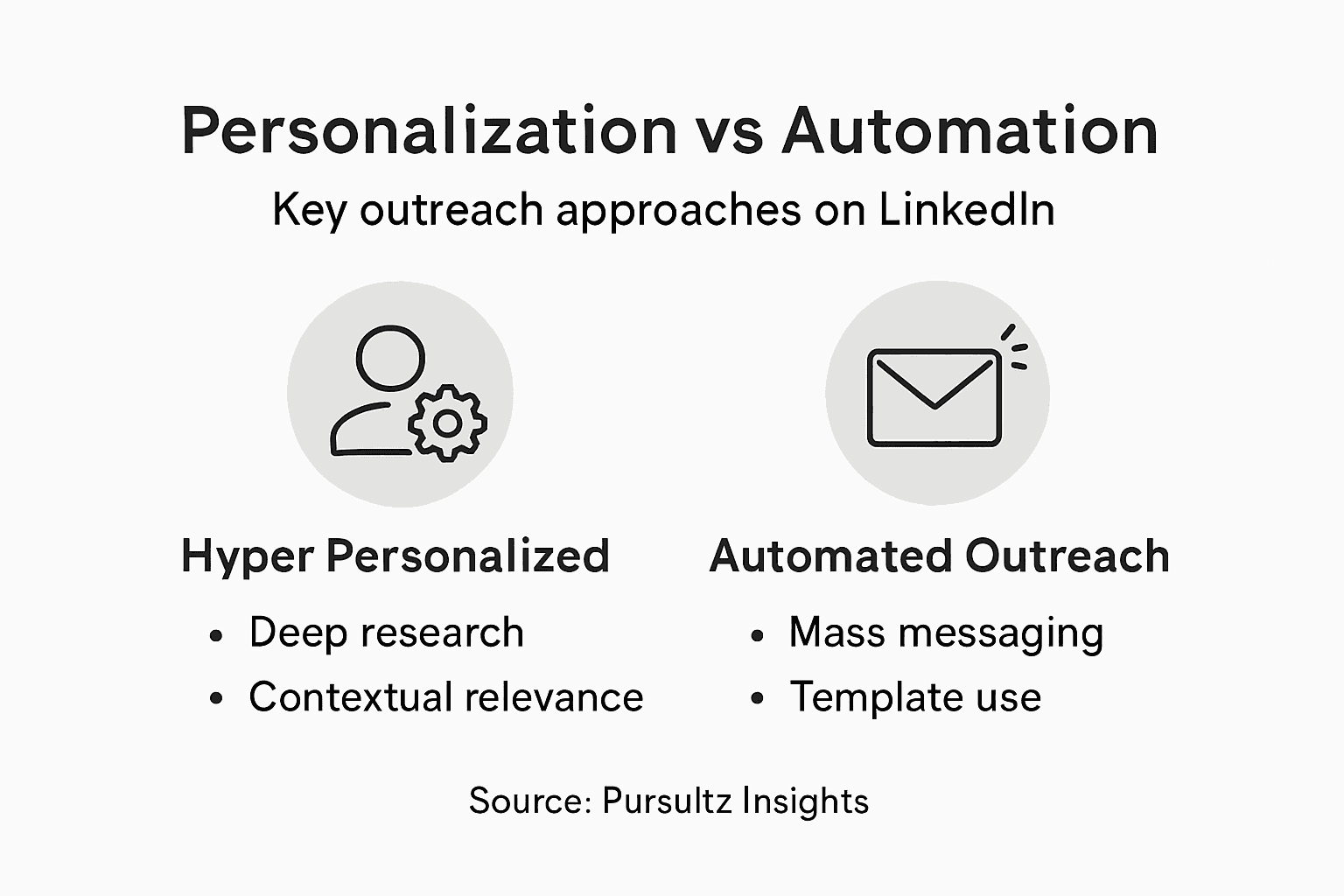
Automated outreach typically follows a predictable pattern: standardized templates, mass messaging, and generic connection requests that blend into the digital noise. These approaches treat professionals like data points rather than complex individuals with unique professional journeys. Retrieval-augmented generation strategies highlight how critical context becomes when attempting to create genuine professional connections, revealing that pure automation often produces mechanically irrelevant communications.
Contextual relevance demands a radically different approach. Instead of treating LinkedIn as a volume game, successful professionals understand that each connection represents a potential collaborative opportunity. This means investing time to understand a prospect’s professional narrative, recent achievements, shared connections, and potential mutual interests. Sophisticated outreach isn’t about sending more messages, but sending the right message to the right person at the right moment.

The fundamental problem with most automation tools is their inability to capture nuanced professional context. They optimize for quantity over quality, generating messages that sound robotic and impersonal. True professional networking requires emotional intelligence, genuine curiosity, and the ability to craft communications that demonstrate authentic interest beyond superficial data points.
Pro tip: Create a personalized research template that helps you systematically capture unique professional context before reaching out, ensuring every message feels individually crafted and genuinely relevant.
Crafting LinkedIn Messages That Truly Matter
Crafting meaningful LinkedIn messages is an art form that transcends simple communication—it’s about building genuine professional relationships that create lasting impact. The most powerful messages are not about selling, pitching, or self-promotion, but about creating authentic connections that demonstrate real understanding and value.
Storytelling becomes the critical mechanism for transforming generic outreach into memorable interactions. Effective LinkedIn communication hinges on messages that tell a compelling narrative, highlight problem-solving experiences, and showcase genuine professional curiosity. Instead of recycling templated approaches, successful professionals construct messages that feel like personalized conversations, not automated scripts.
The anatomy of a message that truly matters involves several strategic components. First, demonstrate that you’ve invested time understanding the recipient’s professional journey. This means referencing specific achievements, recent publications, or shared professional interests that show you’re not just scanning a profile, but genuinely interested in their work. Second, provide clear value—whether through insights, resources, or a thoughtful perspective that advances their professional objectives. Third, maintain a tone of collaborative potential, positioning your message as an opportunity for mutual growth rather than a transactional interaction.
Professional networking on LinkedIn requires emotional intelligence and strategic vulnerability. Optimizing professional outreach means understanding that every message is an opportunity to build trust, demonstrate expertise, and create meaningful professional connections. The most impactful messages are those that make the recipient feel seen, understood, and potentially excited about future collaboration.
Pro tip: Before sending a LinkedIn message, ask yourself: “Would I be genuinely interested in receiving this message if someone sent it to me?”
How Trust Builds Before the First Reply
Trust is not a destination—it’s a carefully cultivated journey that begins long before any direct conversation takes place. Professional relationships on LinkedIn are built through strategic, intentional interactions that demonstrate genuine interest and authentic value.
Authentic outreach strategies reveal that trust develops through consistent, curiosity-driven engagement that respects the recipient’s professional context. This means moving beyond transactional networking and creating meaningful touchpoints that showcase your understanding of their challenges, achievements, and professional trajectory. Psychological triggers like reciprocity emerge when professionals demonstrate they’ve invested time understanding another’s unique professional narrative.
The trust-building process involves a nuanced approach of subtle, value-added interactions. This might include thoughtful comments on their posts, sharing relevant insights that advance their professional interests, or highlighting connections between their work and broader industry trends. LinkedIn engagement techniques emphasize the importance of warm-up sequences that normalize your presence in their professional ecosystem before making any direct outreach.
Successful trust development requires patience and strategic vulnerability. It’s about creating a narrative of reliability, expertise, and genuine collaborative potential—transforming yourself from a random connection request into a meaningful professional ally. The goal is not immediate conversion, but establishing a foundation of mutual respect and potential future collaboration.
The following table summarizes essential steps in building trust before direct outreach:
| Trust-Building Step | Description | Impact on Networking |
|---|---|---|
| Observe & Engage | Follow and interact with posts | Warms up connections |
| Share Value | Offer insights relevant to recipient | Demonstrates expertise |
| Appreciate Achievements | Acknowledge milestones or contributions | Establishes genuine interest |
| Consistent Presence | Engage regularly, not just once | Builds reliability |
Pro tip: Spend 15 minutes daily engaging authentically with your network’s content before attempting any direct outreach, creating a track record of meaningful interactions.
Long-Term Scaling Through Relevance
Scaling professional relationships on LinkedIn is not about increasing volume, but about maintaining genuine contextual relevance as your network expands. The most successful professionals understand that growth is a deliberate, strategic process that prioritizes quality interactions over sheer connection numbers.
LinkedIn outreach scaling strategies reveal that sustainable growth requires a nuanced approach balancing intelligent automation with authentic personalization. Dynamic data utilization becomes critical—leveraging real-time insights to ensure each interaction feels thoughtfully crafted, not mechanically generated. This means developing systems that can dynamically adapt messaging based on evolving professional contexts, rather than relying on static templates.
The fundamental challenge in scaling lies in maintaining individual relationship quality while expanding network reach. Successful professionals create structured outreach frameworks that allow for personalized communication at increasing volumes. This involves developing intelligent segmentation strategies, creating adaptive communication protocols, and continuously refining engagement approaches based on granular performance analytics.
Sustainable outreach systems emphasize patience and consistent value delivery. Scaling is not about aggressive expansion, but about creating a reputation as a trusted, insightful professional who provides meaningful connections. This requires developing a repeatable methodology that respects platform guidelines, maintains high-quality interactions, and builds long-term professional credibility.
Pro tip: Create a detailed tracking system that monitors not just connection rates, but the depth and quality of professional interactions to ensure your scaling efforts maintain authentic relevance.
Unlock True Connection with Hyper Personalized LinkedIn Outreach
The article highlights a critical challenge many professionals face on LinkedIn: the failure of superficial personalization and automated messages that lack genuine context. You understand the frustration of sending countless messages only to receive low engagement and robotic replies. The key lies in adopting contextual relevance, building trust before the first reply, and crafting communications that showcase authentic interest in the recipient’s unique professional journey.
At Pursuitz, we specialize in helping B2B founders and leadership teams overcome these exact challenges by designing hyper-personalized LinkedIn outreach systems. Our approach focuses on trust-first conversations supported by founder-led personal branding and consistent content distribution. By prioritizing quality and genuine connections over volume, we enable predictable deal flow without relying on email outreach, paid ads, or generic lead generation tactics. Discover how you can transform your LinkedIn networking strategy with proven insights from our main landing page and learn about creating systems that respect individual professional contexts.
Ready to stop wasting time on hollow outreach and start building meaningful relationships that accelerate your business growth Every connection matters when paired with the right strategy Explore how Pursuitz can help you scale authentic LinkedIn engagement that converts. Visit our site now and take your professional networking to the next level.
Frequently Asked Questions
What is hyper personalized LinkedIn outreach?
Hyper personalized LinkedIn outreach refers to crafting messages that go beyond basic personalization, focusing on genuine connections by understanding the recipient’s unique professional journey, challenges, and aspirations.
Why do most LinkedIn personalization efforts fail?
Most LinkedIn personalization efforts fail because they often rely on superficial details or standard templates, lacking the depth needed to create meaningful connections that resonate with recipients.
How can I ensure my LinkedIn messages feel genuinely personalized?
To ensure your LinkedIn messages feel genuinely personalized, invest time in researching your recipient’s background, reference specific achievements or experiences, and offer real value that aligns with their professional goals.
What are some benefits of contextual relevance in LinkedIn outreach?
Contextual relevance in LinkedIn outreach leads to higher engagement rates, builds trust, and fosters long-term relationships by focusing on mutual interests and creating collaborative opportunities.