

Every B2B leader knows that connecting with the right decision-makers is harder than ever in today’s crowded digital space. Traditional cold emailing and phone calls quickly fall flat, while generic outreach rarely sparks meaningful conversations. The real opportunity lies in building trust through professional networking on LinkedIn, allowing you to engage precisely with industry-specific prospects and create authentic business relationships. This approach transforms transactional selling into a proven pathway for stronger deal flow by focusing on relevance, expertise, and relationship depth.
Table of Contents
- Defining LinkedIn Lead Generation For B2B
- Trust Dynamics In Complex B2B Sales
- When Relationship-Driven Outreach Delivers Results
- Limitations For Transactional B2B Markets
- Comparing LinkedIn With Other Lead Strategies
Key Takeaways
| Point | Details |
|---|---|
| B2B Lead Generation Shift | LinkedIn emphasizes quality connections over quantity, transforming lead generation into relationship-driven outreach. |
| Trust in Sales | Building trust is essential in complex B2B transactions, requiring ongoing communication and demonstrated expertise. |
| Market Context Matters | Differentiate between relationship-driven and transactional approaches based on market dynamics to align strategies effectively. |
| LinkedIn Advantages | The platform offers superior targeting and access to decision-makers, making it ideal for nuanced, professional engagement. |
Defining LinkedIn Lead Generation for B2B
LinkedIn lead generation for B2B represents a strategic approach to identifying, engaging, and converting potential business clients through professional networking platforms. Unlike traditional sales methods, this process leverages digital relationship building and targeted outreach to connect decision-makers across industries.
The core of LinkedIn lead generation involves several key strategic components:
- Precise audience identification
- Personal brand development
- Content-driven relationship establishment
- Trust-first engagement protocols
- Strategic connection management
Modern B2B lead generation has fundamentally transformed, moving beyond generic mass outreach toward data-driven relationship strategies. Professionals now recognize that quality connections matter significantly more than quantity, requiring a nuanced approach to digital networking.
Traditional sales strategies often relied on cold calling and generic email campaigns. LinkedIn lead generation represents a sophisticated alternative, enabling professionals to:
- Target specific industry segments
- Build credible professional personas
- Demonstrate expertise through consistent content
- Create meaningful professional relationships
- Generate high-quality prospect interactions
The platform’s unique strength lies in its ability to provide contextual professional information, allowing for hyper-targeted engagement strategies. Unlike generic social media platforms, LinkedIn offers rich professional data that enables precise prospect targeting and relationship development.
Here’s a summary comparing traditional B2B lead generation methods and LinkedIn-based approaches:
| Dimension | Traditional Methods | LinkedIn Approach |
|---|---|---|
| Target Audience | Broad, untargeted masses | Specific, industry segments |
| Outreach Method | Cold calls, email blasts | Personalized, direct messages |
| Relationship Creation | Transactional, surface | Deep, ongoing engagement |
| Data Utilization | Limited information | Rich professional profiles |
| Conversion Quality | Quantity over quality | Quality over quantity |
LinkedIn lead generation transforms cold outreach into warm, trust-based professional conversations.
Professional networking on LinkedIn requires understanding complex relationship dynamics. Successful practitioners focus on providing genuine value, sharing insights, and creating meaningful connections rather than pursuing transactional interactions.
Pro tip: Develop a consistent personal brand narrative that authentically represents your professional expertise and value proposition.
Trust Dynamics in Complex B2B Sales
In the intricate landscape of business-to-business sales, trust represents the foundational element that transforms potential transactions into meaningful, long-term professional relationships. Unlike simple consumer interactions, complex B2B sales require deep, multifaceted trust dynamics that extend far beyond initial monetary exchanges.
Trust building in complex sales environments involves several critical dimensions:
- Demonstrating technical competence
- Maintaining consistent communication
- Delivering predictable outcomes
- Showing genuine understanding of client challenges
- Proving ethical and transparent business practices
Psychological components of trust reveal that buyers seek more than surface-level interactions. They want strategic partners who comprehend their nuanced business challenges and can provide sophisticated, contextually relevant solutions.
Complex B2B sales typically involve multiple stakeholders, each with unique perspectives and decision-making criteria. Successful trust development requires a strategic approach that addresses both rational and emotional elements of professional relationships.
Key trust-building strategies include:
- Transparent communication protocols
- Consistent performance documentation
- Proactive problem-solving demonstrations
- Long-term value orientation
- Authentic relationship management
Genuine trust emerges through consistent actions, not merely declarative statements.
Professional credibility becomes the primary currency in these intricate sales environments. Buyers continuously assess potential partners through multiple lenses, evaluating technical expertise, reliability, and alignment with their strategic objectives.

Pro tip: Develop a comprehensive trust portfolio that systematically documents your past successes, client testimonials, and measurable performance metrics.
When Relationship-Driven Outreach Delivers Results
Relationship-driven outreach transcends traditional sales techniques by prioritizing genuine connection and strategic engagement over transactional interactions. In complex B2B environments, this approach transforms prospecting from a numbers game into a nuanced process of building meaningful professional partnerships.
Relationship-driven strategies demonstrate remarkable effectiveness through several key characteristics:
- Prioritizing long-term connections over immediate sales
- Focusing on mutual value creation
- Understanding deeper client context
- Developing trust through consistent interactions
- Delivering personalized engagement experiences
Strategic partnership dynamics reveal that organizations investing in relationship-building consistently outperform those relying on traditional cold outreach methods. These sophisticated approaches recognize that modern business decisions emerge from complex interpersonal networks and deep understanding.
Successful relationship-driven outreach requires professionals to develop comprehensive engagement frameworks that transcend surface-level interactions. This means cultivating deep market intelligence, demonstrating authentic expertise, and consistently delivering insights that create tangible value for potential partners.
Key components of effective relationship-driven approaches include:
- Comprehensive prospect research
- Personalized communication strategies
- Continuous value demonstration
- Strategic network expansion
- Sustained engagement protocols
Meaningful relationships are built through consistent, valuable interactions, not sporadic transactional attempts.
Professional networking becomes a strategic mechanism for understanding market dynamics, identifying opportunities, and creating sustainable business ecosystems. By shifting from transaction-focused to relationship-centered approaches, organizations can develop more resilient and profitable business development strategies.
Pro tip: Develop a systematic approach to tracking and nurturing professional relationships, treating each interaction as an opportunity for mutual growth and understanding.
Limitations for Transactional B2B Markets
Transactional B2B markets operate fundamentally differently from relationship-driven environments, presenting unique challenges for LinkedIn-based lead generation strategies. These markets prioritize speed, volume, and immediate conversion over nuanced relationship building, creating inherent friction with more sophisticated networking approaches.
Transactional market characteristics that limit LinkedIn’s effectiveness include:
- Extremely short sales cycles
- Minimal requirement for deep vendor relationships
- High emphasis on price and immediate value
- Standardized product/service offerings
- Low complexity in decision-making processes
B2B marketing transformation insights reveal that transactional markets demand rapid, scalable, and automated lead generation strategies that LinkedIn’s relationship-focused platform struggles to accommodate efficiently.
Companies operating in transactional B2B contexts typically require lead generation methods that can quickly identify, qualify, and convert potential customers with minimal interaction. LinkedIn’s deliberate, connection-building approach can become a significant impediment in environments where decisiveness and speed are paramount.
Key limitations of relationship-driven approaches in transactional markets include:
- Slower conversion rates
- Higher customer acquisition costs
- Reduced scalability
- Increased time investment per prospect
- Misalignment with market expectations
Transactional markets reward speed and efficiency, not relationship depth.
Market segmentation becomes critical in understanding where LinkedIn-based strategies may underperform. Businesses must carefully assess their specific market dynamics to determine whether relationship-driven approaches align with their sales infrastructure and customer acquisition goals.
The following table highlights when to favor relationship-driven versus transactional lead generation strategies:
| Context Type | Best Approach | Rationale |
|---|---|---|
| Complex B2B Sales | Relationship-driven | Multiple stakeholders, trust |
| Transactional B2B | Transactional-focused | Fast cycles, minimal depth |
| Customized Solutions | Relationship-driven | Require deep discovery |
| Commodity Products | Transactional-focused | Standard offerings, speed |
Pro tip: Conduct a thorough market analysis to determine whether your B2B context demands relationship-driven or transaction-optimized lead generation strategies.
Comparing LinkedIn With Other Lead Strategies
LinkedIn lead generation represents a sophisticated approach distinct from traditional B2B prospecting methods, offering unique advantages and specific limitations across different market contexts. Understanding its comparative strengths requires a nuanced examination of various lead generation strategies and their respective performance characteristics.
Lead generation strategies can be compared through multiple dimensions:
- Targeting precision
- Relationship depth
- Cost per acquisition
- Scalability potential
- Engagement quality
- Professional context relevance
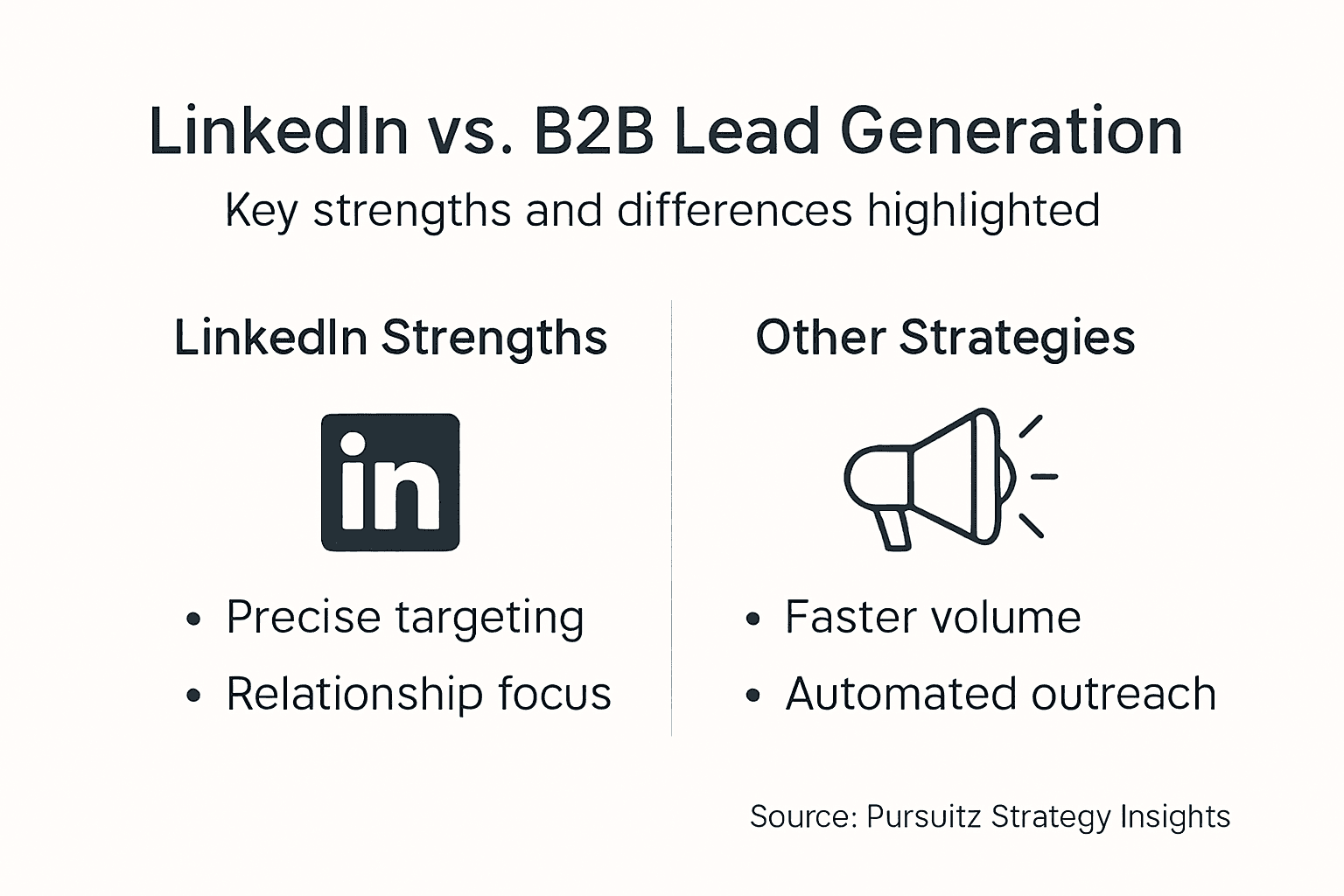
B2B lead generation insights demonstrate that LinkedIn provides superior targeting compared to traditional methods like cold calling, trade shows, and generic email campaigns. The platform’s professional networking infrastructure enables unprecedented access to decision-makers across diverse industries.
Compared to alternative strategies, LinkedIn distinguishes itself through sophisticated targeting capabilities and professional context. While email marketing offers volume and paid advertising provides broad reach, LinkedIn enables hyper-personalized, context-rich engagement that traditional channels cannot replicate.
Key comparative advantages include:
- Direct access to professional decision-makers
- Rich contextual professional data
- Built-in professional credibility signals
- Network-based referral potential
- Lower intrusion compared to cold outreach
Professional networking transcends transactional lead generation, creating meaningful connection pathways.
Strategic differentiation becomes critical when selecting lead generation approaches. Each method carries unique strengths, with LinkedIn excelling in relationship-driven, complex sales environments that require deep professional understanding and trust-based interactions.
Pro tip: Develop a multi-channel lead generation strategy that leverages LinkedIn’s relationship-building strengths while complementing other targeted outreach methods.
Unlock the Full Potential of LinkedIn Lead Generation for Your B2B Growth
If you recognize the challenges highlighted in this article such as building trust-based connections, managing complex relationship dynamics, and moving beyond transactional outreach then you are facing the exact hurdles that many B2B founders and leadership teams experience today. The pain points of slow conversions, high acquisition costs, and the need for personalized engagement require more than generic strategies. They demand a hyper-personalized, trust-first approach supported by consistent personal branding and strategic content distribution.
At Pursuitz, we specialize in designing LinkedIn growth systems that transform your outreach into predictable, measurable deal flow without relying on email blasts or paid ads. Our solution combines founder-led authenticity with data-driven systems to foster the deep, meaningful professional relationships essential for complex B2B sales. Ready to move beyond traditional lead generation and cultivate genuine partnerships that accelerate your business growth? Discover how our tailored approach can help you achieve this by visiting Pursuitz.
Explore how you can implement these strategies today and start building a sustainable pipeline that works for you. Visit Pursuitz now and take the first step towards transforming your LinkedIn lead generation into a strategic advantage.
Frequently Asked Questions
What is LinkedIn lead generation for B2B?
LinkedIn lead generation for B2B is the strategic process of identifying, engaging, and converting potential business clients through the LinkedIn platform. It emphasizes relationship building, targeted outreach, and leveraging professional networking to connect decision-makers across various industries.
How does LinkedIn lead generation differ from traditional B2B sales methods?
Unlike traditional methods such as cold calling and generic emails, LinkedIn lead generation focuses on personalized, trust-based interactions and deep relationship building, prioritizing quality connections over quantity.
What are the key components of effective LinkedIn lead generation?
Key components include precise audience identification, personal brand development, content-driven relationship establishment, trust-first engagement protocols, and strategic connection management to foster meaningful interactions.
When should businesses consider using a relationship-driven outreach strategy on LinkedIn?
Businesses should consider relationship-driven outreach when their sales processes are complex, involve multiple stakeholders, and rely on trust-based evidence of expertise, as this approach tends to yield higher-quality interactions and long-term partnerships.