
Choosing between LinkedIn outreach and cold email often feels like picking sides in a never-ending debate. For B2B founders aiming to build sustainable pipelines, this comparison overlooks the real issue—how each channel shapes trust, context, and relationship depth. Instead of isolated metrics, the key is building a predictable system where LinkedIn’s visible identity and credibility act as a trust accelerator and email supports follow-up once context is established. This article exposes why most channel comparisons miss what actually drives pipeline growth.
Table of Contents
- Why Most Channel Comparisons Miss The Point
- System-Level Structure: Email Vs LinkedIn Outreach
- Trust, Context, And Identity Visibility In Action
- Predictability Versus Volume In Pipeline Building
- Channel Fit: When LinkedIn Outperforms Email
- Relationship-Building Systems Vs Sequence Automation
Key Takeaways
| Point | Details |
|---|---|
| Understand Channel Differences | Recognize that LinkedIn and email serve different purposes; LinkedIn builds trust while email lacks recipient context. |
| Focus on Relationship Building | Shift from measuring response rates to cultivating meaningful relationships for long-term engagement and pipeline predictability. |
| Use Hybrid Strategies | Combine LinkedIn outreach with email follow-ups to enhance credibility and improve overall conversion rates. |
| Prioritize Context and Visibility | Create a system that leverages LinkedIn’s identity visibility to warm up prospects before sending cold email messages. |
Why Most Channel Comparisons Miss the Point
When B2B founders compare LinkedIn outreach to cold email, the conversation usually defaults to surface-level metrics. Open rates. Response rates. Cost per lead. Tools used. Speed of execution. These comparisons create the illusion of clarity, but they actually obscure what matters most: how these channels function within a complete system for building predictable pipelines.
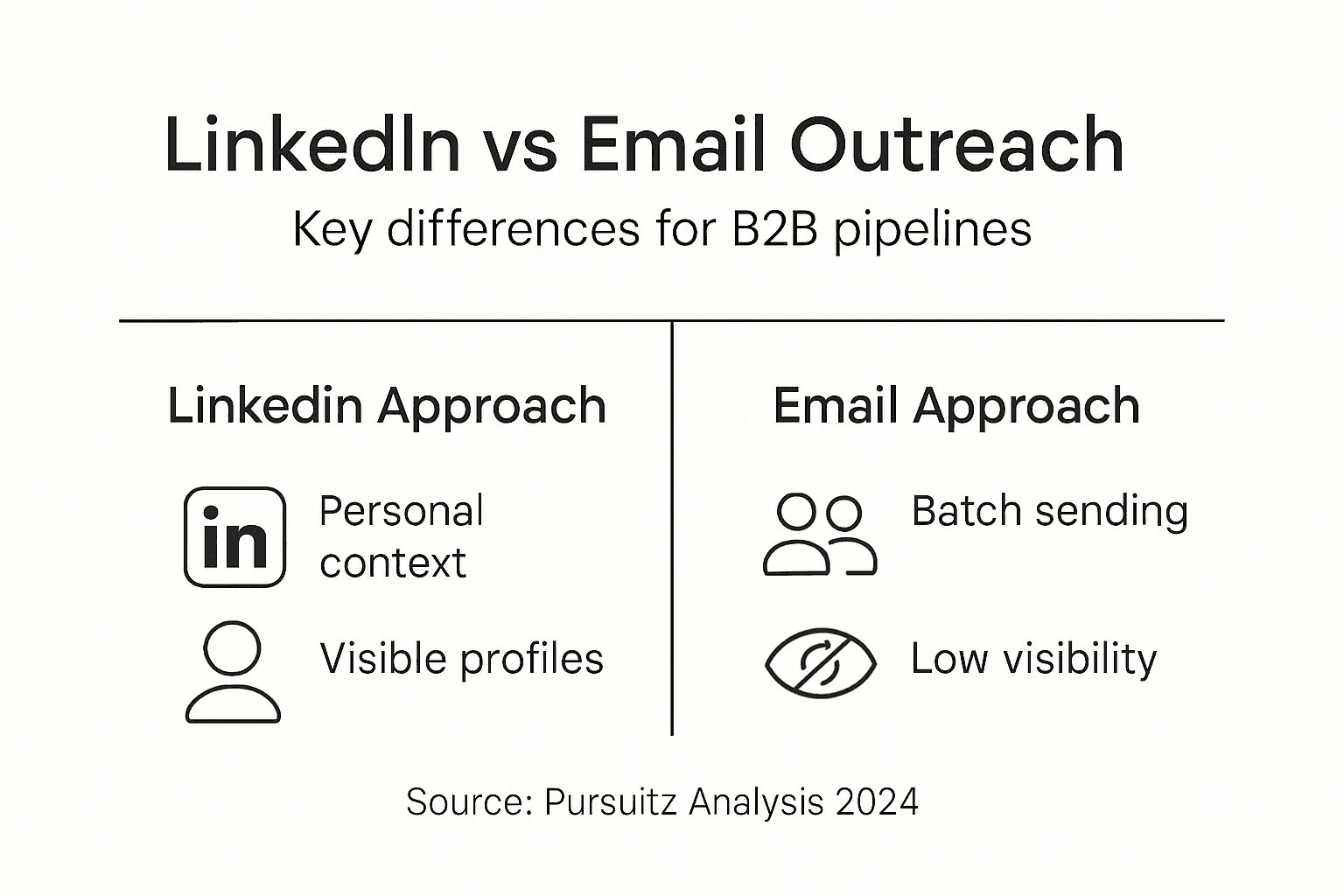
The fundamental problem with most channel comparisons is that they treat LinkedIn and email as interchangeable alternatives competing for the same job. They don’t. LinkedIn adds trust through visible professional profiles, while cold email arrives as text from an unknown sender with no context or social proof. This isn’t a minor difference in delivery mechanism. It’s a difference in how the recipient perceives legitimacy, intent, and whether the message deserves their attention. A prospect seeing your profile, company, mutual connections, and work history processes your message differently than a prospect opening an email from someone they’ve never heard of. The trust architecture is completely different.
Most comparisons also miss the role of sequencing. They measure individual channels in isolation rather than asking how channels work together over time. Research shows that hybrid strategies where LinkedIn conversations precede email conversations produce better results than using either channel alone. But this insight almost never appears in standard channel comparisons because those comparisons measure channel performance, not system performance. When you layer LinkedIn outreach first to establish context and credibility, then follow up through email, you’re not running two separate campaigns. You’re running one integrated system where the first touch builds framework for the second touch. The person recognizes you, has seen your profile, and now an email feels like a continuation of a real conversation rather than unsolicited noise.
There’s another layer here that gets overlooked: channel comparisons typically focus on short-term metrics while ignoring the relationship quality those channels produce. Email can generate fast responses and quick conversations, but those interactions often lack depth or genuine relationship foundation. LinkedIn conversations tend to develop more slowly, but they build on established professional context. For founders building sustainable B2B pipelines, the relevant question isn’t which channel converts faster. It’s which channel produces leads that stay engaged, trust your judgment, and become long-term customers. A lead generated through cold email might respond quickly but skeptically. A lead engaged through LinkedIn over several interactions arrives already positioned to listen because they’ve chosen to accept your connection and view your perspective.
The comparison framework also ignores intent and positioning. When you reach out on LinkedIn, you’re leveraging a platform designed for professional relationship building, so your outreach aligns with why the person is there. When you send cold email, you’re interrupting someone’s inbox with unsolicited sales content. The platform context matters. It shapes whether your message feels like a natural part of someone’s professional life or an intrusion into it. This positioning affects not just open rates, but the entire tone of the conversation that follows.
Pro tip: Instead of choosing between LinkedIn and email, design your system around what each channel does best: use LinkedIn to establish visibility, credibility, and genuine connection, then use email as a follow-up mechanism only after LinkedIn has created context. Measure the combined output of both channels working together, not their individual performance.
System-Level Structure: Email vs LinkedIn Outreach
When you map out how email campaigns and LinkedIn outreach actually function, you’re looking at two fundamentally different structures for moving a prospect from awareness to engagement. Email operates as a broadcast mechanism. You compose a message, load a list of addresses, and push that same content to many inboxes simultaneously. The system treats recipients as database entries. Success means hitting inbox placement targets, achieving open rates above benchmarks, and converting responders into conversations. The structure assumes scale through volume: more sends equals more responses.
LinkedIn outreach operates as a relationship mechanism. Each message is sent to a specific person whose professional context you can see, understand, and reference. You’re not broadcasting identical content to a list. You’re initiating individual conversations where you demonstrate knowledge of that person’s role, company, recent activity, or professional situation. The system treats prospects as individual humans with specific contexts. Success means building genuine connection points that make someone want to respond because they see mutual relevance. The structure assumes scale through personalization depth, not volume multiplication.

These structural differences ripple through every stage of the interaction. In email, the prospect arrives with minimal context about you. They see a sender name, a subject line, and whatever you wrote. They must decide whether to trust you based on credentials in a signature block or company domain. Your credibility lives in copy. In LinkedIn, the prospect sees your profile before reading your message. They can verify your role, your company, your work history, mutual connections, content you’ve posted, and how long you’ve been active in your field. Your credibility is embedded in platform structure itself. The message is context-reinforced before it’s even read.
Email campaigns operate on batch timing. You send to your entire list on Tuesday at 10 a.m., and responses arrive in predictable waves. You batch follow-ups. You batch analysis of what worked. This creates efficiency for the sender but also creates a distinct pattern recognizable to recipients: they know when and how they were reached. LinkedIn outreach operates on individual timing. You send messages throughout your week at different times to different people. You follow up with individuals when they engage or when relevant moments occur (they post content, change jobs, publish something relevant to your solution). This lack of batch pattern makes the interaction feel less like a campaign and more like a real conversation.
The verification loop works differently too. Email offers no built-in proof that you are who you claim to be. Spoofing is possible. Generic templates are standard. Recipients approach email skepticism-first because they’ve been trained by years of phishing attempts and spam. LinkedIn includes verification through the platform itself. Your profile is public. Your endorsements and recommendations are visible. Your activity history is trackable. This doesn’t guarantee trustworthiness, but it shifts the default assumption from skepticism to curiosity.
Consider how objection handling differs. In email, when someone ignores you or declines your offer, there’s limited opportunity for nuanced follow-up. You can send a breakup email or a final reminder, but extended dialogue is awkward in the inbox context. On LinkedIn, you can continue engaging with someone’s content over weeks or months before your next direct message. You can comment on their posts, react to updates, build familiarity before attempting another conversation. This creates what you might call reciprocal legitimacy: they’re seeing you regularly, seeing your perspective, and gradually building their own sense of who you are.
One more structural reality: email requires active list management. You need accurate email addresses, you need to clean lists regularly, you need to manage bounce rates and complaints. LinkedIn requires active profile presence. Your profile must be complete and authentic, your engagement patterns must look genuine, and your messaging must reflect real interest in the person you’re contacting. Email’s friction is logistical. LinkedIn’s friction is relational.
Both structures can work. But they work toward different kinds of scale. Email scales through efficient delivery and volume response rates. LinkedIn scales through depth of relationship and quality of engagement. For B2B founders building pipelines that stay open and convert predictably over time, understanding these structural differences matters more than comparing response rates.
Here is a comparison of how email and LinkedIn outreach differ in core prospecting elements:
| Prospecting Element | Email Approach | LinkedIn Approach |
|---|---|---|
| Initial Trust | Low, sender unknown | High, profile visible |
| Personalization | Limited, often templated | High, context-driven |
| Timing | Batch sends to lists | Individual, event-driven |
| Relationship Depth | Transactional, short-lived | Relational, long-term |
| Verification Mechanism | Signature/company domain | Platform profile/content/activity |
Pro tip: Map your outreach system around LinkedIn’s relationship structure first (individual context, genuine personalization, authentic engagement), then use email selectively as a follow-up after you’ve established LinkedIn-based credibility rather than as your primary prospecting mechanism.
Trust, Context, and Identity Visibility in Action
Imagine two scenarios. In the first, you receive an email from someone named Alex Johnson at a company called Strategic Solutions. You don’t recognize the name. You don’t know the company. The email talks about a problem you face, but you have no way to verify whether Alex actually understands your business or is sending templated messages to hundreds of people. In the second scenario, you receive a message on LinkedIn from Alex Johnson. Before you read the message, you click his profile. You see he’s a VP at a software company serving your industry. You notice you have two mutual connections. You see he posted thoughtfully about a challenge similar to yours three weeks ago. You check his endorsements and see testimonials from recognizable names. Now when you read his message, you’re not reading it as an unknown pitch. You’re reading it as context-informed outreach from someone whose credibility is already partially established.
The difference between these two experiences is identity visibility. LinkedIn doesn’t just deliver a message; it delivers the messenger. Every person reaching out on LinkedIn carries their professional history, their network, their activity, and their digital footprint directly into the conversation. LinkedIn builds social proof through visible identity and network connections, making prospects more receptive to engagement before the actual conversation begins. This is not a minor advantage. This is a structural trust advantage that changes the baseline assumption of the person receiving your message.
When trust begins with identity visibility, the entire engagement dynamic shifts. The prospect doesn’t need to guess whether you’re legitimate. They can verify it themselves. They can see your work history, your company, how long you’ve been in your field, what content you’ve engaged with, and how others in your network have interacted with you. This doesn’t mean they automatically trust you, but it means they begin from a position of context clarity rather than context void. They know who you are before deciding whether what you’re saying matters. This context acts as a trust accelerant. A prospect who can verify your identity is more willing to engage in substantive conversation because there’s reduced risk. If this goes nowhere, they’ve simply had a professional interaction. If you’re offering something valuable, they have legitimate reason to believe you understand their world.
Context visibility works differently on LinkedIn than email. On email, you provide context through words you write. You explain your company, your background, why you’re reaching out. On LinkedIn, context is pre-loaded. The prospect already knows your company because it appears in your profile. They already know your role and background. They already know what you work on because they can see your activity. When you message someone on LinkedIn, you’re not introducing yourself; you’re starting a conversation with someone who has already formed a basic impression of you through platform-visible signals. This means your outreach message can skip the credibility building and move directly to relevance building. You don’t need to convince them you’re real. You can focus on why your message matters to them specifically.
Consider how this affects the warming process. When you engage with someone’s LinkedIn content over time, comment on their posts, react to their updates, you’re building cumulative legitimacy. They see your name repeatedly. They see your perspective on topics they care about. They watch you engage thoughtfully with their professional community. By the time you send them a direct message, you’re not a stranger. You’re someone whose viewpoint they’ve already encountered and evaluated. This accumulation of visibility works in your favor. They recognize your name. They have a sense of your perspective. They’ve already implicitly vetted you by noticing you engage substantively in their professional space. When cold email arrives, none of this precedes it. Every outreach starts from zero visibility.
Identity visibility also changes how objections are handled. When someone on LinkedIn seems hesitant or doesn’t respond immediately, you can continue building relationship through content engagement, public interactions, and gentle follow-ups that don’t feel intrusive. They continue seeing you in their feed. They notice you’re consistent and thoughtful. They watch how you interact with others. This creates opportunities for relationship deepening that don’t exist in email. Email has limited pathways for continued engagement after initial rejection. LinkedIn has unlimited pathways because the platform itself facilitates ongoing visibility and interaction.
There’s a psychological component here worth noting. When prospects know they’re being seen and verified, they apply different standards to your outreach. They assume you’ve done your research, that you understand their context, that this isn’t a mass spray. They’re right. Because on LinkedIn, you demonstrably have done research. You can see their profile. You know their role. You can reference their recent activity. You can see the company they work for. Email doesn’t offer this window, so prospects assume the worst: that you’re blasting hundreds of similar messages hoping something sticks. The platform structure itself creates different baseline assumptions about your intent.
Pro tip: Before sending any LinkedIn outreach message, spend two minutes building visible context: comment on one of their recent posts, engage genuinely with their profile, interact with their content so there’s at least some cumulative visibility when your direct message arrives. This transforms your outreach from cold to warm before they even read your message.
Predictability Versus Volume in Pipeline Building
There’s a fundamental misalignment in how many B2B founders think about pipeline growth. The volume mindset says: send more outreach, get more responses, build bigger pipelines. This logic feels obvious. It’s mathematically sound. If a 2% response rate on 100 emails produces 2 conversations, then 1000 emails should produce 20 conversations. So the strategy becomes: scale volume, optimize templates, automate sends, measure response rates, and push more volume through the system. This approach works for certain goals. It generates activity. It creates short-term conversation volume. But it creates something else too: unpredictability.
When you build your pipeline on volume mechanics, your results depend on external factors you can’t fully control. Email deliverability fluctuates. Response rates vary based on timing, subject line testing, template variations, and sender reputation. You’re constantly adjusting variables, trying to squeeze a slightly better response rate from the system. One week you hit your targets. The next week, a deliverability issue or market shift means your numbers drop 30%. You can’t predict with confidence whether next month will produce the pipeline you need because volume-based systems are inherently variable. You’re playing the odds, and the odds shift.
Predictability-based systems work differently. Instead of asking “How many people can I contact?” you ask “How many meaningful relationships can I build and maintain over time?” This changes everything. A predictability system doesn’t chase volume increases. It builds consistent relationship depth. You might contact fewer people, but you engage with them more substantively. You build familiarity through multiple touchpoints. You demonstrate genuine interest in their world. You show up in their feed regularly through content engagement. You reference specific details about their business when you reach out. You follow up thoughtfully based on their responses and signals, not on a predetermined sequence.
The mathematics of predictability look different. Let’s say you identify 50 high-fit prospects in your target market. You spend time understanding each one: their role, their company, their recent activity, what problems they likely face. You engage with their content. You reference specific details in your outreach message. You follow up based on their actual responses, not a template. You might reach 5 of them per week with this depth-based approach. Your response rate might be 60%, not 2%. Of those 3 people responding each week, maybe 1 becomes a qualified conversation. That’s approximately 4 qualified conversations per month from the same 50 people. Now extend that: as you build relationships over 8-12 weeks, as people see you consistently in their feed, as you demonstrate real understanding of their business, your conversion rates climb. People who initially said “not now” come back when circumstances change. People refer you to colleagues. Relationships deepen into trust.
Here’s the critical difference in predictability: once you’ve built genuine relationships with a defined set of prospects, your pipeline becomes predictable because it’s relational, not transactional. You know roughly how many conversations you’ll have next month because you’re continuing conversations from last month. You know which relationships are warming because you’re tracking engagement quality, not just response volume. You can forecast deal flow based on relationship depth and progression, not response rate percentages. This predictability creates business confidence. You’re not hoping volume multiplies into pipelines. You’re confident in the relationships you’re building and their natural progression.
Volume-based systems also create fatigue. For the prospect, seeing the same company blast outreach across their entire LinkedIn network feels like spam. For you, chasing response rate improvements becomes exhausting. You’re constantly testing, tweaking, measuring micro-variations. Predictability-based systems create momentum. Each meaningful interaction builds on the last. Each week, your engagement with your target market gets more refined. You’re not burning out your prospect base with volume. You’re deepening relationships with quality.
One more critical point: volume-based systems struggle with differentiation. When you’re sending hundreds of messages, you can’t reference specific details about each person’s business or role. Your message must be generic enough to apply broadly. Predictable systems demand the opposite. You must understand each person specifically. LinkedIn’s platform structure enables this depth through profile visibility and engagement history, making it the natural fit for predictability-based pipeline building. You reference their recent post. You mention their company’s market position. You show understanding of their specific challenges. This specificity is what converts contacts into conversations and conversations into relationships.
For founders building durable B2B companies, the predictability approach aligns better with long-term value creation. You’re not grinding through volume metrics. You’re building real relationships with decision makers who know you, trust you, and come back to you when they need your solution. Your pipeline doesn’t disappear if one month’s email send volume dips. Your relationships persist and strengthen.
Pro tip: Instead of measuring success by response rate, measure it by relationship progression: track how many of your key prospects have engaged with your content, attended a call, or moved further down your sales process over a 12-week period. This shifts your focus from volume metrics to the relational depth that actually predicts revenue.
Channel Fit: When LinkedIn Outperforms Email
Not every B2B sales situation fits email. Not every prospect is best reached through cold outreach. Understanding channel fit means recognizing which business contexts favor LinkedIn’s relational structure over email’s transactional mechanics. If you’re selling to enterprise accounts, navigating multiple stakeholders, building relationships that span months, or competing against established incumbents, LinkedIn becomes not just preferable but essential.
Consider the complexity factor. When your deal requires conversations with 5-8 decision makers across finance, operations, technology, and executive teams, email becomes a liability. Each stakeholder has different concerns, different questions, different levels of awareness about your solution. Email forces you to guess which message resonates with whom. LinkedIn lets you see their roles, their departments, their recent activity, their professional concerns. You can craft individually relevant messages to each stakeholder. More importantly, you can map the relationships between them. You understand who influences whom. You see which executives are connected to each other. This stakeholder mapping alone justifies LinkedIn as your primary channel when dealing with complex sales. LinkedIn’s visibility into professional identity and stakeholder networks creates relational pathways that email cannot provide.
Timing and sales cycle length also determine channel fit. Email works well for short-cycle, straightforward deals where a prospect quickly recognizes they have a problem and you have a solution. Those conversations can move fast. But when your average sales cycle stretches to 4-6 months, when buying decisions get postponed, when prospects need to see you multiple times before trusting you, email becomes brittle. The prospect doesn’t respond for three weeks. Do you send a follow-up? How many follow-ups before you look aggressive? On LinkedIn, the same prospect can see you consistently in their feed over those months. You comment on their posts. You share relevant insights. You demonstrate knowledge of their industry. When they’re finally ready to have a conversation, they already know who you are. They’ve implicitly vetted you through your online presence. Email can’t sustain that type of visibility-building. It’s a point-in-time interaction. LinkedIn is ambient presence.
The high-value deal threshold is another critical factor. When your average contract value exceeds a certain amount (this varies by industry, but consider $50,000 and above), the economics of relationship building shift. The cost of your time investment in building relationship depth becomes negligible compared to the deal value. You can spend weeks building genuine familiarity with 10 high-value prospects on LinkedIn because if even one converts to a $200,000 annual contract, your time investment has returned dramatically. With email, you’re scaling volume because individual response rates are low and conversion is uncertain. With LinkedIn, you’re concentrating effort on the deals that justify concentrated effort. The math favors LinkedIn when deal sizes are large because relationship depth matters more than reach breadth.
Market maturity and competitive positioning also affect channel fit. When you’re selling into a mature market where prospects already know solutions exist, where they’re evaluating multiple vendors, where they already have entrenched competitors, you need to stand out. Email templates, even personalized ones, blend together. Every vendor is sending personalized emails. LinkedIn presence stands out. A founder who consistently shares insights about the market problem, who engages thoughtfully with prospects’ content, who demonstrates expertise through their own thought leadership, becomes distinctive. Email doesn’t provide this differentiation opportunity. It’s just another message in an inbox. LinkedIn positions you as a thought leader, not just a sales rep.
There’s also a trust requirement consideration. In regulated industries or enterprises with high security consciousness, prospects are naturally skeptical of unsolicited email. Email from unknown senders raises red flags. But a LinkedIn connection request from someone with clear credentials, shared connections, and visible work history feels legitimate. The verification is built into the platform. This becomes especially important in healthcare, finance, government, and other sectors where compliance and due diligence matter. LinkedIn passes the initial legitimacy test that email cannot.
One final channel fit factor: relationship longevity. If you’re building an account that could represent revenue for 5, 10, or 15 years, the person you meet with today might be with your company for that entire period. Or they might leave and land at another company where you could do business. Either way, the relationship becomes an asset worth maintaining. Email offers no pathway for this long-term relationship maintenance. LinkedIn does. You stay connected. You engage with their content. You maintain presence. When they change roles, you see it and can reach out. When they’re in a new position and face challenges your solution addresses, they think of you because you’ve maintained relationship presence. This long-term relationship value justifies LinkedIn investment when your business model depends on durable customer relationships.
Below is a summary of scenarios where LinkedIn strongly outperforms email for B2B outreach:
| Scenario | Why LinkedIn Wins | Impact on Pipeline |
|---|---|---|
| Multi-Stakeholder Sales | Enables relationship mapping | Accelerates deal coordination |
| High Contract Value ($50K+) | Justifies deep engagement investment | Increases win rate |
| Long Sales Cycles | Facilitates ongoing, ambient visibility | Builds sustained interest |
| Regulated/Skeptical Industries | Establishes legitimacy/credibility | Improves initial response |
| Competitive, Mature Markets | Supports thought leadership positioning | Distinguishes from competitors |
Pro tip: For deals over $50,000 with multiple stakeholders and cycles longer than 8 weeks, allocate 80% of your prospecting effort to LinkedIn relationship building and 20% to email follow-up only after you’ve established initial context. Switch the ratio when you’re pursuing lower-value, faster-cycle deals where volume and speed matter more than relationship depth.
Relationship-Building Systems vs Sequence Automation
Sequence automation sounds efficient. You define a series of touches: initial message on day one, follow-up email on day three, second follow-up on day seven, third attempt on day twelve. You load your prospect list into a tool and let it fire. The system runs automatically. You measure open rates, click rates, response rates. You optimize the sequence based on aggregate performance data. You add more prospects to the list. You scale the sequence. This approach treats prospecting like a machine: input prospects, machine delivers outputs, measure results, improve machine parameters. It feels productive because activity is visible and measurable.
Relationship-building systems work on completely different logic. Instead of loading a list and running it through predetermined touches, you engage with specific prospects in response to their actual behavior and signals. Someone engages with your LinkedIn content? You respond meaningfully to their comment, building familiarity. A prospect posts about a challenge you solve? You comment with a genuine insight, not a sales angle. You notice someone recently changed jobs into a relevant role? You congratulate them and reference a specific way your solution could help in their new position. Every touch is responsive, contextual, and individualized. This approach treats prospecting like relationship building: understand individuals, respond authentically, build trust over time, let relationships progress naturally.
The critical difference lies in what gets optimized. Sequence automation optimizes for delivery efficiency and response volume. The goal is sending more touches to more people with slightly better response rates. Relationship-building systems optimize for engagement quality and conversion depth. The goal is fewer prospects engaged more thoroughly, with higher trust and stronger conversion likelihood. Here’s the counterintuitive part: relationship-building often produces better pipeline outcomes despite lower activity volume. A founder engaging meaningfully with 20 high-fit prospects weekly, building genuine familiarity, referencing their specific challenges, and following up based on their responses, often generates more qualified conversations than someone sending 500 templated sequences. The relationship-builder gets 40% response rates from 20 people (8 conversations). The sequence-optimizer gets 2% response rates from 500 people (10 conversations). But those 8 conversations carry relationship foundation and trust. Those 10 conversations started cold and skeptical.
Maintaining a personal voice and authentic touchpoints in multi-touch engagement creates better pipeline quality than purely automated sequences. This distinction matters enormously when building B2B pipelines because relationship quality predicts not just conversion rate but customer fit, account longevity, and referral likelihood. A customer acquired through relationship-based selling stays longer, expands faster, and refers more readily than one acquired through sequence automation. The lifetime value difference justifies the time investment in relationship building.
Sequence automation also creates a problem with fatigue and perception. When prospects recognize they’re in an automated sequence, the dynamic shifts. They know they’re one of hundreds receiving the same templated messages. They expect the follow-up on day seven because that’s how sequences work. They’ve mentally categorized the interaction as transactional. Relationship-building systems avoid this fatigue because there’s no visible sequence. A prospect receives a thoughtful comment on their post. They engage with a relevant insight you shared. They notice you consistently contribute meaningfully to discussions in their industry. These interactions don’t feel automated because they’re not. They feel like genuine professional engagement. By the time you send a direct outreach message, they’ve already formed a positive impression through multiple authentic interactions.
Let’s be practical about implementation. A pure relationship-building approach requires significant time investment. You can’t build genuine relationships with 500 prospects simultaneously. You need to concentrate on 30-50 high-fit prospects and engage deeply. This works perfectly for B2B founders because your target market is typically defined, relatively small, and high-value. You can know 30-50 decision makers. You can track their activity. You can contribute meaningfully to their professional conversations. You can reference their specific challenges when reaching out. This focus creates competitive advantage because most of your competitors are running sequences to 500 people without differentiation.
There’s also a positioning difference. Founders who build relationship systems position themselves as peers and thought leaders. They’re engaging in industry conversations. They’re sharing perspective. They’re contributing to discussions where their prospects participate. This positioning is more powerful than sales rep positioning. When you’re seen as a peer contributor to industry dialogue, prospects listen differently. When you’re seen as running a sales sequence, prospects defend. The platform and system design shape how prospects perceive your intent.
One practical reality: relationship-building systems require consistency. You can’t engage thoughtfully with someone’s content one week and disappear for three weeks. The accumulation of visibility matters. This means building systems that make consistency feasible. Setting aside dedicated time for LinkedIn engagement. Creating content that attracts your target prospects so they come to you. Identifying which prospects are highest priority so you concentrate engagement where it matters most. Without these system elements, relationship-building becomes sporadic and ineffective.
Pro tip: Build a relationship system by identifying your 30-50 highest-fit prospects, spending 30-45 minutes daily engaging with their content and contributing meaningfully to their professional feed, then sending highly personalized outreach messages only after you’ve established baseline familiarity through 3-4 weeks of visible, authentic engagement.
Build Predictable B2B Pipelines with Trust-First LinkedIn Outreach
The article highlights the challenge B2B founders face when choosing between LinkedIn outreach and cold email for pipeline growth. It reveals that success depends not on volume or fast response rates but on building trust, context, and genuine relationships over time. The key pain points include overcoming low initial trust, avoiding generic transactional messaging, and creating predictable deal flow through system design rather than random volume pushes.
At Pursuitz, we specialize in hyper-personalized LinkedIn outreach combined with founder-led personal branding and consistent content distribution. Our approach aligns perfectly with the article’s emphasis on relationship depth and identity visibility as foundations for sustainable pipelines. We do not rely on email outreach or mass automation but focus on measurable inputs that translate into long-term engagement and business confidence. If you want to move beyond short-term metrics and build a system that truly performs over months and years, explore how we help founders and leadership teams grow their pipeline through authentic LinkedIn strategies at Pursuitz.
Ready to replace unpredictable email blasts with a trust-driven LinkedIn system designed for lasting impact? Discover our unique methodology that prioritizes relationship-building and founder presence by visiting Pursuitz and learn how to combine personal branding with strategic outreach for measurable growth today.
Frequently Asked Questions
What are the key differences between LinkedIn outreach and cold email?
LinkedIn outreach focuses on building personal relationships and context-driven engagement, while cold email operates as a broadcast mechanism targeting recipients with minimal context. LinkedIn provides higher initial trust, personalization, and deeper relationship development compared to the more transactional nature of cold email.
How can I effectively use both LinkedIn and cold email in my B2B outreach strategy?
Design your system to leverage LinkedIn for visibility and credibility first, then use cold email as a follow-up mechanism. This integrated approach allows you to establish genuine connections before sending email follow-ups, resulting in more meaningful interactions and higher conversion rates.
Why is trust and identity visibility important in B2B outreach?
Trust and identity visibility are crucial because they shape the recipient’s perception of legitimacy and intent. LinkedIn allows prospects to view your professional profile, connections, and previous activity, which enhances credibility and increases the likelihood of a positive response to your outreach.
How does relationship depth impact the success of B2B pipelines?
Focusing on relationship depth leads to more sustained engagements and higher trust, contributing to a predictable pipeline. Stronger relationships with prospects can enhance conversion rates, lead to long-term customer retention, and increase the likelihood of referrals, contrasting with the fleeting nature of transactions from cold emails.