
Every ambitious founder faces the challenge of turning cold prospects into genuine business relationships on LinkedIn. The difference between being ignored and becoming indispensable often comes down to how well you understand your outreach context. For consultants and SaaS leaders looking for sustainable growth, crafting trust-first connections requires far more than just sending templated messages. This guide breaks down the process so you can build authentic professional credibility and drive meaningful conversations from the very first connection.
Table of Contents
- Step 1: Define The Core Context For Outreach
- Step 2: Assess Visibility And Trust-Building Potential
- Step 3: Evaluate Conversation Context And Personalization
- Step 4: Verify Predictability And System-Level Outcomes
- Step 5: Clarify Tradeoffs For Selected Lead Generation Method
Quick Summary
| Key Point | Explanation |
|---|---|
| 1. Understand Your Audience Well | Research your target’s professional role, challenges, and online behavior for tailored outreach. |
| 2. Build Trust Through Your Profile | Ensure your LinkedIn profile is complete and showcases your professional brand effectively to enhance credibility. |
| 3. Personalize Your Communication | Use insights from potential connections’ profiles to create relevant, genuine messages instead of generic requests. |
| 4. Track Outreach Effectiveness Systematically | Monitor key engagement metrics to refine your outreach approach and improve conversion rates over time. |
| 5. Weigh Tradeoffs of Lead Generation Methods | Consider the time, scalability, and trust-building aspects of different outreach channels to choose the best for your goals. |
Step 1: Define the core context for outreach
Defining the core context represents the strategic foundation of your LinkedIn outreach approach. This critical first step determines whether your entire lead generation system will succeed or struggle.
Starting with audience understanding is paramount. Before reaching out to any potential connection, you must deeply comprehend who you’re targeting. Strategic engagement activities require a precise mapping of your ideal client profile that goes beyond surface demographics. Consider these essential research dimensions:
- Professional role and hierarchical position
- Company size and industry specifics
- Current challenges and strategic objectives
- Potential pain points related to your service offering
- Online behavior and content consumption patterns
Research transforms generic outreach into hyper-personalized communication. Public engagement frameworks emphasize understanding audience needs as the cornerstone of meaningful connections. This means diving deep into LinkedIn profiles, analyzing shared content, and identifying genuine opportunities for value-driven interactions.
The most effective LinkedIn outreach emerges from authentic curiosity about your potential connection’s professional journey. Treat each interaction as an opportunity to understand their unique context rather than merely pursuing a transaction.
Pro tip: Spend at least 15-20 minutes researching each potential connection before crafting your initial outreach message to ensure genuine, contextually relevant communication.
Step 2: Assess visibility and trust-building potential
Assessing visibility and trust-building potential is crucial for creating meaningful LinkedIn connections that convert. Your goal is to understand how your professional presence translates into genuine engagement opportunities.
LinkedIn outreach builds trust through transparent, verifiable professional identities. This means your profile becomes more than a resume – it’s a strategic trust-building platform. Consider evaluating these key visibility dimensions:
- Profile completeness and professional presentation
- Quality and consistency of shared content
- Number and relevance of professional connections
- Endorsements and recommendations
- Engagement metrics on your posts and interactions
Trust emerges from demonstrating authentic professional credibility. Your LinkedIn presence should showcase not just achievements, but your unique perspective and professional philosophy. This means going beyond listing job titles and instead crafting a narrative that reveals your professional approach and values.
Credibility is built through consistent, value-driven interactions that reveal your genuine professional identity.
Pay close attention to how potential connections perceive your digital footprint. Every recommendation, post, comment, and shared article contributes to your professional reputation and influences trust-building potential.

Pro tip: Audit your LinkedIn profile quarterly from a stranger’s perspective to ensure your digital presence authentically represents your professional brand and value proposition.
Step 3: Evaluate conversation context and personalization
Evaluating conversation context and personalization transforms your LinkedIn outreach from generic connection requests to meaningful professional dialogues. This critical step determines whether your approach resonates authentically with potential connections.
LinkedIn outreach offers rich contextual personalization through detailed profile insights that enable hyper-targeted communication. Understanding personalization requires a strategic approach to analyzing potential connection points:
- Professional background alignment
- Shared industry experiences
- Mutual professional connections
- Recent content interactions
- Career trajectory similarities
Contextual personalization goes beyond surface-level data. Your goal is crafting a narrative bridge that demonstrates genuine professional interest. This means moving past templated messages and creating communication that feels like a natural, value-driven conversation.
Authentic personalization emerges when your outreach reflects a nuanced understanding of the recipient’s professional journey.
Carefully examine each potential connection’s digital footprint. Look for meaningful engagement opportunities that demonstrate you’ve invested time in understanding their professional context and unique value proposition.
Pro tip: Develop a personalization framework that captures 3-5 unique insights about each potential connection before initiating contact, ensuring your outreach feels genuinely tailored and thoughtful.
Step 4: Verify predictability and system-level outcomes
Verifying predictability and system-level outcomes transforms your LinkedIn outreach from random interactions to a reliable, repeatable business growth mechanism. This critical step helps you understand whether your approach can consistently generate meaningful professional connections.
Building a predictable outreach system requires carefully tracking and analyzing your engagement metrics. Focus on these key performance indicators:
- Connection acceptance rates
- Meaningful conversation initiation
- Quality of initial interactions
- Conversion to deeper professional discussions
- Long-term relationship development potential
Predictability emerges from systematic observation and refinement. This means treating your LinkedIn outreach not as a one-time tactic but as an evolving communication strategy that improves with each interaction. You want to develop a repeatable approach that consistently generates high-quality professional connections.
Predictable systems are built through meticulous tracking, continuous learning, and strategic adaptation of your communication approach.
Track your outreach efforts with surgical precision. Document not just quantitative metrics but qualitative insights about why certain approaches work and others fall flat. Your goal is creating a dynamic, intelligent system that learns and improves with each interaction.
Pro tip: Create a detailed tracking spreadsheet that captures both numerical metrics and subjective interaction quality to develop a comprehensive understanding of your outreach effectiveness.
Use this reference to evaluate your outreach system’s effectiveness:
| Metric | What It Reveals | Why It Matters |
|---|---|---|
| Acceptance Rate | Connection message resonance | Indicates targeting accuracy |
| Meaningful Replies | Quality of engagement | Measures conversation quality |
| Conversion to Calls/Meetings | Lead nurturing capability | Reflects relationship depth |
| Long-Term Connections | Retention potential | Shows ongoing value creation |
Step 5: Clarify tradeoffs for selected lead generation method
Clearing tradeoffs for your selected lead generation method requires a nuanced understanding of how different approaches impact your professional growth strategy. This step helps you make an informed decision about the most suitable communication channel for your specific business objectives.
LinkedIn outreach builds professional credibility through strategic engagement that goes beyond simple contact collection. Understanding the key tradeoffs means evaluating multiple dimensions of your potential approach:
- Time investment required
- Scalability of communication
- Depth of potential connections
- Trust-building potential
- Resource allocation needed
Each lead generation method carries unique strategic implications. LinkedIn outreach typically offers deeper, more contextual interactions but demands more personalized effort. Cold email provides broader reach but risks lower engagement and potential reputation damage.
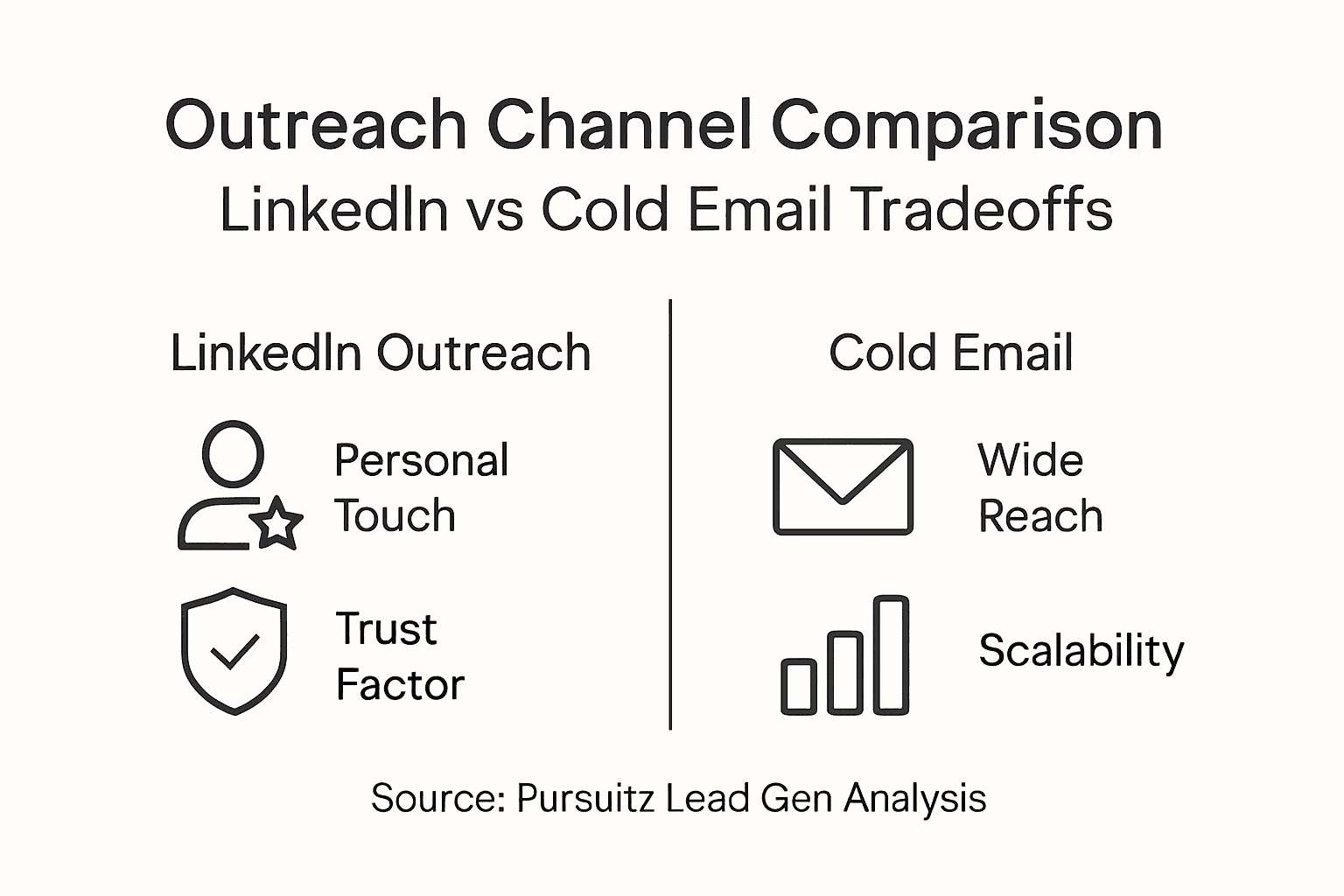
Here’s a quick comparison of LinkedIn outreach and cold email for B2B lead generation:
| Approach | Personalization Potential | Reach & Scalability | Trust-Building Impact |
|---|---|---|---|
| LinkedIn Outreach | Very high, profile-based | Moderate, time-intensive | Strong, profile transparency |
| Cold Email | Low to moderate, list-based | High, easy to automate | Weak, may appear impersonal |
The most effective lead generation approach balances systematic reach with genuine, value-driven communication.
Carefully weigh the long-term implications of your chosen method. Consider not just immediate metrics but how your approach aligns with your broader professional positioning and relationship-building goals.
Pro tip: Develop a hybrid approach that leverages the strengths of multiple channels while mitigating their individual limitations, creating a more robust and adaptable lead generation system.
Transform Your B2B Lead Generation with Trusted LinkedIn Outreach
The challenge highlighted in this article centers on choosing between LinkedIn outreach and cold email for B2B lead generation. Many B2B founders and leadership teams struggle to build authentic relationships while avoiding generic, impersonal tactics. Key pain points include the need for hyper-personalization, trust-building, and creating a predictable system that delivers consistent results. The article clearly explains how authentic, profile-driven LinkedIn engagement outshines cold email by fostering meaningful conversations and deeper connections.
At Pursuitz we specialize in helping you overcome these exact challenges by crafting trust-first outreach systems that rely entirely on LinkedIn’s unique advantages. Our approach combines hyper-personalized messaging with founder-led personal branding and consistent content distribution. This creates measurable inputs that lead to predictable deal flow over time without wasting time on cold emails or paid ads. If you want to move past random outreach attempts and build a reliable growth engine focused on meaningful professional conversations explore how our solution works at https://pursuitz.io.
Ready to shift from scattershot lead tactics to a strategic LinkedIn growth process tailored for B2B founders? Discover how you can design a systematic, trust-building outreach strategy by visiting Pursuitz. Don’t miss the opportunity to transform your lead generation with a method built for long-term success. Start your journey today and see why authentic LinkedIn outreach is the smarter choice than cold email.
Frequently Asked Questions
What is the main difference between LinkedIn outreach and cold email for B2B lead generation?
LinkedIn outreach focuses on building authentic, personalized relationships through profile insights, while cold email typically aims for broader reach with less personal connection. To choose the right method, evaluate your business goals and the level of personalization you can provide.
How can I effectively personalize my LinkedIn outreach messages?
To effectively personalize your LinkedIn outreach, research your potential connections’ professional backgrounds, mutual connections, and recent activities. Aim to include 3-5 unique insights in your initial message to make it feel genuinely tailored and thoughtful.
What metrics should I track to measure the success of my LinkedIn outreach?
Key metrics to track for LinkedIn outreach success include connection acceptance rates, meaningful replies, and conversion to deeper conversations. Regularly assess these metrics to refine your approach, aiming for a 20% increase in meaningful interactions within a few months.
How can I develop a predictable lead generation system for LinkedIn outreach?
To develop a predictable lead generation system, meticulously track your outreach efforts, documenting both quantitative metrics and qualitative insights. Create a detailed spreadsheet to analyze connection rates and engagement quality, allowing you to adapt your strategy effectively over time.
What are the time investments required for LinkedIn outreach compared to cold email?
LinkedIn outreach generally requires more time for research and personalization, while cold email can be automated for broader scalability. Assess your resources and goals to decide on the most suitable approach, dedicating at least 15-20 minutes per potential LinkedIn connection for effective outreach.