

Many B2B technology founders in North America struggle to break through the noise on LinkedIn and generate steady leads. The difference often comes down to the strength of a go-to-market (GTM) strategy that aligns every outbound effort with a clear, actionable framework. Comprehensive market planning gives you the structure to identify your best customers, sharpen your message, and replace random outreach with precision-targeted engagement that actually delivers results.
Table of Contents
- Go-To-Market Strategy: Foundation For Outbound
- Positioning And Targeting Shape Relevance
- Crafting A Narrative For Buyer Context
- From Relevance To Meaningful Conversations
- Risks Of Outbound Without Strategic Direction
Key Takeaways
| Point | Details |
|---|---|
| GTM Strategy is Essential | A well-defined Go-To-Market strategy structurally enhances outbound efforts, leading to better targeting and conversion rates. |
| Precise Targeting and Positioning | Effective segmentation and understanding of customer needs are critical for crafting relevant messaging that resonates with specific audiences. |
| Focus on Buyer Narratives | Transforming transactional messages into impactful narratives deepens emotional connections and fosters meaningful conversations. |
| Importance of Strategic Alignment | Without a clear GTM framework, outbound efforts risk wasting resources and creating brand inconsistency, undermining overall effectiveness. |
Go-To-Market Strategy: Foundation for Outbound
A go-to-market (GTM) strategy represents the critical blueprint that transforms product potential into market success. Unlike generic sales approaches, a well-crafted GTM strategy provides the architectural framework for predictable, targeted outbound engagement. Comprehensive market planning becomes the strategic compass guiding every customer interaction.
At its core, a GTM strategy systematically addresses fundamental business questions that directly impact outbound effectiveness:
- Customer Identification: Who represents the ideal target audience?
- Value Proposition: What unique problem does the solution solve?
- Competitive Positioning: How does the offering differentiate from alternatives?
- Channel Strategy: Which communication and sales pathways maximize reach?
The most successful GTM strategies transform abstract market insights into actionable frameworks. Academic marketing research consistently demonstrates that organizations with robust GTM strategies experience significantly higher conversion rates and more predictable revenue generation. These strategies create a structured approach that eliminates guesswork and replaces random outreach with precision-targeted engagement.
Strategic Alignment becomes the critical differentiator between random outbound attempts and systematic market penetration. When every organizational function – from product development to sales – operates from a unified strategic perspective, outbound efforts become exponentially more powerful.
Pro tip: Map your ideal customer profile with extreme specificity, treating it as a living document that evolves with market insights.
Positioning and Targeting Shape Relevance
The art of crafting relevant outbound communication hinges on two fundamental strategic pillars: precise targeting and strategic positioning. Segmentation and targeting models provide the critical framework that transforms broad market approaches into laser-focused engagement strategies.
Effective targeting requires deep understanding of customer segments through multiple dimensions:
- Demographic Insights: Age, income, location, professional role
- Behavioral Patterns: Purchase history, interaction frequency, decision-making triggers
- Psychographic Characteristics: Professional goals, challenges, aspirational mindsets
- Technological Readiness: Current tool stack, adoption appetite, digital sophistication
Marketing research demonstrates that precision targeting directly correlates with outbound marketing profitability. By narrowing focus and understanding granular customer attributes, companies can design messaging that resonates at a deeply personal level, dramatically improving engagement potential.
Positioning transforms targeted insights into compelling narratives. It’s about articulating a unique value proposition that speaks directly to specific segment pain points, transforming generic outreach into meaningful conversations. Strategic positioning bridges the gap between market understanding and emotional connection.
Relevance is not about speaking to everyone. It’s about speaking precisely to someone.
Pro tip: Develop multiple micro-targeted messaging variations, each tailored to specific sub-segments within your ideal customer profile.
Crafting a Narrative for Buyer Context
Narrative development transforms outbound communication from transactional messaging into meaningful conversations. Psychological storytelling research reveals that compelling narratives create deep emotional connections by speaking directly to the buyer’s lived experience and aspirational goals.
Effective buyer narratives must incorporate multiple strategic dimensions:
- Professional Context: Current challenges and operational constraints
- Emotional Landscape: Hidden motivations and personal career objectives
- Transformational Potential: Desired future state beyond immediate problem
- Credibility Markers: Proof points that validate potential transformation
Strategic storytelling approaches demonstrate that narratives succeed when they transcend product features and address deeper organizational and personal narratives. The most powerful outbound stories create a bridge between the buyer’s current reality and an achievable, compelling future.

Successful narrative crafting requires understanding the buyer’s perspective as a protagonist, not a target. This means designing communication that positions the buyer as the hero, with your solution serving as the critical enabler of their success journey. The narrative must feel personalized, authentic, and intimately relevant.
The following table summarizes narrative elements essential for buyer engagement:
| Narrative Element | Purpose | Impact on Conversation |
|---|---|---|
| Professional Context | Address operational challenges | Builds immediate relevance |
| Emotional Landscape | Tap into personal motivations | Fosters trust and transparency |
| Transformational Arc | Illustrate desired future state | Inspires action and commitment |
| Credibility Markers | Provide validation and proof | Enhances persuasiveness |
Great narratives don’t sell products. They illuminate possibilities.
Pro tip: Map your narrative arc around the buyer’s transformation journey, not your product’s capabilities.
From Relevance to Meaningful Conversations
Transitioning from mere relevance to genuine dialogue requires a fundamental shift in outbound communication philosophy. Psychological research on conversations emphasizes that meaningful interactions are built on empathy, active listening, and authentic connection, not scripted sales pitches.
Meaningful conversations demand a sophisticated approach with multiple critical components:
- Genuine Curiosity: Prioritizing understanding over selling
- Contextual Intelligence: Demonstrating deep awareness of buyer’s ecosystem
- Adaptive Communication: Responding dynamically to buyer’s verbal and non-verbal signals
- Value-First Engagement: Offering insights before requesting anything in return
Organizational communication research reveals that transformative conversations transcend transactional exchanges. They create opportunities for deeper connection, mutual exploration, and collaborative problem-solving that fundamentally reshape buyer-seller relationships.
Successful conversations require releasing attachment to predetermined outcomes. Instead, sales professionals must become skilled facilitators who guide buyers toward their own insights and conclusions. This approach transforms outbound communication from a push mechanism to an invitation for meaningful dialogue.
Conversations are not about winning. They’re about understanding.
Pro tip: Design conversation frameworks that prioritize buyer discovery over product presentation.
Risks of Outbound Without Strategic Direction
Undirected outbound efforts are essentially corporate gambling, where organizations invest resources without understanding potential returns. Strategic planning research reveals that outbound marketing without clear strategic alignment creates significant operational risks that extend far beyond simple resource waste.
The primary risks of unfocused outbound strategies include:
- Resource Misallocation: Spending money on unproductive targeting
- Message Inconsistency: Generating conflicting market signals
- Credibility Erosion: Damaging brand perception through scattered communication
- Competitive Vulnerability: Creating opportunities for more strategic competitors
Strategy science research demonstrates that companies without comprehensive go-to-market frameworks experience compounding negative consequences. These organizations frequently suffer from internal misalignment, where sales, marketing, and product teams operate without a unified strategic vision.
The absence of strategic direction transforms outbound from a precision instrument into a blunt, ineffective tool. Without clear positioning, targeting frameworks, and narrative alignment, companies essentially broadcast noise instead of meaningful communication, repelling potential buyers rather than attracting them.
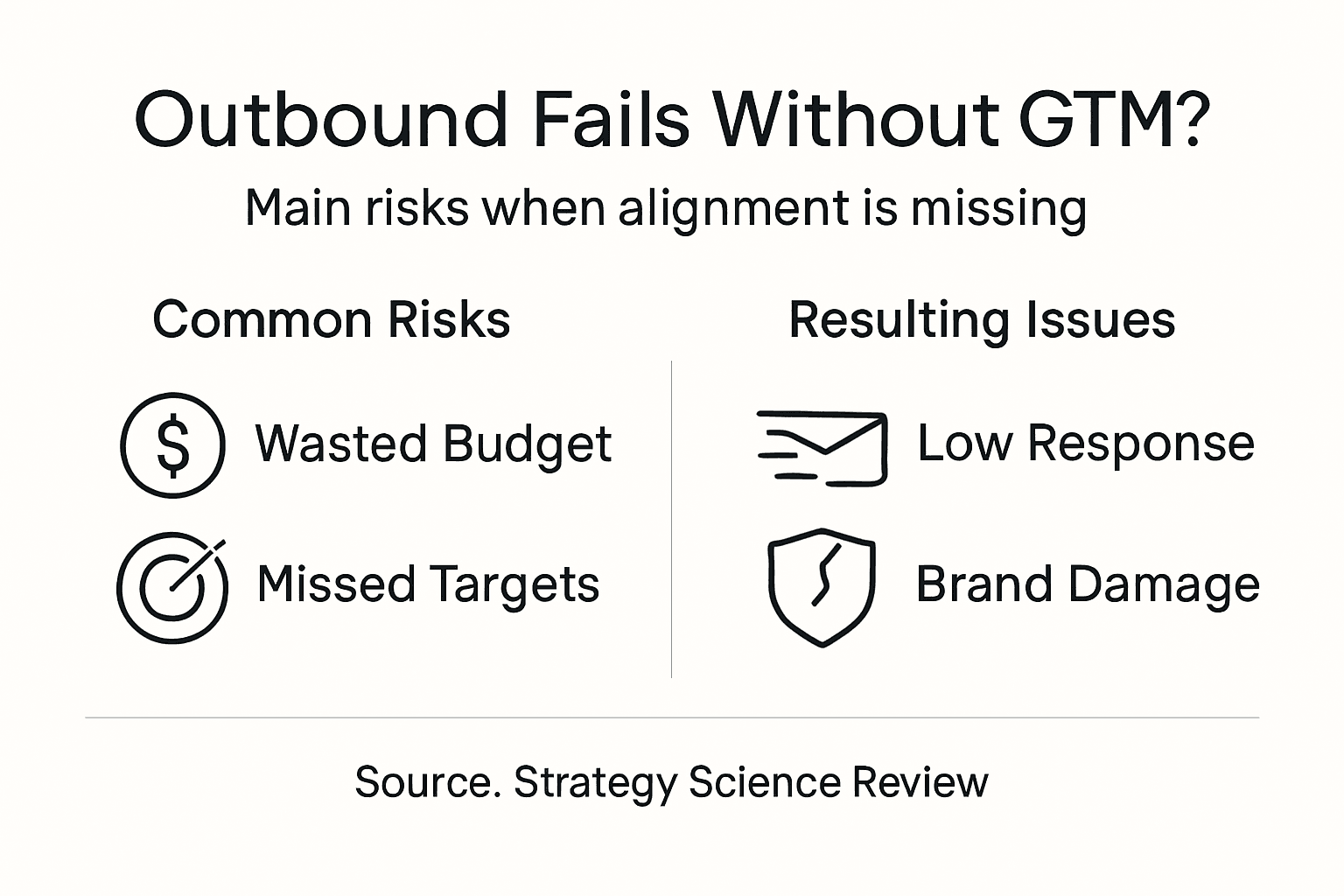
Here’s how outbound risks differ with and without strategic direction:
| Risk Factor | With GTM Strategy | Without Strategic Direction |
|---|---|---|
| Resource Allocation | Efficient, targeted spending | Wasteful, random use of resources |
| Brand Consistency | Unified message, strong brand | Conflicting signals, brand erosion |
| Revenue Predictability | Stable and forecastable | Unpredictable, volatile outcomes |
| Competitive Position | Clear differentiation | Vulnerable, easily outmaneuvered |
| Team Alignment | High collaboration | Frequent internal confusion |
Unfocused outbound is not just ineffective. It’s actively harmful.
Pro tip: Conduct a quarterly strategic alignment audit to ensure all outbound efforts connect directly to core business objectives.
Align Your Outbound Strategy with Purpose and Precision
When outbound efforts lack a clear go-to-market alignment they risk wasting precious resources and missing meaningful connections. This article highlights key challenges like resource misallocation, inconsistent messaging, and lost credibility that arise without a strategic foundation. If your goal is to shift from scattered outreach to trust-first conversations that build predictable deal flow focusing on buyer relevance and narrative alignment is essential.
At Pursuitz we specialize in helping B2B founders and leadership teams overcome these exact pain points by combining hyper-personalized LinkedIn outreach with founder-led personal branding and consistent content distribution. Our system design prioritizes meaningful engagement and measurable inputs to create scalable, authentic connections that resonate strategically. Ready to transform ineffective outbound tactics into a purposeful growth engine explore more about our approach on the Pursuitz home page and discover how to steer your outbound communication toward genuine conversations that convert.
Stop gambling on unfocused outreach and start building a predictable pipeline grounded in strategic alignment today at Pursuitz. Take the first step to unify your outbound efforts around clarity and trust.
Frequently Asked Questions
What is a go-to-market (GTM) strategy?
A go-to-market strategy is a plan that outlines how a company will sell its products or services to its target audience. It includes customer identification, value propositions, competitive positioning, and channel strategies to effectively penetrate the market.
Why is strategic alignment important for outbound marketing?
Strategic alignment ensures that all departments within an organization, such as sales, marketing, and product development, work towards a common objective. This unification enhances the effectiveness of outbound marketing efforts and minimizes wasted resources.
How can I improve my outbound communication strategy?
To improve your outbound communication strategy, focus on precise targeting of customer segments and develop compelling narratives that speak to their specific pain points. Additionally, ensure that conversation frameworks prioritize buyer discovery over selling.
What risks are associated with outbound marketing without a clear strategy?
Outbound marketing without a clear strategy can lead to resource misallocation, message inconsistency, diminished brand credibility, and increased vulnerability to competitors. It creates confusion and ineffective communication that can harm potential buyer relationships.