

Chasing new leads is only part of the B2B sales equation. The true challenge lies in turning those first connections into lasting business relationships, especially for founders and sales leaders in fast-moving technology startups. As sales cycles get longer and more complex, success depends on building trust with decision-makers through highly personalized outreach. This introduction explores how a strategic approach to lead nurturing using LinkedIn can forge credibility, accelerate engagement, and help transform cold connections into committed customers.
Table of Contents
- What Is Lead Nurturing in B2B Sales
- Key Stages and Methods on LinkedIn
- How Nurturing Builds Trust and Authority
- Common Challenges and Missteps to Avoid
- Real-World Results of Consistent Nurturing
Key Takeaways
| Point | Details |
|---|---|
| Lead Nurturing Essentials | Focus on personalized interactions to build trust and develop long-term relationships with prospects. |
| Systematic Approach | Utilize structured engagement processes to manage complex B2B sales cycles effectively. |
| LinkedIn Utilization | Leverage LinkedIn for targeted relationship-building and meaningful professional interactions. |
| Trust and Authority Building | Consistently deliver valuable insights and maintain transparent communication to earn credibility. |
What Is Lead Nurturing in B2B Sales
Lead nurturing represents a strategic approach for building meaningful relationships with potential customers throughout their buying journey. Unlike traditional sales tactics, this process focuses on guiding prospects through personalized interactions that address their specific needs and challenges.
At its core, lead nurturing is about establishing trust and credibility by providing relevant content that demonstrates deep understanding of a potential customer’s business context. The process involves multiple critical stages:
- Identifying ideal customer profiles
- Understanding individual prospect pain points
- Delivering targeted educational materials
- Maintaining consistent communication
- Tracking engagement and adjusting approach
The complexity of B2B sales cycles demands a sophisticated approach. Structured engagement processes become essential when dealing with multiple decision-makers, high-value investments, and extended purchasing timelines. Modern B2B lead nurturing transcends traditional marketing by creating meaningful connections that transform potential leads into committed customers.
Sales Relationship Dynamics play a crucial role in this approach. Successful lead nurturing isn’t about aggressive selling but about becoming a trusted advisor who understands and anticipates customer needs. This requires deep market research, empathy, and a commitment to providing genuine value at every interaction.
Here’s a quick comparison of traditional sales tactics versus strategic lead nurturing in B2B sales:
| Approach | Focus | Relationship Building | Impact on Customer Trust |
|---|---|---|---|
| Traditional Sales | Immediate transactions | Minimal personal connection | Often limited and short-lived |
| Lead Nurturing | Long-term value | Deep, ongoing engagement | Strong, sustained trust |
Pro tip: Focus on creating personalized content that addresses specific industry challenges rather than generic marketing materials.
Key Stages and Methods on LinkedIn
LinkedIn offers a robust platform for B2B lead nurturing, providing unique opportunities to connect with professional decision-makers through strategic engagement. Targeted relationship-building campaigns require a nuanced approach that goes beyond traditional sales tactics.
The key stages of LinkedIn lead nurturing include:
- Research Phase: Identifying and analyzing potential prospects
- Connection Stage: Initiating meaningful professional relationships
- Content Engagement: Sharing valuable, industry-specific insights
- Personalized Outreach: Crafting targeted, individualized communication
- Relationship Development: Consistently adding value without direct selling
Prospect Targeting demands precision and strategic thinking. LinkedIn Sales Navigator becomes a critical tool for identifying and segmenting potential leads based on specific professional characteristics such as industry, job title, company size, and geographical location.
Successful LinkedIn lead nurturing requires a systematic approach that transforms cold connections into warm relationships. This means moving beyond generic networking to creating genuine professional value through thoughtful, tailored interactions that demonstrate deep understanding of a prospect’s business challenges.
Effective LinkedIn lead nurturing is about building trust, not generating immediate sales.
Pro tip: Develop a consistent personal brand that showcases your expertise and provides genuine value in every interaction.
How Nurturing Builds Trust and Authority
Trust and authority are fundamental currencies in B2B sales, representing the critical bridge between initial contact and meaningful business relationships. Personalized content delivery transforms transactional interactions into strategic partnerships by demonstrating genuine understanding of prospect challenges.
The key elements of building trust and authority include:
- Consistently delivering accurate, valuable insights
- Showcasing deep industry expertise
- Providing transparent, unbiased information
- Sharing relevant case studies and success stories
- Maintaining professional and responsive communication
Credibility Signals play a crucial role in establishing professional trust. Prospects evaluate potential partners through multiple lenses, including thought leadership content, professional endorsements, and the ability to address complex business challenges with nuanced, strategic solutions.
Trust is not given. It is earned through consistent demonstration of expertise and genuine commitment to solving client problems.
Authentic authority emerges from systematic trust-building approaches that prioritize meaningful engagement over superficial sales tactics. This requires a comprehensive strategy that combines deep industry knowledge, empathetic communication, and a demonstrable track record of solving real-world business challenges.

Pro tip: Create a content repository that systematically addresses your ideal customer’s most pressing industry challenges, positioning yourself as a trusted advisor.
Common Challenges and Missteps to Avoid
Lead nurturing is a delicate process that requires strategic thinking and nuanced execution. Many B2B professionals inadvertently sabotage their efforts by approaching relationship-building with misguided tactics that prioritize short-term gains over long-term trust.
Common pitfalls in lead nurturing include:
- Treating every prospect identically
- Overwhelming leads with aggressive sales messaging
- Failing to personalize communication
- Neglecting continuous value delivery
- Inconsistent or sporadic engagement
- Focusing solely on product features
- Ignoring individual prospect pain points
Relationship Dynamics in B2B sales demand a sophisticated approach that recognizes the complexity of professional decision-making. Prospects are not commodities to be processed, but strategic partners whose trust must be carefully cultivated through genuine understanding and consistent value demonstration.
Successful lead nurturing is about creating meaningful connections, not manufacturing transactions.
The most critical mistake professionals make is viewing lead nurturing as a linear, transactional process. In reality, it requires ongoing adaptation, deep empathy, and a commitment to understanding the nuanced challenges facing each potential client.
Pro tip: Develop a systematic approach to tracking prospect interactions that allows you to personalize communication based on their specific engagement history and demonstrated interests.
Real-World Results of Consistent Nurturing
Strategic lead nurturing transforms potential connections into sustainable business relationships by demonstrating consistent value and genuine commitment. The most powerful outcomes emerge not from transactional interactions, but from systematic, personalized engagement that addresses specific business challenges.
Consistent nurturing produces remarkable results across multiple dimensions:
- Shortened sales cycles
- Increased prospect trust
- Higher conversion rates
- More qualified leads
- Improved customer retention
- Enhanced brand reputation
- Predictable revenue generation
Relationship Progression represents the most significant outcome of dedicated lead nurturing. Professionals who invest time in understanding prospect needs create a competitive advantage that transcends traditional sales approaches. This means moving beyond generic pitches to developing nuanced, tailored communication strategies that demonstrate deep industry understanding.
Genuine nurturing turns potential leads into committed partners, not just temporary customers.
Successful lead nurturing requires a holistic approach that balances strategic communication, continuous value delivery, and authentic relationship building. By consistently demonstrating expertise and commitment, B2B professionals can transform initial interactions into long-term, mutually beneficial partnerships.
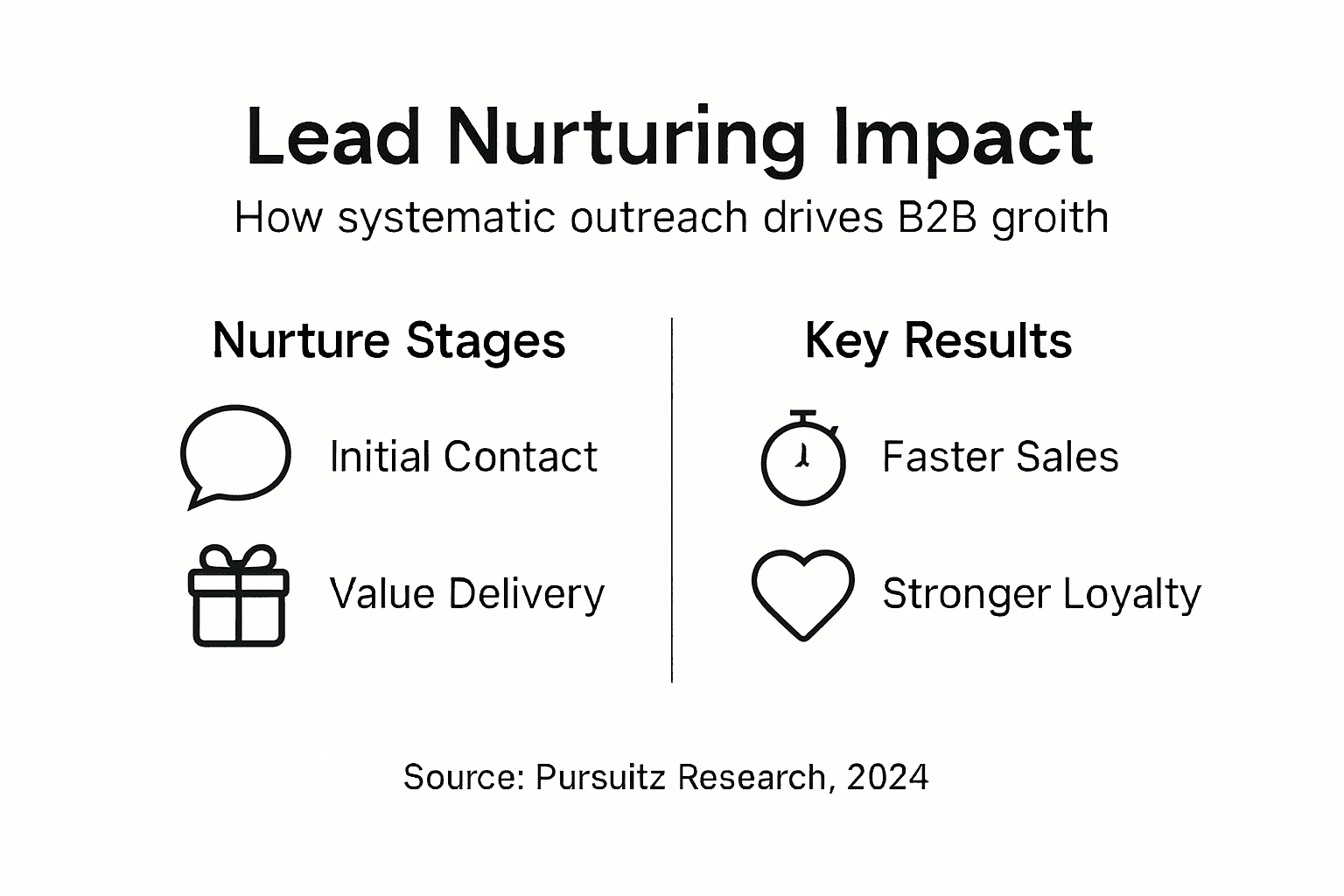
Review the measurable business outcomes achievable through consistent lead nurturing:
| Outcome | Description | Benefit to Organization |
|---|---|---|
| Accelerated Sales Cycles | Shortened time from lead to customer | Faster revenue generation |
| Higher Conversion Rates | Increased percentage of leads becoming customers | Improved sales efficiency |
| Strong Brand Reputation | Enhanced perception among industry peers | Greater competitive advantage |
| Improved Customer Retention | Clients remain loyal over time | Stable and recurring revenue |
Pro tip: Develop a quarterly review process to analyze your lead nurturing interactions, identifying patterns of success and areas requiring strategic refinement.
Unlock Predictable B2B Growth Through Strategic Lead Nurturing
The article highlights the challenge B2B professionals face in building trust and delivering personalized value across LinkedIn to nurture leads effectively. If you find yourself overwhelmed with generic outreach methods that yield little trust or engagement, it is time to embrace a method that prioritizes trust-first conversations and personalized relationship-building. Key pain points such as inconsistent engagement and lack of tailored outreach strategies can be overcome by leveraging systems designed around hyper-personalized LinkedIn communication and founder-led personal branding.
Pursuitz understands the importance of nurturing authentic professional relationships as described in the article. Our approach focuses on system design and consistent content distribution that directly aligns with the lead nurturing principles of providing relevant insights and fostering long-term value. If you want to move beyond traditional sales tactics and transform LinkedIn connections into committed partners, explore how Pursuitz helps B2B founders and leadership teams grow.
Take control of your lead nurturing success by visiting Pursuitz now and discover how to build measurable inputs that deliver predictable deal flow over time. Stop struggling with one-size-fits-all outreach and start engaging your prospects with the systematic, effective approach your business deserves.
Frequently Asked Questions
What is lead nurturing in B2B sales?
Lead nurturing is a strategic approach that focuses on building meaningful relationships with potential customers throughout their buying journey, emphasizing personalized interactions that address specific needs and challenges.
Why is lead nurturing important for building trust?
Lead nurturing is vital for building trust as it involves consistent communication, delivering relevant content, and demonstrating a deep understanding of the prospect’s business challenges, which helps to establish credibility and authority.
What are common pitfalls in lead nurturing?
Common pitfalls include treating every prospect identically, overwhelming leads with aggressive sales messages, failing to personalize communication, and neglecting continuous value delivery, which can undermine relationship-building efforts.
How can LinkedIn be used effectively for lead nurturing?
LinkedIn can be used effectively for lead nurturing by researching potential prospects, initiating meaningful professional relationships, sharing valuable content, crafting personalized outreach, and consistently adding value without direct selling.