

Struggling to make your emails stand out while reaching the right inbox can feel like a never-ending challenge for B2B founders. Without strong email deliverability, your carefully crafted messages might never connect with top prospects or decision makers. Mastering the principles behind inbox placement, sender reputation, and engagement not only protects your brand but empowers every LinkedIn outreach to start conversations and win trust with potential clients worldwide.
Table of Contents
- Defining Email Deliverability And Core Principles
- Key Metrics For Tracking Deliverability Success
- Common Challenges That Hurt Email Deliverability
- Reputation, Risks, And Lost Opportunities Explained
- Alternatives: Focusing On LinkedIn Outreach Metrics
Key Takeaways
| Point | Details |
|---|---|
| Email Deliverability | Ensures that marketing emails successfully reach recipient inboxes rather than being filtered as spam. |
| Reputation Management | A proactive approach to maintaining sender reputation is crucial for consistent email performance. |
| Key Metrics | Regularly track metrics like open rates, bounce rates, and spam complaints to evaluate deliverability success. |
| Harnessing LinkedIn | Consider LinkedIn outreach for more personalized, trust-building communication over traditional email methods. |
Defining Email Deliverability And Core Principles
Email deliverability represents the critical pathway determining whether marketing communications successfully reach their intended recipients’ primary inboxes. Understanding this concept goes beyond simple email transmission – it’s about ensuring messages bypass spam filters and land precisely where they should.
At its core, email deliverability measures the success of emails reaching recipient inboxes without being blocked or filtered into spam folders. Unlike basic email delivery, which merely confirms a server received the message, deliverability focuses on inbox placement and engagement potential.
The fundamental principles of strong email deliverability include:
- Sender Authentication: Implementing protocols like SPF, DKIM, and DMARC to verify email legitimacy
- List Hygiene: Maintaining a clean subscriber list with engaged contacts
- Reputation Management: Monitoring and protecting sender reputation through consistent performance
- Content Optimization: Crafting messages that avoid spam trigger words and align with recipient expectations
- Performance Analysis: Continuously tracking metrics like open rates, click-through rates, and bounce rates
Sender reputation plays a pivotal role in determining deliverability success. Email providers evaluate multiple factors including historical engagement, complaint rates, and technical authentication to assess an organization’s email credibility.
Pro tip: Regularly clean your email list by removing unengaged subscribers and implementing double opt-in processes to maintain high-quality contact databases.
Key Metrics For Tracking Deliverability Success
Effective email marketing demands precise tracking of multiple critical metrics that reveal the health and performance of your communication strategies. Monitoring key deliverability indicators provides actionable insights into how recipients interact with your emails and how internet service providers perceive your sender reputation.
The most crucial metrics for assessing email deliverability include:
- Bounce Rate: Percentage of emails not successfully delivered
- Hard bounces (permanent delivery failures)
- Soft bounces (temporary delivery issues)
- Inbox Placement Rate: Percentage of emails reaching primary inboxes
- Open Rate: Number of recipients who actually open the email
- Click-Through Rate (CTR): Percentage of recipients clicking links within the email
- Spam Complaint Rate: Tracking how often recipients mark emails as spam
- Unsubscribe Rate: Number of contacts opting out of future communications
Spam complaint rates are particularly critical, with industry standards suggesting maintaining complaints under 0.1% to preserve sender reputation. High complaint rates signal potential content or list quality issues that require immediate attention.
Technical authentication protocols like SPF, DKIM, and DMARC play a significant role in establishing credibility with internet service providers. These mechanisms help validate your email’s legitimacy and improve overall deliverability performance by reducing the likelihood of messages being filtered as potential spam.

Pro tip: Implement automated deliverability monitoring tools that provide real-time insights and allow rapid troubleshooting of potential email performance issues.
Common Challenges That Hurt Email Deliverability
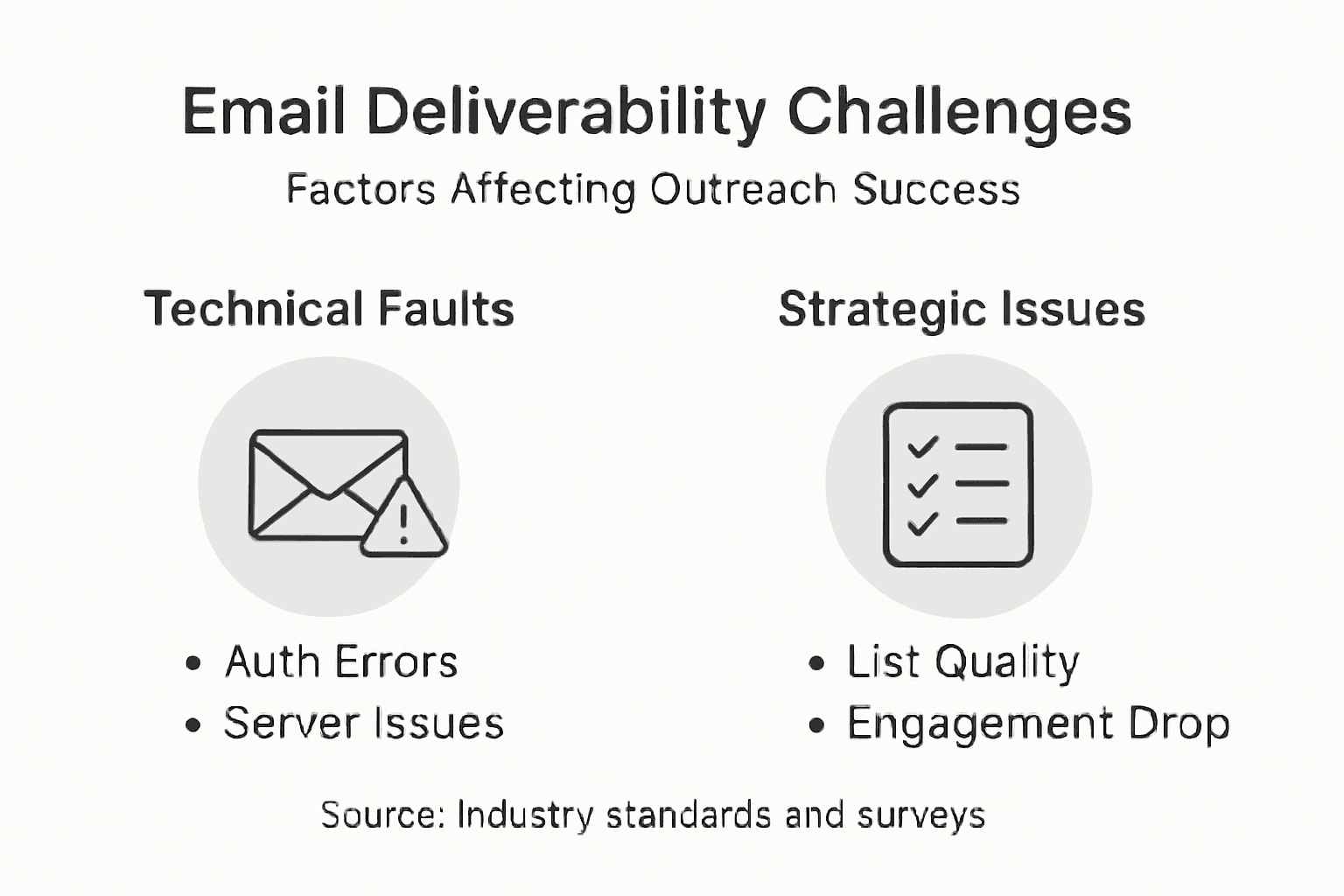
Email deliverability is a complex ecosystem where multiple factors can dramatically impact your communication effectiveness. Common challenges consistently undermine email performance and require strategic, proactive management to maintain optimal sender reputation.
The most significant challenges affecting email deliverability include:
- List Quality Issues
- Invalid or outdated email addresses
- High percentage of unengaged subscribers
- Lack of regular list cleaning and maintenance
- Authentication Vulnerabilities
- Incomplete SPF, DKIM, and DMARC configurations
- Missing technical verification protocols
- Engagement Deterioration
- Low open and click-through rates
- Inconsistent sending patterns
- Irrelevant or poorly targeted content
Spam complaints represent a critical warning signal for email programs. Technical faults and configuration problems can quickly transform a promising communication strategy into a potential blacklisted nightmare. Internet service providers closely monitor these indicators, using them to assess sender credibility and determine inbox placement.
Complex technical and strategic challenges require comprehensive monitoring and adaptive approaches. Successful email communication demands continuous optimization of list quality, authentication protocols, and recipient engagement strategies to maintain high deliverability performance.
Pro tip: Implement a quarterly email list audit to remove inactive subscribers and validate email address accuracy, ensuring long-term sender reputation and communication effectiveness.
Reputation, Risks, And Lost Opportunities Explained
Email deliverability transcends mere technical configurations – it represents a critical business performance metric with substantial financial and reputational implications. Major risks can dramatically impact organizational communication strategies, creating cascading consequences that extend far beyond simple messaging challenges.
The key risks associated with poor email reputation include:
- Business Performance Risks
- Missed communication opportunities
- Reduced customer engagement
- Diminished marketing campaign effectiveness
- Brand Perception Challenges
- Decreased professional credibility
- Potential perception of unreliability
- Negative customer trust signals
- Compliance and Legal Vulnerabilities
- Potential regulatory violations
- Risk of significant financial penalties
- Non-compliance with data protection standards
Sender reputation operates as a complex ecosystem where consistent positive interactions determine future communication potential. Reputation management involves more than technical foundations – it requires a holistic approach balancing user engagement, content quality, and strategic communication.
The consequences of neglecting email reputation can be profound. Internet service providers continuously evaluate sender behavior, using sophisticated algorithms that monitor engagement rates, spam complaints, and technical authentication to make instantaneous filtering decisions that directly impact message visibility.
Pro tip: Develop a comprehensive reputation management strategy that includes regular list cleaning, consistent engagement monitoring, and proactive authentication protocol maintenance.
Here’s how common email deliverability risks compare in terms of business impact and mitigation complexity:
| Risk Type | Business Impact | Mitigation Complexity | Potential Long-Term Effect |
|---|---|---|---|
| Poor Sender Reputation | Lost revenue, lower engagement | Challenging, ongoing | Increased blacklist risk |
| Compliance Violations | Legal fines, trust issues | Requires policy overhaul | Contract loss, brand damage |
| List Quality Problems | Low deliverability, poor ROI | Moderate, regular audits | Costly list rebuilds |
| Authentication Issues | Messages blocked or flagged | Technical setup needed | Persistent inbox placement issues |
Alternatives: Focusing On LinkedIn Outreach Metrics
LinkedIn outreach represents a more strategic and predictable alternative to traditional email communication, offering B2B founders a trust-first approach to building meaningful professional connections. Unlike email’s fragmented and often impersonal communication model, LinkedIn provides a comprehensive platform for genuine relationship development and targeted engagement.
Key metrics for evaluating LinkedIn outreach performance include:
- Connection Quality Metrics
- Personalized connection request acceptance rate
- Profile view to connection conversion ratio
- Meaningful conversation initiation percentage
- Engagement Performance Indicators
- Content interaction rates
- Direct message response rates
- Recommendation and endorsement frequency
- Relationship Development Signals
- Network growth within target industry
- Depth of professional interactions
- Long-term connection sustainability
The Social Selling Index offers a quantitative framework for assessing professional networking effectiveness, measuring an individual’s capacity to establish a professional brand, find the right people, engage with insights, and build strong relationships.
Unlike email’s technical complexities, LinkedIn outreach prioritizes human-centered communication strategies that focus on creating genuine value and establishing trust through consistent, thoughtful interactions.
Pro tip: Develop a systematic approach to LinkedIn engagement by creating a weekly content and interaction plan that prioritizes meaningful professional connections over transactional communication.
See how email deliverability metrics differ from LinkedIn outreach metrics in measuring campaign success:
| Metric Focus | Email Deliverability | LinkedIn Outreach |
|---|---|---|
| Engagement Quality | Open and click rates | Conversation initiation rate |
| List Management | Bounce and unsubscribe rates | Network growth metrics |
| Reputation Signals | Spam complaints, sender score | Social Selling Index, endorsements |
| Communication Style | Automated, broad distribution | Personalized, professional dialog |
Discover a Trust-First Alternative to Email Deliverability Challenges
Struggling with poor email deliverability, spam complaints, or complex technical setups can drain your marketing efforts and harm your sender reputation. The article highlights how issues like authentication vulnerabilities, list quality problems, and engagement deterioration make email outreach unpredictable and often frustrating for B2B leaders. You deserve a smarter approach that bypasses these pain points and builds genuine connections through consistent, personalized communication.
At Pursuitz, we help B2B founders and leadership teams grow using hyper-personalized LinkedIn outreach combined with founder-led personal branding and steady content sharing. Our system focuses on trust-first conversations that avoid the risks and limitations of traditional email campaigns. Instead of battling inbox filters or tracking endless deliverability metrics, you can leverage proven strategies that foster meaningful engagement and measurable results over time.
Explore how our unique growth system can transform your outreach by visiting our main landing page and learn why forward-thinking leaders choose LinkedIn for predictable deal flow. Say goodbye to email deliverability headaches and start building authentic professional relationships today.
Frequently Asked Questions
What is email deliverability?
Email deliverability is the ability of email messages to successfully reach recipients’ primary inboxes without being blocked or filtered as spam.
Why is tracking email deliverability important?
Tracking email deliverability is crucial for ensuring that your marketing communications reach your audience effectively, that your sender reputation remains strong, and that your email engagement metrics are optimized for better results.
What are the key metrics to monitor for email deliverability?
Key metrics for tracking email deliverability include bounce rates (both hard and soft), inbox placement rates, open rates, click-through rates, spam complaint rates, and unsubscribe rates to assess overall email performance.
How does sender reputation impact email deliverability?
Sender reputation is a critical factor; it reflects how mail servers view your email credibility based on past engagement, complaint rates, and technical authentication. A strong sender reputation increases the likelihood of emails reaching the inbox rather than being filtered out.