

Most American companies lose nearly 50 percent of B2B leads due to poor targeting and generic outreach. Knowing exactly who your ideal clients are makes all the difference when it comes to winning new business. Defining an Ideal Client Profile gives you a clear roadmap to attract prospects who truly fit your solution, helping you build stronger relationships and achieve higher returns from every effort.
Table of Contents
- Step 1: Define Your Ideal Client Profile And Target List
- Step 2: Build Multichannel Outreach Campaigns
- Step 3: Personalize Messaging For Higher Engagement
- Step 4: Handle Replies And Book Qualified Meetings
- Step 5: Verify Lead Quality And Export To Crm
Quick Summary
| Key Insight | Explanation |
|---|---|
| 1. Define Your Ideal Client | Create a detailed profile of your best customers to improve targeting and outreach strategies. |
| 2. Multichannel Outreach Approach | Utilize diverse communication platforms to connect with prospects, enhancing engagement and conversion rates. |
| 3. Personalize Your Messaging | Customize your communication based on in-depth research of each prospect to demonstrate understanding of their needs. |
| 4. Handle Replies Strategically | Respond quickly and thoughtfully to inquiries, focusing on engaging prospects meaningfully to book meetings. |
| 5. Verify Lead Quality | Develop a robust lead verification process to ensure you are targeting the most promising prospects before CRM entry. |
Step 1: Define Your Ideal Client Profile and Target List
Building a robust Ideal Client Profile (ICP) is the strategic foundation for generating qualified B2B leads. By creating a detailed map of your most promising prospects, you’ll transform your sales approach from scattered attempts to precision targeting.
To craft an effective ICP, start by analyzing your existing successful client base. Identify key characteristics that define your best customers across dimensions like industry, company size, revenue range, technological infrastructure, and organizational pain points. Look beyond surface demographics and dig into deeper behavioral and psychographic attributes. Examine patterns such as which clients generate the most revenue, have the shortest sales cycles, or demonstrate highest satisfaction and retention rates.
While developing your target list, prioritize quality over quantity. Segment potential clients based on precise qualification criteria that align with your ideal customer characteristics. This means creating a granular profile that goes beyond basic firmographics. Consider factors like technological readiness, growth trajectory, budget allocation for solutions like yours, and strategic alignment with your value proposition.
Warning: Avoid the common trap of creating an ICP that’s either too broad or unrealistically narrow. Your profile should be specific enough to guide targeted outreach but flexible enough to capture genuinely promising opportunities.
With a well-defined ICP and target list, you’re now prepared to move into the next critical phase: developing a personalized outreach strategy that speaks directly to your ideal prospects’ unique needs and challenges.
Step 2: Build Multichannel Outreach Campaigns
Multichannel outreach represents a strategic approach to connecting with potential B2B clients across various communication platforms, maximizing your chances of engagement and conversion. By diversifying your outreach methods, you’ll create multiple touchpoints that increase visibility and opportunity.
Developing an omnichannel lead generation strategy requires careful planning and synchronized communication across platforms like LinkedIn, email, phone, and targeted digital advertising. Start by mapping out a comprehensive communication strategy that ensures consistent messaging while adapting the tone and format to each specific channel. For instance, your LinkedIn approach might involve personalized connection requests and thought leadership content, while email campaigns could focus on direct value propositions and targeted problem solving.
Each communication channel demands a unique approach. LinkedIn allows for professional networking and direct relationship building, email provides space for detailed value propositions, and phone outreach enables real time conversation and immediate rapport building. Craft personalized messages that demonstrate deep understanding of your prospect’s specific business challenges rather than using generic templates.

Warning: Avoid communication fatigue by establishing clear intervals between outreach attempts and maintaining a respectful frequency that doesn’t overwhelm potential clients.
With your multichannel campaign strategically designed, you’re now prepared to execute precise, personalized outreach that speaks directly to your ideal prospects’ unique needs and professional contexts.
Step 3: Personalize Messaging for Higher Engagement
Personalizing your messaging is the critical bridge between catching a prospect’s attention and converting them into a qualified lead. Your communication must go far beyond generic templates to demonstrate genuine understanding of their unique business challenges and opportunities.
Crafting effective email outreach strategies requires deep research into each prospect’s professional context. Start by analyzing their company’s recent press releases, LinkedIn activity, financial reports, and digital footprint to uncover specific pain points and strategic objectives. Transform this research into hyper targeted messaging that speaks directly to their current business situation. For example, if a technology company recently announced expansion into a new market, your outreach could reference this specific context and connect it to how your solution supports such growth initiatives.
The art of personalization extends beyond surface level details. It demands creating a narrative that positions your solution as a strategic partner rather than a transactional vendor. Develop messaging frameworks that demonstrate immediate value by highlighting how your offering solves specific challenges unique to their industry vertical or organizational stage. This means moving beyond generic value propositions to crafting communications that feel like they were written specifically for that individual prospect.
Warning: Avoid the temptation to use superficial personalization tactics like merely inserting a prospect’s name. True personalization requires substantive insight that shows you understand their genuine business ecosystem.
With meticulously personalized messaging in place, you are now prepared to execute an outreach approach that resonates authentically and increases your probability of meaningful engagement.
Step 4: Handle Replies and Book Qualified Meetings
Successfully handling prospect replies and converting them into qualified meetings requires a strategic approach that combines rapid responsiveness with thoughtful engagement. Your goal is to transform initial interest into a meaningful sales conversation that moves prospects closer to becoming customers.
Phone calls remain the most powerful channel for B2B sales engagement, generating the majority of qualified meetings. When a prospect responds to your initial outreach, prioritize a phone conversation over endless email exchanges. Develop a concise call script that addresses their specific business context, demonstrates immediate value, and creates a clear pathway to understanding how your solution solves their unique challenges.
Selecting the right sales appointment booking tools can streamline your meeting scheduling process and reduce administrative friction. Implement a robust scheduling system that allows prospects to choose convenient time slots while maintaining your control over meeting parameters. This approach respects the prospect’s time and increases the likelihood of successful meeting conversion.
Warning: Avoid the common mistake of being overly pushy or rigid during initial interactions. Your communication should feel collaborative and focused on solving the prospect’s business challenges.
With a strategic approach to handling replies and booking meetings, you are now positioned to transform initial interest into meaningful sales conversations that drive business growth.
Step 5: Verify Lead Quality and Export to CRM
Verifying lead quality is the critical final stage that separates potentially promising prospects from genuinely qualified sales opportunities. Your objective is to meticulously assess each lead against predetermined criteria to ensure maximum conversion potential and efficient resource allocation.
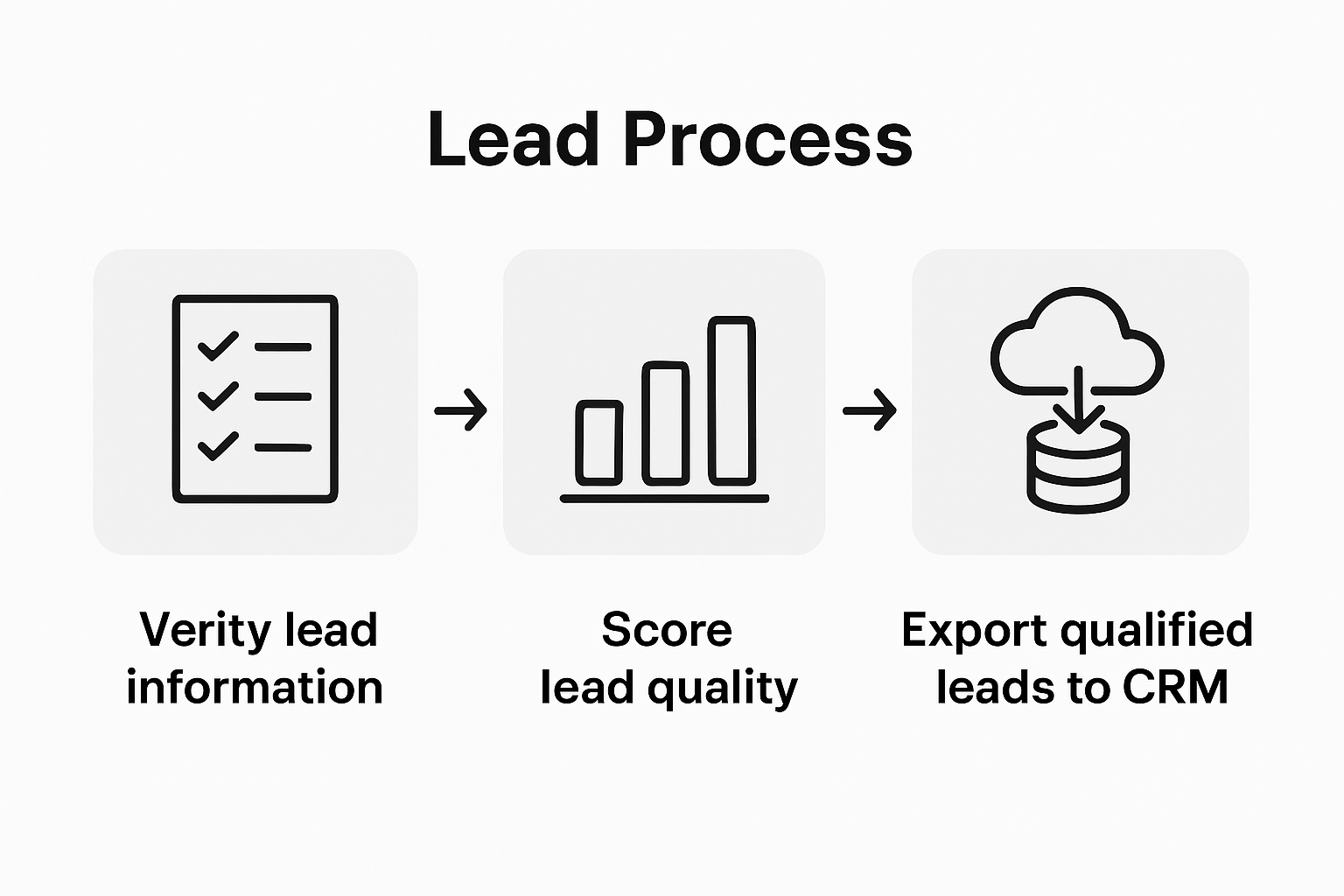
Machine learning predictive models offer sophisticated techniques for evaluating lead quality by analyzing historical performance data and forecasting potential sales outcomes. Develop a comprehensive scoring system that considers multiple dimensions such as company size, technological readiness, budget alignment, decision maker engagement, and strategic compatibility with your solution. This systematic approach transforms lead assessment from subjective guesswork into a data driven selection process.
Advanced client network analysis provides innovative methods for predicting lead potential through sophisticated organizational connectivity models. Implement a rigorous verification workflow that cross references prospect information against your ideal client profile, examining factors like organizational structure, technological infrastructure, growth trajectory, and potential for long term partnership. This multifaceted evaluation ensures that only the most promising leads are exported to your customer relationship management system.
Warning: Resist the temptation to export every lead. Quality consistently trumps quantity in B2B sales prospecting.
With your lead quality verification complete, you are now prepared to strategically populate your CRM with high potential prospects that align precisely with your business objectives.
Unlock Consistent B2B Sales Success With Expert Lead Generation
Generating qualified leads remains a top challenge for B2B companies trying to fill their sales pipelines. The article highlights key pain points like creating a precise Ideal Client Profile, building multichannel outreach campaigns, and personalizing messaging to boost engagement. At Pursuitz, we turn these challenges into your strongest advantages by managing every step from prospect sourcing to booking qualified meetings. Our approach ensures your outreach feels hyper personalized as if we spent 10 minutes researching before reaching out, directly addressing your prospects’ unique needs and increasing your ROI significantly.

Ready to stop guessing where your next client will come from Use our proven multichannel lead generation strategies to consistently fill your pipeline with qualified leads. Visit Pursuitz to learn how our end-to-end services from ICP creation to lead export can transform your B2B sales approach. Don’t wait to experience a reliable and predictable sales funnel that delivers results.
Frequently Asked Questions
How do I define my Ideal Client Profile for B2B sales?
To define your Ideal Client Profile, start by analyzing your best existing clients to identify key characteristics like industry, company size, and specific pain points. Gather data and create a detailed profile that includes both firmographics and behavioral attributes, enabling targeted outreach strategies.
What are effective strategies for multichannel outreach?
Effective multichannel outreach includes using LinkedIn, email, phone calls, and digital advertising to connect with potential clients. Develop a synchronized communication plan that tailors messages to fit the unique characteristics of each channel, ensuring consistency while respecting each platform’s nuances.
How can I personalize my messaging for better engagement?
To personalize your messaging, conduct in-depth research on each prospect’s business situation and recent updates. Craft your communication to address their specific challenges and demonstrate how your solution can bring immediate value, avoiding generic templates that fail to resonate.
What steps should I take to handle prospect replies and book meetings?
When a prospect replies, prioritize a phone call to establish a direct connection and facilitate a more engaging discussion. Use a streamlined scheduling system to allow prospects to choose convenient meeting times, making the booking process efficient and respectful of their time.
How do I verify lead quality before exporting to my CRM?
To verify lead quality, develop a comprehensive scoring system that evaluates prospects based on criteria like company size, decision maker engagement, and budget alignment. Conduct a thorough review of each lead against your Ideal Client Profile to ensure you’re only exporting high-potential leads to your CRM.
What common mistakes should I avoid in B2B lead generation?
Avoid creating an Ideal Client Profile that is too broad or too narrow, as this can limit your outreach effectiveness. Additionally, steer clear of superficial personalization tactics that do not demonstrate genuine understanding; instead, focus on crafting targeted messages that resonate with the prospect’s unique context.
Recommended
- Pursuitz – Master Lead Qualification Workflow for B2B Sales Success
- Pursuitz – What Is Sales Prospecting? Complete B2B Guide
- Pursuitz – Omnichannel lead generation: How to do it right
- Pursuitz – Lead generation tutorial for beginners
- 10 Effective Lead Generation Strategies for Businesses – Jarrod Harman
- Understanding the B2B Content Strategy Framework