

Most American B2B sales leaders still believe being present on every channel is enough, yet studies reveal only 28 percent of multichannel efforts deliver consistent ROI without coordination. In a crowded sales environment, real success depends on more than just sending messages everywhere. This guide cuts through myths and confusion, showing you how smart, integrated multichannel prospecting reaches the right decision makers, boosts response rates, and gives your team a measurable competitive edge.
Table of Contents
- Core Definition And Common Misconceptions
- Essential Channels And Outreach Variations
- How Multichannel Prospecting Works In B2B
- Personalization, Data, And CRM Integration
- Risks, Legal Concerns, And Common Pitfalls
- Comparing Multichannel, Single, And Omnichannel
Key Takeaways
| Point | Details |
|---|---|
| Multichannel Prospecting Requires Strategy | Simply being present on multiple channels is not enough; a coordinated approach tailored to your audience’s preferences is essential for success. |
| Integration of Channels is Key | Effective outreach needs a seamless integration of different communication methods to provide a consistent message and enhance engagement. |
| Data-Driven Personalization is Vital | Utilizing advanced data integration and analytics significantly improves the ability to tailor communications to individual prospects, driving better engagement rates. |
| Legal and Compliance Awareness is Crucial | Sales teams must proactively manage legal risks associated with data privacy and ensure consistent messaging to prevent cross-channel conflicts. |
Core Definition and Common Misconceptions
Multichannel prospecting represents a strategic approach to B2B lead generation where sales professionals leverage multiple communication channels simultaneously to connect with potential clients. Research exploring marketing channel evolution reveals this technique is far more nuanced than simply broadcasting messages across platforms.
At its core, multichannel prospecting means systematically using diverse communication channels like LinkedIn, email, phone, and social media to engage potential business customers. Unlike traditional single-channel approaches, this method recognizes that different prospects prefer different communication methods. Some executives might respond quickly to LinkedIn messages, while others are more responsive to personalized email outreach. The key is understanding your target audience’s preferences and creating a coordinated strategy that increases engagement probability.
However, significant misconceptions persist about multichannel prospecting. Many sales teams mistakenly believe that simply being present on multiple channels guarantees success. Research on multichannel retailing strategies highlights that channel presence alone is insufficient without strategic coordination. Common mistakes include:
- Treating each channel as an independent communication platform
- Failing to maintain consistent messaging across channels
- Not tracking cross-channel performance metrics
- Assuming equal effectiveness of all channels for every prospect
Successful multichannel prospecting requires a sophisticated, integrated approach that considers channel-specific nuances and individual prospect behaviors. This means developing personalized communication strategies, understanding channel-specific etiquette, and continuously adapting your approach based on engagement data.
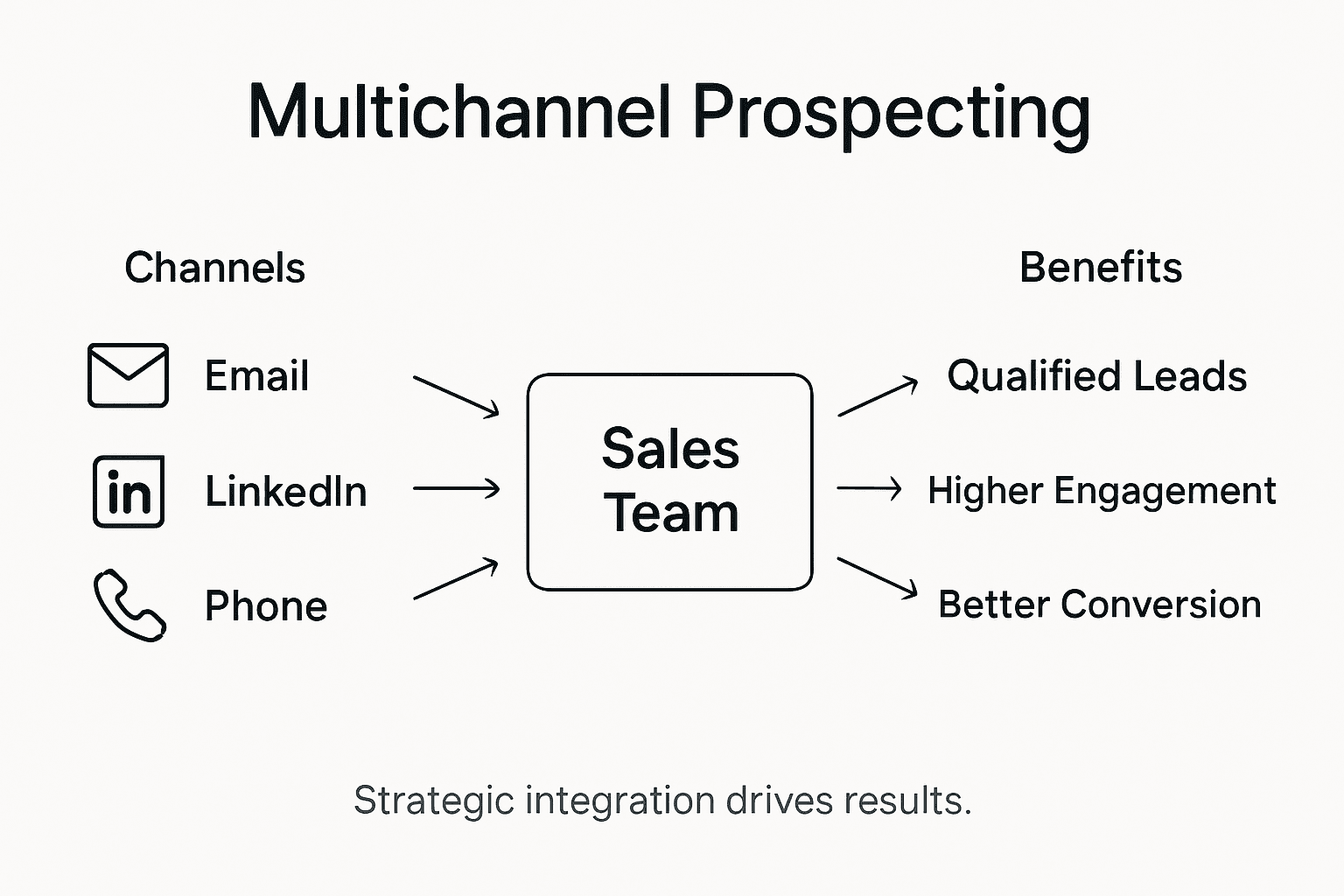
Pro tip: Create a detailed channel preference matrix for your ideal customer profile, documenting response rates and engagement metrics for each communication method to optimize your multichannel prospecting strategy.
Essential Channels and Outreach Variations
B2B lead generation demands a strategic approach to multichannel outreach that goes beyond traditional communication methods. Sales outreach techniques have evolved dramatically, requiring professionals to master multiple communication platforms to effectively engage potential clients.
Multichannel prospecting encompasses several critical communication channels, each with unique strengths and engagement potential. The primary channels include:
- LinkedIn: Professional networking platform ideal for direct business connections
- Email: Formal communication channel with high personalization potential
- Phone: Direct, immediate communication for complex discussions
- Social Media: Platforms like Twitter and Facebook for broader industry engagement
- Video Conferencing: Tools like Zoom for virtual face-to-face interactions
Successful outreach requires understanding the nuanced communication dynamics of each channel. LinkedIn, for instance, allows targeted connection requests and personalized messaging, while email enables more detailed, structured communication. Phone conversations provide immediate rapport building, and video conferencing bridges geographical gaps with personal interactions.
The key to effective multichannel prospecting is not just channel presence, but strategic integration and message consistency. Sales professionals must develop a coordinated approach that adapts communication style to each platform while maintaining a cohesive brand message. This means crafting channel-specific content that resonates with prospects’ preferences and professional contexts.
Pro tip: Create a personalized communication matrix mapping each prospect’s preferred channels and communication styles to optimize your multichannel engagement strategy.
How Multichannel Prospecting Works in B2B
Multichannel prospecting in B2B sales represents a sophisticated approach to connecting with potential clients through carefully orchestrated communication strategies. B2B lead generation strategies reveal a complex ecosystem where successful outreach requires precision, personalization, and strategic channel selection.
Prospect Engagement Workflow typically follows a structured progression across multiple channels:
- Initial Research and Targeting
- Identify ideal customer profile (ICP)
- Develop comprehensive prospect database
- Segment potential clients by industry, company size, and potential needs
- Channel Sequencing
- Start with professional networking platforms like LinkedIn
- Follow up with personalized email communication
- Use phone calls for high-value or complex prospect interactions
- Integrate social media touchpoints for broader engagement
The mechanics of multichannel prospecting demand nuanced understanding of each communication platform’s unique dynamics. LinkedIn allows targeted professional networking, email enables detailed personalized communication, phone conversations provide immediate interaction, and social media platforms offer broader contextual engagement. Successful B2B professionals seamlessly transition between these channels, creating a cohesive and adaptive outreach strategy.
Effective multichannel prospecting requires continuous monitoring and optimization. Sales teams must track interaction metrics, analyze response rates across different channels, and dynamically adjust their approach. This means developing sophisticated tracking systems that capture prospect interactions, preferences, and engagement patterns, allowing for increasingly refined and personalized communication strategies.

Pro tip: Develop a sophisticated interaction tracking system that maps each prospect’s preferred communication channels and response patterns to create hyper-personalized engagement workflows.
Personalization, Data, and CRM Integration
Multichannel prospecting has transformed from a simple communication strategy to a sophisticated, data-driven approach that demands intelligent integration of customer relationship management (CRM) systems and advanced personalization techniques. Comprehensive data integration frameworks reveal the critical importance of leveraging predictive analytics and artificial intelligence to create hyper-targeted communication strategies.
Data Integration Components play a crucial role in effective multichannel prospecting:
- Customer Data Platform (CDP): Consolidates prospect information from multiple sources
- CRM System: Tracks interaction history and manages relationship progression
- Analytics Engine: Provides insights into prospect behavior and engagement patterns
- Personalization Layer: Enables dynamic content and communication customization
Successful personalization goes beyond merely inserting a prospect’s name into a template. It requires deep understanding of individual business contexts, pain points, and potential needs. Modern B2B sales teams use sophisticated data mapping techniques that connect prospect demographics, interaction history, industry trends, and behavioral signals to craft precisely targeted communication strategies.
Here’s a quick reference to key components that enable effective multichannel prospecting:
| Component | Function | Business Impact |
|---|---|---|
| Customer Data Platform | Centralizes prospect data from channels | Enables unified data analysis |
| CRM System | Tracks interactions, manages relationships | Improves sales cycle management |
| Analytics Engine | Analyzes engagement and patterns | Supports campaign optimization |
| Personalization Layer | Customizes content for each prospect | Increases engagement rates |
The integration of artificial intelligence and machine learning has revolutionized multichannel prospecting by enabling predictive engagement models. These advanced systems can anticipate prospect needs, recommend optimal communication channels, and dynamically adjust outreach strategies based on real-time interaction data. By continuously learning from each interaction, AI-powered CRM systems help sales professionals create increasingly refined and effective personalization approaches.
Pro tip: Implement a comprehensive data governance strategy that ensures clean, consistent, and actionable prospect data across all communication platforms and tracking systems.
Risks, Legal Concerns, and Common Pitfalls
Multichannel prospecting introduces complex legal and operational risks that demand strategic management and proactive compliance approaches. Comprehensive research on multichannel integration risks reveals critical challenges that can potentially undermine B2B sales strategies if not carefully navigated.
Primary Legal and Compliance Risks include:
- Data Privacy Violations: Potential breaches of regulations like GDPR and CCPA
- Consent Management: Ensuring proper communication consent across channels
- Cross-Border Communication Regulations: Navigating international legal requirements
- Unsolicited Communication Restrictions: Avoiding potential spam and harassment claims
Channel conflict represents a significant operational risk in multichannel prospecting. Sales teams often inadvertently create inconsistent messaging or competing interactions across different communication platforms. This fragmentation can confuse potential clients, dilute brand messaging, and potentially damage professional relationships. Sophisticated B2B organizations must develop robust coordination mechanisms that ensure seamless, consistent communication strategies across all touchpoints.
Technical and operational risks extend beyond legal compliance. Mismanaged multichannel approaches can lead to significant data integrity issues, including duplicate prospect records, incomplete interaction tracking, and ineffective lead scoring. Sales teams must implement rigorous data governance protocols, invest in advanced CRM integration technologies, and continuously audit their multichannel communication infrastructure to mitigate these potential vulnerabilities.
Pro tip: Develop a comprehensive communication compliance checklist that maps legal requirements, consent protocols, and communication restrictions across all prospecting channels to minimize regulatory risks.
Comparing Multichannel, Single, and Omnichannel
B2B sales professionals must understand the nuanced differences between single-channel, multichannel, and omnichannel approaches to optimize their prospecting strategies. Comparative marketing strategies research reveals critical distinctions that dramatically impact lead generation effectiveness.
Channel Strategy Comparison:
- Single-Channel Approach
- Utilizes only one communication method
- Limited reach and engagement potential
- Minimal flexibility in prospect interaction
- Highest risk of missed opportunities
- Multichannel Approach
- Uses multiple independent communication channels
- Broader prospect engagement potential
- Channels operate somewhat independently
- Moderate complexity in coordination
- Omnichannel Approach
- Fully integrated communication ecosystem
- Seamless prospect experience across touchpoints
- Consistent messaging and brand representation
- Advanced data synchronization
The fundamental difference lies in integration complexity and customer experience design. Single-channel strategies severely limit communication options, while multichannel approaches provide more flexibility but lack true synchronization. Omnichannel strategies represent the most sophisticated approach, creating a unified prospect experience that adapts dynamically across different communication platforms.
Compare communication strategies and their user experience across B2B sales:
| Approach | Integration Level | Prospect Experience | Coordination Difficulty |
|---|---|---|---|
| Single-channel | Very low | Limited, not tailored | Easiest to coordinate |
| Multichannel | Moderate | More options, some consistency | Moderate complexity |
| Omnichannel | High, fully unified | Seamless, adaptive, consistent | Most difficult to achieve |
Successful B2B sales teams recognize that modern prospects expect sophisticated, personalized communication journeys. The transition from single-channel to omnichannel strategies requires significant technological infrastructure, data management capabilities, and strategic alignment across marketing and sales functions.
Pro tip: Progressively evolve your channel strategy by first mastering multichannel coordination before attempting full omnichannel integration to minimize implementation complexity.
Unlock the Full Potential of Multichannel Prospecting with Pursuitz
The article highlights the challenge of effectively coordinating and personalizing outreach across multiple channels to maximize B2B lead generation. If you find it difficult to seamlessly integrate LinkedIn, email, phone, and social media outreach while maintaining consistent messaging and tracking engagement, you are not alone. Key pain points include the struggle to deliver hyper-personalized content that feels well researched and relevant to each prospect, managing complex workflows, and ensuring your sales pipeline never runs dry.
At Pursuitz, we specialize in solving these exact challenges with an end-to-end multichannel lead generation solution. Our process covers everything from ideal customer profile creation to prospect sourcing and executing linked LinkedIn and email campaigns that double your ROI within months. Through personalized, strategic outreach and expert reply handling, we ensure you never have to guess where your next client will come from. Explore how our proven approach aligns with the sophisticated multichannel prospecting concepts in this article by visiting our website.

Ready to elevate your B2B lead generation with a proven multichannel partner? Visit Pursuitz now to discover how our fully managed outreach solution can transform your sales pipeline. Learn more about our strategies and results at Pursuitz Lead Generation Agency.
Don’t settle for disjointed communication or low engagement. Take the next step toward consistent qualified leads today.
Frequently Asked Questions
What is multichannel prospecting in B2B sales?
Multichannel prospecting refers to a strategic approach in B2B lead generation where sales professionals use multiple communication channels—such as LinkedIn, email, phone, social media, and video conferencing—to engage potential clients effectively. This method recognizes that different prospects have varying preferences for how they like to be contacted.
How do I create an effective multichannel prospecting strategy?
To create an effective multichannel prospecting strategy, start by identifying your ideal customer profile and segmenting your prospects. Use a channel preference matrix to document response rates for each communication method, allowing you to tailor your approach. Ensure your messaging is consistent across channels and continuously track performance metrics to refine your strategy.
What are common mistakes to avoid in multichannel prospecting?
Common mistakes in multichannel prospecting include treating each channel as an independent platform, failing to maintain consistent messaging, not tracking cross-channel performance metrics, and assuming that all channels are equally effective for every prospect. A coordinated strategy that respects the nuances of each channel is crucial.
How does data and CRM integration enhance multichannel prospecting?
Data and CRM integration allows sales teams to consolidate prospect information, track interaction history, and analyze engagement patterns. By leveraging advanced analytics and personalization techniques, businesses can create highly targeted communication strategies that improve response rates and enhance overall prospect engagement.