

Most American sales leaders agree that understanding industry jargon is not just helpful but crucial. Without clear definitions, even experienced professionals can waste time on the wrong prospects or miss out on valuable opportunities. With so many terms to master, this guide breaks down the most important sales prospecting language so you can build real business connections and maximize every conversation.
Table of Contents
- Sales Prospecting Terms Explained Clearly
- Types Of Prospects And Qualification Stages
- Key Outreach Methods And Terminology
- Common Misconceptions In Sales Prospecting
- Mistakes To Avoid In B2B Prospecting
Key Takeaways
| Point | Details |
|---|---|
| Sales Prospecting is Essential | Effective prospecting turns cold outreach into valuable connections, crucial for B2B success. |
| Prioritize Qualified Leads | Use frameworks like BANT and lead scoring to focus on prospects with genuine purchasing potential. |
| Embrace Multi-Channel Approaches | Combining methods such as cold calling, email outreach, and social selling maximizes engagement. |
| Continuous Education is Key | Regular training on new strategies and technologies keeps the sales team adaptive and effective. |
Sales Prospecting Terms Explained Clearly
Sales prospecting represents the critical first phase of identifying and engaging potential business customers who might purchase your products or services. When done strategically, prospecting transforms cold outreach into meaningful connections. Understanding key terminology allows B2B leaders to communicate more effectively and design targeted approaches.
The foundation of successful sales prospecting begins with lead generation – the process of attracting potential customers through various channels like social media, email marketing, and networking events. Professionals utilize specific techniques to qualify these leads, determining which prospects have genuine potential. A qualified lead represents a potential customer who meets specific criteria indicating they are more likely to purchase, such as having the appropriate budget, authority, need, and timeline.
Some critical sales prospecting terms every B2B leader should understand include Ideal Customer Profile (ICP), which defines the perfect customer characteristics for your business. This involves analyzing demographic, firmographic, and behavioral attributes that suggest a high likelihood of conversion. Understanding sales prospecting techniques helps leaders develop more precise targeting strategies and allocate resources more efficiently.
Another crucial concept is lead scoring, a methodical approach to ranking prospects based on their potential value and likelihood of converting. Sales teams assign numerical values to leads depending on specific interactions, engagement levels, and demonstrated interest. This systematic process helps prioritize outreach efforts and concentrate resources on the most promising opportunities.
Pro Tip: Develop a standardized lead qualification framework that everyone in your sales team understands and can apply consistently, ensuring a unified approach to identifying and pursuing high-potential prospects.
Types of Prospects and Qualification Stages
In the B2B sales landscape, understanding different types of prospects and their progression through qualification stages is crucial for building a robust sales pipeline. Prospects are not created equal, and categorizing them strategically helps sales teams allocate resources efficiently and focus on the most promising opportunities.
The initial stage typically involves cold leads, which are potential contacts with minimal demonstrated interest. These prospects require significant nurturing and have not yet shown clear intent to purchase. Understanding the marketing funnel reveals how these cold leads can be transformed through targeted engagement strategies. As prospects move through the funnel, they transition into warm leads – individuals who have shown some level of interest by engaging with content, attending webinars, or downloading resources.
Qualification stages typically follow a progressive model where prospects are evaluated based on specific criteria. The BANT framework (Budget, Authority, Need, Timeline) remains a standard approach for assessing lead potential. Sales teams assess whether a prospect has the financial resources, decision-making power, genuine requirement for the product, and a realistic timeframe for implementation. Advanced qualification methods also incorporate behavioral signals, engagement levels, and strategic alignment with the company’s ideal customer profile.

Moreover, prospects can be categorized into distinct segments like marketing qualified leads (MQLs), sales qualified leads (SQLs), and product qualified leads (PQLs). Each category represents a different level of engagement and readiness to purchase. MQLs have shown interest through marketing channels, SQLs have been vetted by sales development representatives and deemed potential opportunities, while PQLs have actually used the product and demonstrated clear potential for conversion.
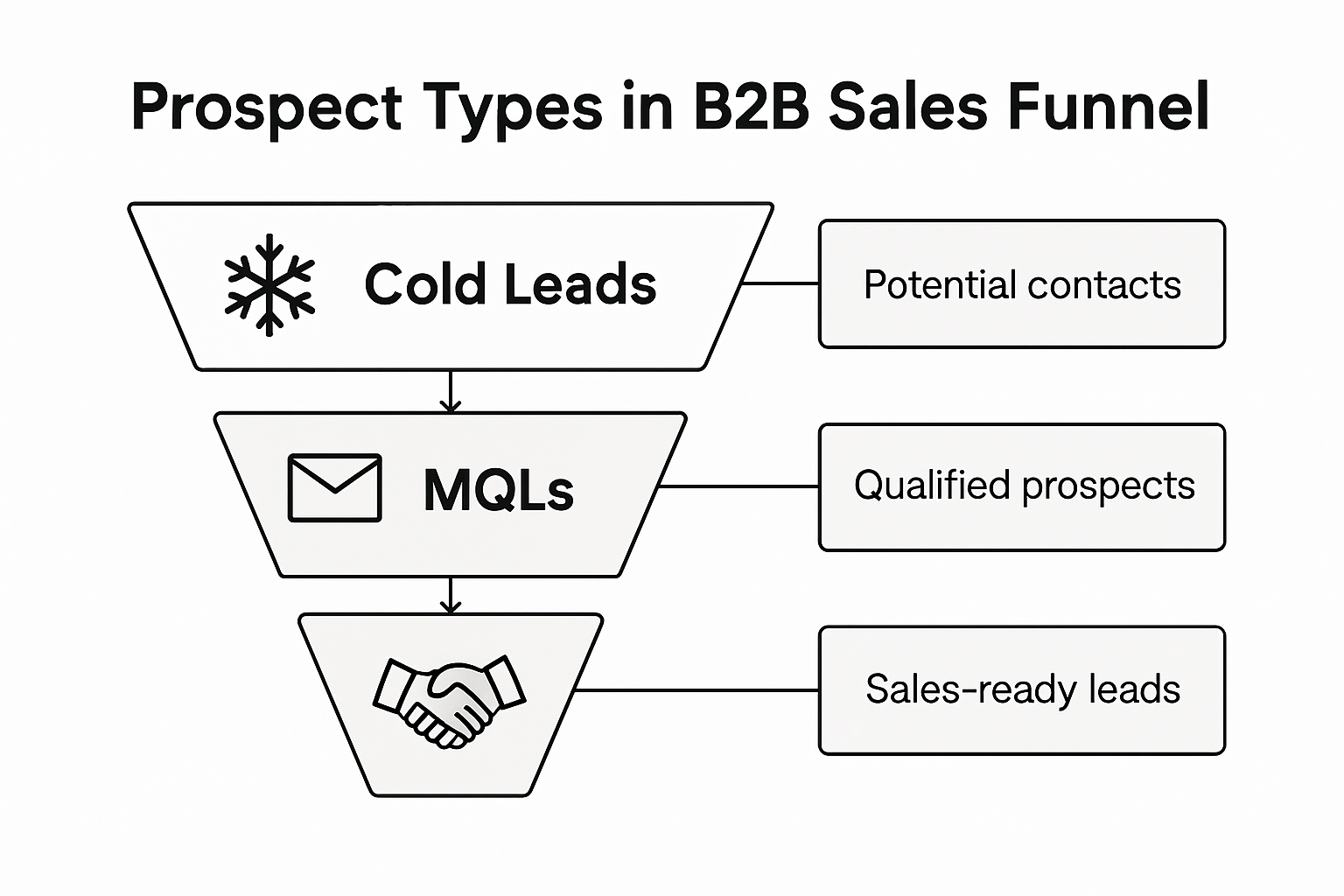
Here’s a summary of major prospect types and how they progress through qualification stages:
| Prospect Type | Stage in Sales Funnel | Typical Actions or Indicators | Qualification Method |
|---|---|---|---|
| Cold Lead | Top of Funnel | Minimal engagement, no prior contact | Outreach, basic criteria check |
| Warm Lead | Middle of Funnel | Downloaded resources, attended events | Engagement analysis, follow-up |
| MQL (Marketing Qualified Lead) | Middle-Upper Funnel | Frequent marketing interactions | Scoring, marketing criteria |
| SQL (Sales Qualified Lead) | Lower-Middle Funnel | Vetted by sales team, ready for contact | Detailed qualification (BANT) |
| PQL (Product Qualified Lead) | Bottom of Funnel | Actively used product, positive signals | Product usage analysis |
Pro Tip: Create a dynamic lead scoring system that assigns numerical values to different prospect interactions, allowing your team to automatically prioritize and route the most promising leads to the right sales representatives.
Key Outreach Methods and Terminology
Sales prospecting requires a strategic approach to reaching potential customers through multiple communication channels. Sales prospecting techniques encompass a diverse range of methods designed to connect with and engage potential business opportunities, each with its unique terminology and approach.
Cold calling remains a fundamental outreach method where sales representatives directly contact potential customers who have not previously expressed interest. This approach involves unsolicited phone conversations aimed at generating immediate interest or scheduling future discussions. Complementing cold calling, email outreach provides a less intrusive alternative, allowing sales professionals to craft personalized messages that can be delivered at scale and tracked for engagement.
Networking represents another critical outreach strategy, with social selling emerging as a powerful modern technique. This method leverages professional social platforms like LinkedIn to build relationships, share valuable content, and establish credibility before direct sales engagement. Sales professionals use connection requests, inmail, and direct messaging to initiate conversations and nurture potential leads through strategic digital interactions.
Advanced outreach methods also include multi-channel prospecting, which combines different communication approaches to increase the likelihood of engaging potential clients. This might involve coordinating phone calls, personalized emails, LinkedIn messages, and even targeted social media content to create a comprehensive engagement strategy. The goal is to create multiple touchpoints that gradually build trust and demonstrate value to potential prospects.
The table below compares key sales outreach methods by effectiveness and strategy:
| Outreach Method | Typical Use Case | Strengths | Potential Challenge |
|---|---|---|---|
| Cold Calling | Initial contact with unknown leads | Immediate feedback, direct conversation | Rejection rate can be high |
| Email Outreach | Scalable personalized messaging | Allows tracking and follow-up | Risk of emails being ignored |
| Social Selling | Building relationships through platforms | Builds trust, ongoing engagement | Time-intensive relationship building |
| Multi-Channel | Combining several outreach types | Maximizes touchpoints, higher response rate | Complex to coordinate |
Pro Tip: Develop a systematic approach to tracking and measuring the effectiveness of each outreach method, creating a data-driven strategy that allows you to optimize your prospecting efforts and improve conversion rates.
Common Misconceptions in Sales Prospecting
Sales prospecting is fraught with misconceptions that can derail even the most well-intentioned sales strategies. Common myths about sales prospecting continue to mislead professionals, potentially preventing them from developing effective customer acquisition approaches.
One prevalent misconception is that cold calling is dead. While digital communication has transformed sales strategies, targeted cold calling remains a viable technique when executed strategically. Many sales professionals mistakenly believe that email and social media have completely replaced phone outreach. In reality, a multichannel approach that integrates phone conversations with digital communication often yields the most comprehensive results. Another widespread myth suggests that selling is purely about aggressive pitch delivery, when successful prospecting actually requires nuanced relationship building and genuine value proposition understanding.
Another critical misunderstanding involves lead volume versus lead quality. Many sales teams erroneously focus on generating massive numbers of potential contacts without considering their actual conversion potential. This shotgun approach wastes resources and creates unrealistic expectations. Instead, successful prospecting demands a precision-driven strategy that emphasizes targeted lead generation, focusing on prospects who genuinely align with the company’s ideal customer profile and demonstrate authentic purchasing potential.
Perhaps the most dangerous misconception is that sales prospecting is a one-time event rather than an ongoing, dynamic process. Effective prospecting requires consistent engagement, continuous learning, and adaptive strategies that evolve with changing market conditions and customer behaviors. Sales professionals must view prospecting as a sophisticated, data-driven discipline that combines human insight with strategic technological tools.
Pro Tip: Develop a systematic approach to continuously educate your sales team about emerging prospecting strategies, creating a culture of adaptability and continuous improvement that challenges existing misconceptions.
Mistakes to Avoid in B2B Prospecting
B2B sales prospecting requires precision and strategic thinking, yet many professionals fall into predictable traps that compromise their success. Common prospecting errors can significantly undermine a company’s ability to generate quality leads and convert potential opportunities.
One critical mistake is lack of personalization in outreach efforts. Generic, templated messages that fail to address a specific prospect’s unique challenges and business context rarely generate meaningful engagement. Sales professionals often default to mass communication strategies, sending identical emails or making identical phone calls, which modern buyers quickly recognize as impersonal and irrelevant. Successful prospecting demands a deep understanding of each potential client’s specific needs, pain points, and organizational dynamics.
Another significant pitfall involves inconsistent follow-up and poor timing in communication. Many sales teams either follow up too aggressively, overwhelming potential clients with frequent contact, or become passive and inconsistent, allowing potential opportunities to cool. The most effective prospecting strategies involve a carefully calibrated approach that balances persistence with respect for the prospect’s time and decision-making process. This requires developing a structured communication cadence that provides value in each interaction and demonstrates genuine understanding of the prospect’s business challenges.
Perhaps the most dangerous mistake is neglecting data-driven insights and failing to leverage technological tools that can enhance prospecting efficiency. Modern B2B sales professionals must integrate sophisticated customer relationship management (CRM) systems, utilize advanced analytics, and continuously refine their approach based on measurable outcomes. Relying solely on intuition or outdated prospecting techniques can lead to diminishing returns and missed opportunities in an increasingly competitive business landscape.
Pro Tip: Implement a rigorous training program that consistently educates your sales team about emerging prospecting technologies and customer engagement strategies, ensuring your approach remains adaptive and sophisticated.
Transform Your Sales Prospecting with Precision and Confidence
Understanding key sales prospecting terms like Ideal Customer Profile, lead scoring, and multi-channel outreach is essential to building a reliable sales pipeline. Yet many B2B leaders struggle with inconsistent lead quality and lack of personalized engagement—problems that stall growth and waste resources. If you want to stop guessing where your next client will come from and start converting warm, qualified leads more efficiently, strategic support can make all the difference.
Pursuitz specializes in executing hyper-personalized, multi-channel prospecting strategies that align perfectly with your ICP and BANT qualification criteria. We manage everything from prospect sourcing through tailored LinkedIn and email outreach to direct meeting bookings, delivering the kind of precision lead generation highlighted in the article. Our clients consistently experience doubled ROI after working with us for just three months.
Ready to apply proven sales prospecting terminology and techniques to your business? Take control of your pipeline today.

Explore how our end-to-end lead generation services at Pursuitz can fuel your sales funnel with qualified leads. Visit now to start building meaningful connections that convert.
Frequently Asked Questions
What is sales prospecting?
Sales prospecting is the initial phase of identifying and engaging potential business customers who may be interested in purchasing your products or services.
What is a qualified lead in sales prospecting?
A qualified lead is a potential customer who meets specific criteria, indicating they are more likely to make a purchase. This includes factors such as budget, authority, need, and timeline.
How do I categorize different types of leads in my sales strategy?
Leads can be categorized into different types such as cold leads, warm leads, marketing qualified leads (MQLs), sales qualified leads (SQLs), and product qualified leads (PQLs), each representing different levels of engagement and readiness to purchase.
What are common outreach methods used in sales prospecting?
Common outreach methods include cold calling, email outreach, social selling, and multi-channel prospecting, each designed to connect with potential customers and engage them effectively.