

Most American businesses lose nearly 80 percent of potential sales leads due to ineffective targeting and weak follow up. With competition for qualified clients at an all time high, finding a winning B2B lead generation strategy is more critical than ever. This guide reveals how top companies transform outreach and relationship building into a steady stream of valuable opportunities, helping you avoid costly mistakes while increasing your chances for long term business success.
Table of Contents
- Defining B2B Lead Generation Strategies
- Multichannel Outreach Methods Explained
- Building and Leveraging Your Ideal Client Profile
- Integrating Personal Branding for Better Results
- Common Mistakes in B2B Lead Generation
- Maximizing ROI and Success Metrics
Key Takeaways
| Point | Details |
|---|---|
| B2B Lead Generation Strategy | Focus on relationship building and value demonstration to transform cold contacts into engaged opportunities. |
| Ideal Client Profile | Develop a dynamic and precise Ideal Client Profile to enhance targeting accuracy and conversion potential. |
| Multichannel Outreach | Utilize diverse communication channels to create a seamless engagement strategy that maximizes visibility and interaction. |
| Common Mistakes | Address common pitfalls such as poorly defined targeting and ineffective outreach strategies to improve lead quality and conversion rates. |
Defining B2B Lead Generation Strategies
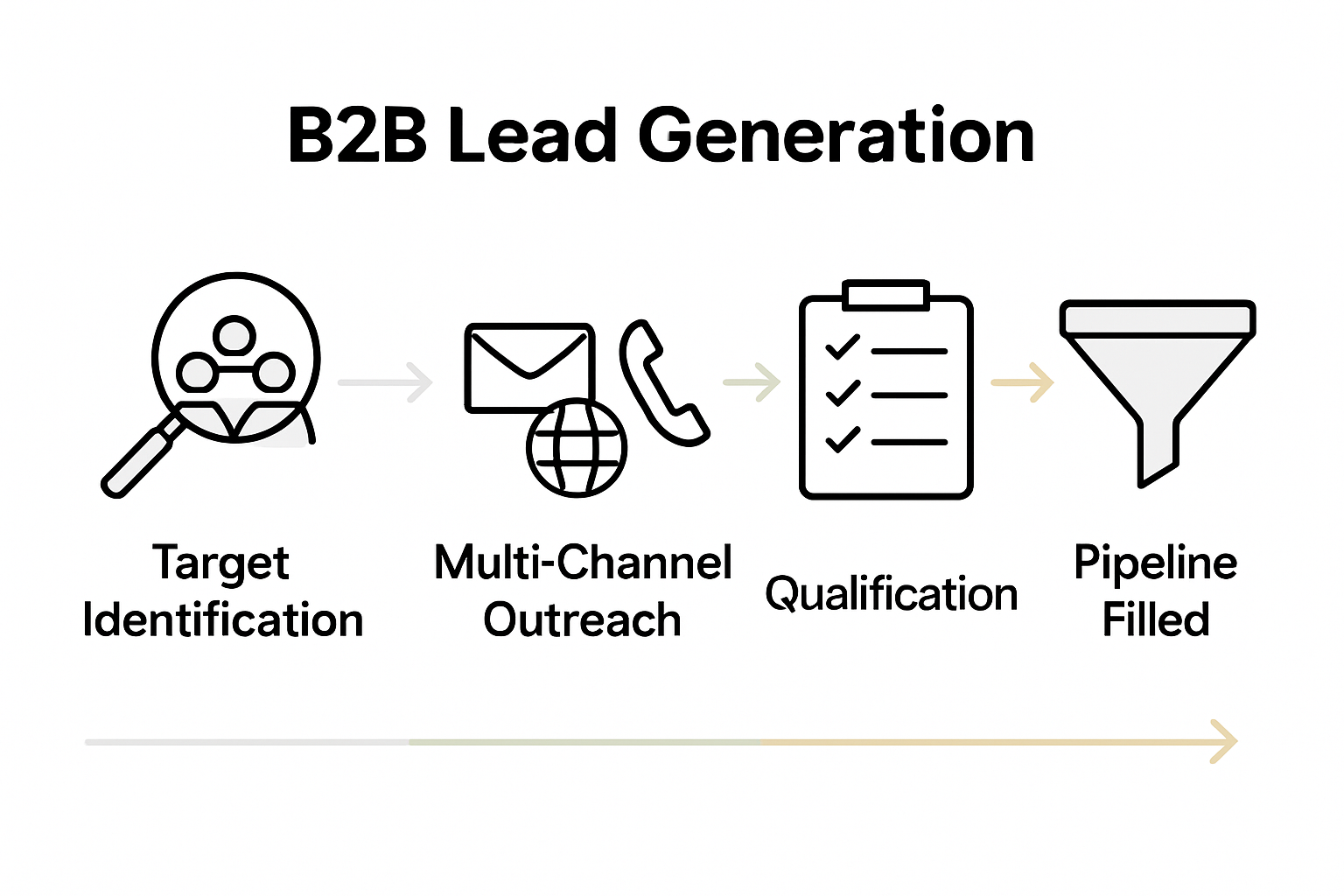
B2B lead generation represents a strategic approach to identifying, attracting, and converting potential business customers into qualified sales opportunities. At its core, this process involves systematically discovering companies that might benefit from your products or services and nurturing their interest through targeted marketing and sales techniques.
Understanding lead generation requires recognizing it as a multichannel mechanism for enterprise growth. Researchers examining modern marketing strategies highlight its critical role in connecting businesses with potential clients through sophisticated engagement methods. This approach goes far beyond simple contact collection, focusing instead on building meaningful relationships that can translate into long term business partnerships.
Effective B2B lead generation strategies typically encompass several key components:
- Targeted Prospect Identification: Developing precise ideal customer profiles
- Multi-Channel Outreach: Leveraging LinkedIn, email, content marketing, and strategic networking
- Personalized Engagement: Creating hyper-customized communication that demonstrates genuine research and understanding
- Qualification Framework: Systematically evaluating potential leads based on predefined business criteria
- Conversion Optimization: Implementing strategic touchpoints that guide prospects through the sales funnel
Successful B2B lead generation ultimately transforms cold contacts into warm opportunities, creating a predictable and scalable pathway for business growth. By implementing strategic approaches that prioritize relationship building and value demonstration, companies can construct robust sales pipelines that consistently deliver high quality prospects.
Multichannel Outreach Methods Explained
Multichannel outreach represents a sophisticated approach to B2B lead generation that strategically combines multiple communication platforms to engage potential clients. Unlike traditional single-channel marketing, this method creates a comprehensive and interconnected strategy designed to maximize visibility and interaction across different touchpoints.

Modern enterprise research on marketing strategies emphasizes the critical importance of integrating diverse communication channels to enhance prospect engagement. Successful multichannel approaches typically involve synchronizing platforms like LinkedIn, email, targeted advertising, content marketing, and direct networking to create a seamless and persistent presence in potential clients’ professional environments.
Key multichannel outreach methods include:
- LinkedIn Professional Networking
- Personalized connection requests
- Targeted content sharing
- Engaging with industry-specific groups
- Email Marketing
- Segmented email campaigns
- Personalized messaging
- Strategic drip communication sequences
- Content Marketing
- Industry-specific blog posts
- Whitepapers and research reports
- Webinars and educational materials
- Direct Outreach
- Personalized cold email strategies
- Strategic phone consultation approaches
- Tailored introductory communications
The power of multichannel outreach lies in its ability to create multiple interaction points, increasing the probability of meaningful engagement. By presenting a consistent, value-driven message across different platforms, businesses can effectively nurture potential leads and transform initial contacts into substantial business opportunities.
Building and Leveraging Your Ideal Client Profile
Defining an Ideal Client Profile (ICP) is a critical strategic foundation for successful B2B lead generation. This comprehensive framework goes beyond basic demographic information, diving deep into the nuanced characteristics that represent your most valuable potential customers. By creating a precise and dynamic ICP, businesses can dramatically improve their targeting accuracy and conversion potential.
Companies seeking to generate qualified leads for B2B sales must develop a multifaceted understanding of their target audience. An effective Ideal Client Profile typically encompasses several key dimensions:
-
Firmographic Characteristics
- Company size and revenue
- Industry vertical
- Geographic location
- Organizational structure
-
Psychographic Elements
- Business challenges and pain points
- Strategic goals and objectives
- Decision making processes
- Technological sophistication
-
Behavioral Indicators
- Previous technology adoption
- Engagement with similar solutions
- Growth trajectory
- Investment patterns
Building a robust Ideal Client Profile requires continuous refinement and data driven insights. Successful organizations treat their ICP as a living document, regularly updating it based on sales interactions, customer feedback, and evolving market dynamics. By maintaining a dynamic and precise profile, businesses can create targeted outreach strategies that resonate deeply with potential clients, transforming cold prospects into engaged opportunities.
Integrating Personal Branding for Better Results
Personal branding has emerged as a powerful strategy for B2B lead generation, transforming how professionals connect and build trust in competitive markets. Unlike traditional marketing approaches, personal branding focuses on establishing individual credibility and thought leadership that extends beyond corporate messaging.
Professional brand development strategies reveal that authentic personal positioning can dramatically enhance prospect engagement and conversion potential. Successful personal branding in B2B contexts requires a strategic approach that showcases expertise, builds genuine connections, and demonstrates unique professional value.
Key elements of effective personal branding include:
-
Professional Online Presence
- Optimized LinkedIn profile
- Consistent professional headshot
- Comprehensive work history
- Skill endorsements and recommendations
-
Content Creation and Sharing
- Industry relevant blog posts
- Thoughtful LinkedIn articles
- Video content showcasing expertise
- Podcast or webinar participation
-
Thought Leadership Strategies
- Sharing unique industry insights
- Commenting on industry trends
- Engaging in meaningful professional discussions
- Providing valuable perspectives
Transforming personal branding from a passive profile to an active engagement strategy requires consistent effort and genuine authenticity. By positioning yourself as a knowledgeable and approachable expert, you create opportunities for meaningful connections that extend far beyond traditional sales interactions.
Common Mistakes in B2B Lead Generation
B2B lead generation is a complex process fraught with potential pitfalls that can dramatically undermine sales pipeline development. Many organizations inadvertently sabotage their own efforts by falling into predictable traps that reduce lead quality and conversion potential.
Businesses seeking to improve their lead qualification workflow must first recognize and address the most common strategic mistakes. These errors often stem from a fundamental misunderstanding of effective prospecting techniques and target audience engagement.
Key mistakes that consistently undermine B2B lead generation include:
-
Poorly Defined Ideal Customer Profile
- Overly broad targeting
- Lack of specific demographic criteria
- Ignoring behavioral indicators
- Failing to update ICP regularly
-
Ineffective Outreach Strategies
- Generic, non personalized messaging
- Inconsistent communication frequency
- Neglecting multi channel approaches
- Insufficient follow up mechanisms
-
Qualification Process Failures
- Undefined lead scoring methodology
- No clear handoff between marketing and sales
- Overlooking intent signals
- Treating all leads with equal priority
-
Data and Technology Limitations
- Inadequate CRM utilization
- Poor data hygiene and maintenance
- Lack of integration between tools
- Minimal use of analytics and tracking
Successful B2B lead generation requires a strategic, systematic approach that continuously evaluates and refines prospecting techniques. By proactively identifying and addressing these common mistakes, organizations can transform their lead generation from a hit or miss activity into a predictable, scalable revenue generation machine.
Maximizing ROI and Success Metrics
Return on Investment (ROI) remains the ultimate benchmark for evaluating B2B lead generation effectiveness, transforming raw performance data into actionable strategic insights. Successful organizations understand that measuring lead generation goes far beyond simple numerical tracking, requiring a sophisticated approach to understanding value creation and performance optimization.
Multichannel marketing strategies reveal that comprehensive ROI measurement demands a holistic view of lead generation performance, incorporating both quantitative and qualitative metrics. Advanced B2B organizations develop nuanced frameworks that capture the complete value trajectory of their lead generation investments.
Key success metrics for maximizing lead generation ROI include:
-
Financial Performance Indicators
- Customer Acquisition Cost (CAC)
- Lifetime Value (LTV)
- Revenue per Lead
- Conversion Rate Optimization
-
Engagement Quality Metrics
- Lead Response Time
- Initial Meeting Conversion Rate
- Pipeline Velocity
- Sales Qualified Lead Percentage
-
Strategic Performance Tracking
- Channel Effectiveness Comparison
- Target Market Penetration
- Lead Source Attribution
- Predictive Performance Modeling
The most sophisticated B2B organizations treat ROI measurement as a dynamic, continuous process of refinement and optimization. By developing granular, data driven approaches to performance tracking, companies can transform lead generation from a cost center into a strategic revenue acceleration engine.
Transform Your B2B Lead Generation Into a Reliable Sales Engine
Facing challenges like poorly defined Ideal Client Profiles or ineffective multichannel outreach can stall your sales pipeline growth. This article highlights how personalized engagement and strategic qualification are critical for turning cold contacts into warm leads. At Pursuitz, we specialize in eliminating guesswork by combining expert ICP creation, hyper-personalized LinkedIn and email outreach, and personal branding strategies to consistently deliver qualified leads.
Our end-to-end approach includes everything from prospect sourcing to direct meeting booking so you see clear results quickly. Clients working with us report at least 2x return on investment within three months by leveraging proven multichannel lead generation tactics backed by tailored data-driven insights.
Ready to stop wondering where your next client will come from and start filling your sales pipeline predictably Visit Pursuitz today to discover how our solutions align perfectly with the concepts outlined in this article including how to generate qualified leads for B2B sales and lead qualification workflow.

Take control of your B2B lead generation now and experience the power of a strategic, hands-on partner. Learn more and get started at https://pursuitz.io.
Frequently Asked Questions
What are the key components of effective B2B lead generation strategies?
Effective B2B lead generation strategies typically include targeted prospect identification, multi-channel outreach, personalized engagement, a qualification framework, and conversion optimization.
How can I define my Ideal Client Profile (ICP) for better lead generation?
To define your Ideal Client Profile, focus on firmographic characteristics, psychographic elements, and behavioral indicators, ensuring it is a dynamic document updated based on market changes and feedback.
What common mistakes should I avoid in B2B lead generation?
Common mistakes include having a poorly defined Ideal Customer Profile, ineffective outreach strategies with generic messages, failures in the qualification process, and limitations in data and technology usage.
How do I measure the ROI of my B2B lead generation efforts?
Measuring ROI in B2B lead generation requires a comprehensive approach, analyzing financial performance indicators like Customer Acquisition Cost, engagement quality metrics, and strategic performance tracking like channel effectiveness comparison.