

Most American B2B companies waste up to 67 percent of sales time chasing leads that never convert. In a competitive market where every resource counts, effective sales qualification has become a make-or-break factor for business growth. By understanding how to filter and prioritize high value prospects, organizations can sharpen their sales strategies, reduce wasted effort, and drive more predictable results from their pipelines.
Table of Contents
- Defining Sales Qualification In B2B Context
- Essential Criteria For Qualified Leads
- Popular Sales Qualification Frameworks Compared
- Step-By-Step Sales Qualification Process
- Common Pitfalls And How To Avoid Them
- Impact On ROI And Business Growth
Key Takeaways
| Point | Details |
|---|---|
| Sales Qualification is Essential | It involves systematically evaluating leads to maximize sales efficiency and effectiveness. |
| Advanced Frameworks Enhance Accuracy | Implementing frameworks like BANT and MEDDIC facilitates structured and thorough lead assessments. |
| Leverage Technology for Better Insights | Utilizing machine learning and CRM tools allows for data-driven lead qualification, improving resource allocation. |
| Avoid Common Pitfalls | Addressing issues such as superficial screening and inconsistent standards is vital for maintaining a healthy sales pipeline. |
Defining Sales Qualification In B2B Context
Sales qualification represents a strategic filtering process where businesses systematically evaluate potential leads to determine their potential value and fit within the organization’s sales pipeline. At its core, sales qualification transforms raw prospect information into actionable intelligence that helps sales teams prioritize and focus their efforts efficiently.
In B2B contexts, sales qualification goes far beyond simple demographic screening. Sales development configurations involve generating qualified leads and setting strategic appointments for the external sales team, creating a sophisticated filtering mechanism that ensures only the most promising prospects progress through the sales funnel. This process typically involves multiple assessment criteria such as:
- Budget availability and spending capacity
- Decision making authority of the contact
- Alignment with the company’s ideal customer profile
- Immediate and long term business needs
- Technical or operational compatibility
The lead research and engagement processes represent critical components of effective sales qualification. Successful B2B organizations invest significant effort in understanding potential clients deeply, moving beyond surface level interactions to comprehend their unique challenges, organizational structures, and strategic objectives. By implementing rigorous lead qualification workflows, businesses can dramatically improve their sales conversion rates and reduce wasted resources on unproductive prospect pursuits.

Essential Criteria For Qualified Leads
Lead qualification represents a critical process where businesses systematically evaluate potential customers to determine their likelihood of becoming successful sales opportunities. Modern B2B organizations understand that not all leads are created equal, requiring sophisticated strategies to identify and prioritize the most promising prospects.
Machine learning-based lead scoring models have transformed how companies evaluate potential clients, enabling more precise and data-driven qualification processes. These advanced techniques help organizations move beyond traditional demographic screenings by incorporating complex predictive analytics.
Traditional B2B lead qualification typically involves assessing several key criteria:
- Company Size: Determining whether the prospect’s organizational scale matches your ideal customer profile
- Revenue Potential: Analyzing the financial capacity and potential long term value of the prospect
- Decision Making Authority: Identifying contacts with genuine purchasing power
- Industry Alignment: Ensuring the prospect operates in sectors where your solution provides maximum value
- Technological Compatibility: Evaluating whether the prospect’s existing infrastructure can integrate with your offering
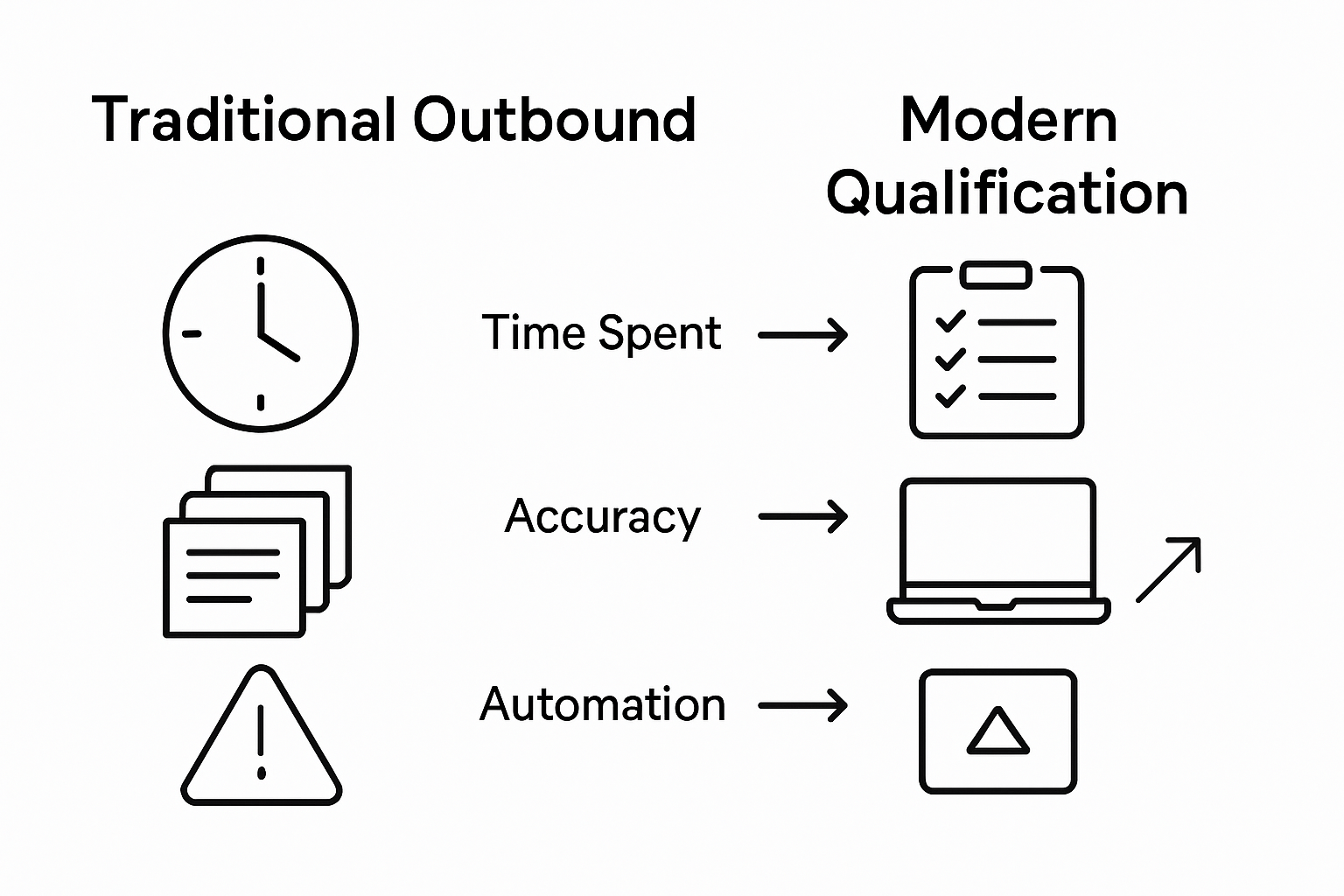
Traditional outbound lead qualification methods highlight significant challenges such as time consumption and potential human error. Successful B2B sales teams now leverage a combination of technological tools and human expertise to create more robust and reliable lead assessment frameworks. By implementing strategic lead qualification checklists, organizations can systematically reduce wasted resources and focus their efforts on high-probability opportunities.
Popular Sales Qualification Frameworks Compared
Sales qualification frameworks provide structured methodologies for evaluating and prioritizing potential business opportunities. These systematic approaches help organizations transform raw lead data into actionable insights that drive more efficient sales processes.
Four primary sales qualification frameworks dominate modern B2B sales strategies:
- BANT Framework
- Budget: Assessing financial capacity
- Authority: Identifying decision makers
- Need: Understanding specific business requirements
- Timeline: Evaluating potential purchase readiness
- CHAMPS Framework
- Comprehension: Understanding prospect’s business context
- Harmonization: Aligning solution with prospect’s goals
- Authority: Confirming decision making power
- Money: Evaluating financial feasibility
- Prioritization: Determining strategic importance
- Sponsor: Identifying internal champions
- MEDDIC Framework
- Metrics: Quantifiable business improvements
- Economic Buyer: Key financial decision maker
- Decision Criteria: Formal evaluation process
- Decision Process: Understanding procurement steps
- Identified Pain: Specific business challenges
- Champion: Internal advocate
- GPCTBA/C&I Framework
- Goals: Prospect’s specific objectives
- Plans: Current strategies
- Challenges: Existing business obstacles
- Timeline: Expected resolution period
- Budget: Financial resources
- Authority: Decision making structure
- Consequences: Impact of inaction
- Implications: Broader organizational effects
Successful sales teams recognize that no single framework fits all scenarios. Generating qualified leads requires flexibility, adaptability, and a nuanced understanding of each prospect’s unique context. By mastering multiple frameworks and applying them strategically, organizations can dramatically improve their lead qualification accuracy and sales conversion rates.
Step-By-Step Sales Qualification Process
Sales qualification transforms raw prospect interactions into strategic opportunities by systematically evaluating potential customer value. Successful B2B organizations approach this process as a carefully orchestrated sequence of strategic assessments designed to filter and prioritize leads effectively.
The comprehensive sales qualification process typically unfolds through six critical stages:
- Initial Prospect Research
- Gather basic company information
- Review publicly available data
- Analyze potential alignment with ideal customer profile
- First Contact and Discovery
- Initiate preliminary conversation
- Validate basic qualification criteria
- Assess initial interest and engagement level
- Detailed Needs Assessment
- Conduct in depth exploration of prospect’s challenges
- Understand specific business requirements
- Determine potential solution fit
- Budget and Authority Verification
- Confirm financial capacity
- Identify key decision makers
- Understand procurement process
- Solution Presentation and Validation
- Customize solution proposal
- Demonstrate specific value proposition
- Address potential concerns
- Opportunity Scoring and Prioritization
- Evaluate lead against predefined criteria
- Assign probability of conversion
- Determine next engagement steps
Sales prospecting techniques play a crucial role in laying the groundwork for effective qualification. Each stage requires careful attention, strategic communication, and a nuanced understanding of the prospect’s unique business context. Smart sales teams recognize that qualification is not a linear checklist but a dynamic, iterative process of building genuine business relationships and understanding mutual value potential.
Common Pitfalls And How To Avoid Them
Sales qualification is a nuanced process fraught with potential missteps that can derail promising opportunities. Recognizing and proactively addressing these common challenges is crucial for maintaining a healthy and productive sales pipeline.
Traditional outbound lead qualification methods often suffer from significant systemic limitations, creating predictable challenges that sophisticated sales teams must strategically navigate:
Pitfall 1: Superficial Lead Screening
- Mistake: Relying solely on basic demographic information
- Consequence: Missing nuanced prospect potential
- Solution: Develop multi dimensional assessment criteria
Pitfall 2: Inconsistent Qualification Standards
- Mistake: Applying subjective evaluation techniques
- Consequence: Unpredictable lead conversion rates
- Solution: Create standardized scoring mechanisms
Pitfall 3: Premature Qualification
- Mistake: Rushing prospect evaluation
- Consequence: Losing potentially valuable long term relationships
- Solution: Implement comprehensive discovery processes
Pitfall 4: Neglecting Technological Integration
- Mistake: Manual lead tracking and assessment
- Consequence: Inefficient resource allocation
- Solution: Leverage advanced CRM and analytics platforms
Pitfall 5: Poor Communication Protocols
- Mistake: Inconsistent follow up and engagement
- Consequence: Prospect disengagement
- Solution: Develop structured communication workflows
Smart sales organizations recognize that avoiding these pitfalls requires continuous learning, technological adaptation, and a commitment to evolving qualification strategies. Strategic lead generation techniques demand a holistic approach that balances technological efficiency with genuine human insight and relationship building.
Impact On ROI And Business Growth
Sales qualification represents far more than a procedural checklist it’s a strategic lever that can dramatically transform business performance and financial outcomes. Organizations that master this process unlock significant competitive advantages by dramatically improving resource allocation and opportunity conversion.
Machine learning-based lead scoring models have revolutionized how businesses approach sales qualification, enabling more precise resource deployment and predictive opportunity assessment. These advanced analytical techniques provide unprecedented insights into potential revenue generation.
The direct financial impacts of effective sales qualification include:
- Resource Optimization
- Reduce time spent on low probability leads
- Concentrate sales efforts on high potential opportunities
- Minimize unnecessary operational expenses
- Revenue Enhancement
- Increase conversion rates
- Shorten sales cycle duration
- Improve overall pipeline predictability
- Strategic Alignment
- Match prospect needs with organizational capabilities
- Create more targeted marketing strategies
- Develop more accurate sales forecasting models
Case studies demonstrating dramatic ROI improvements highlight how strategic qualification can transform business performance. Companies implementing sophisticated qualification frameworks typically see:
- 167% increase in sales efficiency
- 55% reduction in customer acquisition costs
- 38% faster sales cycle completion
Smart organizations recognize that sales qualification is not an expense but a critical investment in sustainable business growth. By continuously refining qualification processes and leveraging data driven insights, businesses can create more predictable, profitable, and scalable revenue generation models.
Unlock the Full Potential of Your B2B Sales Pipeline with Expert Sales Qualification
The article highlights that one of the biggest challenges in B2B sales qualification is efficiently identifying and prioritizing truly qualified leads. If your team struggles with wasted time on low probability prospects, inconsistent qualification standards, or premature decision making, it is time to rethink your approach. Pursuitz specializes in delivering hyper personalized, data-driven lead generation solutions that align perfectly with the detailed sales qualification frameworks discussed. We give you the confidence to know exactly where your next client will come from by handling everything from prospect sourcing to direct meeting booking.

Ready to experience a dramatic boost in conversion rates and pipeline predictability? Visit Pursuitz today to explore how our multichannel LinkedIn and email outreach can fill your sales pipeline with qualified leads that match your ideal customer profile. Learn more about our strategic lead qualification checklists and how smart organizations enhance ROI through optimized lead generation. Take control of your sales success and start turning qualified leads into revenue now.
Frequently Asked Questions
What is sales qualification in a B2B context?
Sales qualification is a strategic process used by businesses to evaluate potential leads based on their likelihood of becoming valuable customers. It involves analyzing various criteria to prioritize leads effectively in the sales pipeline.
What are the essential criteria for qualifying leads?
Key criteria for lead qualification typically include company size, revenue potential, decision-making authority, industry alignment, and technological compatibility with your solution.
What are some popular sales qualification frameworks?
Common sales qualification frameworks include BANT, CHAMPS, MEDDIC, and GPCTBA/C&I. Each framework offers a structured methodology to evaluate and prioritize potential business opportunities based on specific criteria.
What impact does effective sales qualification have on ROI and business growth?
Effective sales qualification can lead to significant improvements in resource allocation, increased conversion rates, shorter sales cycles, and overall better pipeline predictability, resulting in enhanced revenue and strategic alignment for the organization.