

Over 60 percent of American B2B companies admit their sales strategies miss the mark with their ideal clients. In a world where accurately pinpointing the right audience can dramatically impact growth and efficiency, understanding sales targeting makes all the difference. This guide breaks down the fundamentals and advanced approaches, offering clear insights into how smart American businesses identify, reach, and win over the customers who matter most.
Table of Contents
- Defining Sales Targeting and Its Importance
- Types of Sales Targeting Approaches in B2B
- Building and Applying an Ideal Client Profile
- Effective Outreach Strategies for Sales Targeting
- Common Pitfalls and How to Avoid Them
Key Takeaways
| Point | Details |
|---|---|
| Strategic Sales Targeting | Businesses should focus on specific market segments to optimize resources and improve sales efficiency. |
| Varied Targeting Approaches | Utilizing undifferentiated, differentiated, concentrated, and micromarketing strategies allows for tailored engagement with potential customers. |
| Ideal Client Profile Development | Creating an ideal client profile enhances targeting accuracy by understanding industry specifics, company size, and decision-making hierarchies. |
| Continuous Improvement in Outreach | Effective outreach requires an adaptive strategy that leverages multiple channels and personalizes communication to maintain customer engagement. |
Defining Sales Targeting and Its Importance
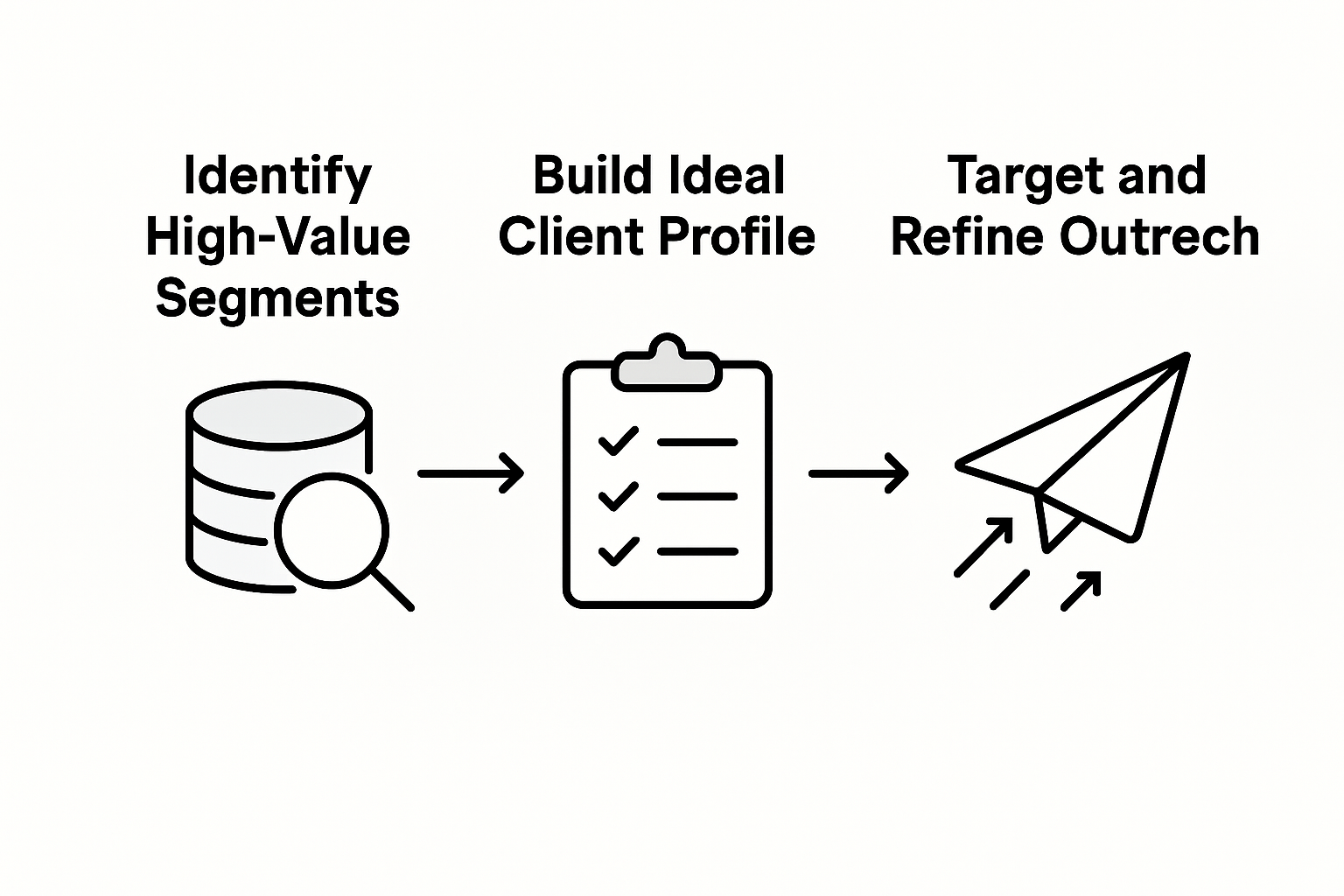
Sales targeting is the strategic process of identifying and focusing on specific market segments that offer the highest potential for business growth. By selecting attractive market segments, companies can optimize their resources and marketing efforts to maximize impact.
In the B2B landscape, sales targeting goes beyond simple demographic analysis. Strategic targeting involves evaluating market segments based on firmographics, technographics, organizational needs, and potential value. This nuanced approach allows businesses to create highly personalized marketing strategies that resonate with specific customer profiles.
The core objectives of effective sales targeting include:
- Concentrating marketing resources on most promising customer segments
- Improving conversion rates through precise audience engagement
- Reducing customer acquisition costs
- Enhancing overall sales efficiency
Successful sales targeting requires continuous refinement. Businesses must regularly analyze market data, track performance metrics, and adapt their targeting strategies to maintain competitive advantage in an evolving marketplace.
Types of Sales Targeting Approaches in B2B
B2B sales targeting encompasses multiple strategic approaches that enable businesses to effectively reach and engage potential customers. B2B marketers utilize diverse targeting methods ranging from broad mass targeting to highly specific niche strategies, each designed to optimize resource allocation and marketing effectiveness.
The primary sales targeting approaches include:
- Undifferentiated Targeting: A broad approach addressing the entire market without specific segmentation
- Differentiated Targeting: Creating distinct marketing strategies for different market segments
- Concentrated Targeting: Focusing intensely on a specific, narrow market segment
- Micromarketing: Tailoring strategies to local or individual customer needs
B2B market segmentation methods provide sophisticated techniques for identifying and engaging potential customers. These advanced approaches include:
- Firmographic Segmentation: Categorizing businesses by industry, company size, revenue, and location
- Technographic Segmentation: Analyzing technological infrastructure and digital capabilities
- Needs-Based Segmentation: Identifying specific organizational challenges and requirements
- Value-Based Segmentation: Evaluating potential customer value and long-term revenue potential
Successful B2B sales targeting requires a nuanced understanding of these approaches. Businesses must continuously assess and adapt their targeting strategies, combining multiple methods to create a comprehensive and dynamic sales approach that maximizes engagement and conversion potential.
Building and Applying an Ideal Client Profile
Developing an ideal client profile represents a critical strategic process that enables businesses to precisely target their most valuable potential customers. This sophisticated approach goes beyond basic demographic analysis, diving deep into understanding the unique characteristics and needs of a company’s most promising prospects.
The key components of a comprehensive ideal client profile include:
- Industry Specifics: Detailed understanding of target industry dynamics
- Company Size: Revenue range, employee count, organizational structure
- Technological Infrastructure: Current systems, digital capabilities
- Business Challenges: Specific pain points and operational constraints
- Decision-Making Hierarchy: Key stakeholders and buying influencers
Creating an ideal client profile requires meticulous analysis of firmographics, technographics, and behavioral data. Businesses must systematically evaluate potential clients across multiple dimensions, including:
- Organizational goals and strategic objectives
- Historical purchasing behaviors
- Current market positioning
- Growth potential and scalability
- Alignment with company’s value proposition
Successful implementation of an ideal client profile demands continuous refinement. Sales and marketing teams must collaborate closely, regularly updating the profile based on real-world interactions, market shifts, and evolving business landscapes. This dynamic approach ensures that targeting strategies remain precise, relevant, and highly effective in generating quality B2B leads.

Effective Outreach Strategies for Sales Targeting
Advanced B2B targeting strategies demand a sophisticated, multi-channel approach that goes beyond traditional sales techniques. Modern businesses must craft nuanced, personalized outreach methods that resonate with specific audience segments and address their unique challenges.
Key components of effective B2B outreach strategies include:
- Granular Content Development: Creating hyper-targeted content assets
- Remarketing Integration: Strategically re-engaging potential leads
- Social Media Engagement: Leveraging platforms for top-of-funnel interactions
- Personalized Communication: Tailoring messaging to specific audience needs
B2B outreach requires a comprehensive strategy encompassing multiple communication channels, including:
- Personalized email campaigns
- Industry event hosting and participation
- Strategic word-of-mouth marketing
- Targeted referral programs
- Precision paid search advertising
Successful outreach is an iterative process that demands continuous optimization. Sales teams must constantly analyze engagement metrics, refine targeting approaches, and adapt communication strategies to maintain relevance in a rapidly evolving business landscape. The most effective organizations treat outreach as a dynamic, data-driven discipline that combines technological insight with genuine human connection.
Common Pitfalls and How to Avoid Them
B2B sales teams frequently encounter complex challenges that can derail their targeting strategies, requiring a proactive and strategic approach to overcome potential obstacles. Understanding these common pitfalls is the first step toward developing more effective and resilient sales processes.
Key challenges in B2B sales targeting include:
- Value Demonstration Failure: Inability to quantify monetary benefits
- Misaligned Customer Strategies: Approaches that do not address specific client needs
- Outdated Sales Methodologies: Resistance to technological and digital transformations
- Poor Communication: Ineffective articulation of value propositions
- Lack of Personalization: Generic messaging that fails to resonate
Adapting to digital sales landscapes requires strategic investment in technology and training, with businesses needing to focus on:
- Continuous skills development
- Technology integration
- Data-driven decision making
- Flexible communication strategies
- Customer-centric approach
Mitigating these pitfalls demands a holistic approach that combines technological sophistication with genuine human insight. Successful B2B sales teams must remain agile, continuously learning and adapting their strategies to meet evolving market dynamics and customer expectations.
Turn Your Sales Targeting Strategy Into a High-Quality Lead Machine
The article highlights critical challenges in B2B sales targeting such as misaligned customer strategies, lack of personalization, and difficulty demonstrating clear value to prospects. If you are struggling to create a precise Ideal Client Profile or finding that your outreach efforts fail to engage key decision makers, you are not alone. These pain points slow down growth and increase the cost of customer acquisition—issues that Pursuitz solves with expert precision.
At Pursuitz, we specialize in transforming abstract sales targeting concepts like firmographic and technographic segmentation into real results. We provide hyper-personalized, multichannel outreach on LinkedIn and email designed to feel as if you took ten minutes researching each prospect. Our end-to-end management from prospect sourcing to meeting booking ensures your sales pipeline consistently fills with qualified leads who match your ideal client profile. Clients see measurable improvements such as at least doubling their return on investment within three months.
Discover how strategic sales targeting drives high-converting leads and stop guessing where your next client will come from.

Take control of your sales targeting inefficiencies today. Visit Pursuitz to learn how to align your outreach strategy with your sales objectives and start booking meetings that advance your pipeline. Don’t let outdated tactics hold you back—partner with Pursuitz and achieve measurable growth with personalized B2B lead generation.
Frequently Asked Questions
What is sales targeting in the B2B context?
Sales targeting refers to the strategic process of identifying and focusing on specific market segments that offer the highest potential for business growth, enabling companies to optimize resources and marketing efforts.
What are the main types of sales targeting approaches in B2B?
The main types of sales targeting approaches in B2B include undifferentiated targeting, differentiated targeting, concentrated targeting, and micromarketing, each with varying levels of specificity in audience engagement.
How can businesses build an ideal client profile?
Businesses can build an ideal client profile by analyzing factors like industry specifics, company size, technological infrastructure, business challenges, and decision-making hierarchy, to identify the characteristics of their most valuable prospects.
What are common pitfalls in B2B sales targeting and how can they be avoided?
Common pitfalls in B2B sales targeting include value demonstration failure, misaligned customer strategies, outdated sales methodologies, poor communication, and lack of personalization. Avoiding these issues requires a focus on continuous skills development, technology integration, and a customer-centric approach.